
Solar Cables and Connectors
MC4 Assembly Tools & Plugs
Building a secure, weather-sealed system requires more than just hand-tightening. MC4 assembly spanners are essential for fully locking your solar cables and connectors, ensuring that no moisture can enter the terminals during heavy UK rain. We also recommend keeping a pack of spare male/female connectors on hand for custom cable lengths or repairing existing leads, providing you with the long-term flexibility to expand or maintain your home power setup as your energy needs grow.
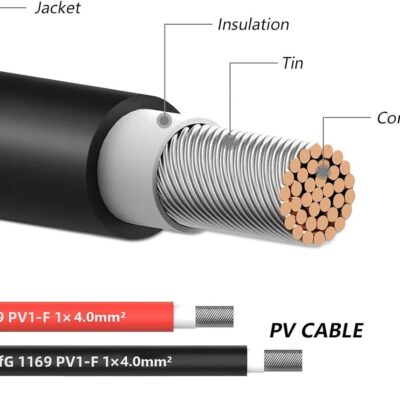
Ideal for neat balcony or patio installations, these 5m leads offer the perfect balance of reach and efficiency. Rated IP67/IP68 for total weather protection, they utilize tinned copper conductors to prevent corrosion in the damp British climate.



10 Metre MC4 Solar Extension Cables
For garden-to-house connections, these 10m heavy-duty leads are essential. Built with UV-resistant XLPE insulation, they are rated for operation between -40°C and 90°C+, ensuring your power flow remains stable through summer heatwaves and winter freezes.


Y-Branch Connectors for Dual-Panel Setups
To reach the 800W limit using two panels, you need high-quality Y-Branch solar cables and connectors. These allow you to wire panels in parallel, maintaining a safe voltage for your micro-inverter while doubling your current output. All our picks are rated for 30A and 1500V systems, with IP67/IP68 waterproofing to ensure long-term outdoor safety.”


- Fire Safety: All our picks carry a UL-94-V0 flame retardant rating, ensuring your connections are as safe as your home wiring.
- Minimal Power Loss: With a contact resistance of ≤5mΩ, these connectors ensure your harvested solar power isn’t wasted as heat at the joint.
- Built for Extremes: Rated for operation down to -45°C, these units are proven to handle even the harshest British winters without the plastic becoming brittle.
- Heavy Duty: For larger 800W systems, the 50A current capacity on our premium picks provides a 67% safety buffer over standard connectors.
Professional MC4 Crimping & Tool Kits
For a truly bespoke setup, professional crimping tools allow you to cut your solar cables and connectors to the exact length required for your balcony or garden. These all-in-one kits provide the ratchet-style pliers needed for a secure electrical join and assembly spanners for waterproof locking. Using proper tools is the only way to ensure your DIY system meets professional safety standards.


The Buying Guide
Understanding Solar Panel Cables
and MC4 Connectors
When setting up a residential solar array, the energy generation relies completely on the physical infrastructure linking your panels to your inverter.
Choosing generic electrical wiring instead of dedicated solar panel leads is one of the most common mistakes DIY installers make.
Standard household wires lack the specialized insulation required to survive continuous exposure to the elements, leading to rapid degradation and system faults.
Technical Spec
| Cable Gauge Size | Best Use Case | Max Current (Amps) |
|---|---|---|
| 4.0 mm² Solar Cable | Short cable runs, small plug-in kits, individual balcony panels. | Up to 55 Amps |
| 6.0 mm² Solar Cable | Long runs (over 10 meters), multi-panel arrays, home battery links. | Up to 70 Amps |
| Standard MC4 Plugs | Universal waterproof panel-to-panel connection points. | IP67 Weather Rated |
When configuring your hardware layouts, matching the wire thickness with your conversion electronics is non-negotiable. To ensure your protective fuses and link cables can safely handle intense low-voltage current draws without triggering system cutoff errors, read through our ultimate guide on Solar Inverters and Chargers.
Understanding Solar Cable Quality & Safety
- Preventing Voltage Drop: Using thin, generic wiring over long distances causes power to be lost as heat. We recommend a minimum of 4mm² or 6mm² cross-section for all solar cables and connectors to ensure your 800W generation actually reaches your battery without significant loss.
- UV & Weather Resistance: Standard electrical wire will degrade and crack in the UK sun and rain. All the solar cables and connectors featured here are TÜV certified and UV-resistant, designed to last 25+ years in harsh outdoor conditions.
- Fire Safety: A loose connection is a major fire risk in high-voltage DC systems. Always ensure you hear the distinct ‘click’ when joining your solar cables and connectors, ensuring your DIY installation follows the safety principles of BS 7671 wiring regulations
What to Look for in a Solar Tool Kit
- Ratchet Mechanism: Ensures consistent pressure for a perfect crimp every time.
- Interchangeable Jaws: Look for kits that support 2.5mm², 4mm², and 6mm² cable thicknesses.
- Assembly Spanners: Essential for tightening connectors to their IP67/IP68 waterproof rating.
- Spare Connectors: We recommend kits like the Someline (B07Y4B5CCR) which include 12+ pairs of spare plugs for future maintenance.
FAQ
Is standard household twin-and-earth wire safe for linking external solar arrays? [Expand]
- No, standard domestic wiring is highly dangerous here.
- It lacks cross-linked polyethylene weather insulation.
- It cannot handle extreme high-voltage DC paths safely.
- Use dedicated Solar Cables and Connectors outdoors instead.
- They securely route fault currents to Solar Surge Protectors.
What is the main difference between 4mm² and 6mm² solar cabling? [Expand]
- Cable cross-section thickness directly affects overall circuit resistance thresholds.
- Choose 4mm² lines for standard micro-generation runs under 10 metres.
- Select heavy-duty 6mm² variations for long outdoor transmission tracks.
- Thicker copper conductive areas lower voltage drop penalties significantly.
Are all MC4 solar connectors fully waterproof against rain? [Expand]
- Certified high-quality plugs carry strict IP67 or IP68 protection ratings.
- Internal rubber compression seals block driving moisture and condensation completely.
- Ensure connections snap together firmly during setup to lock components.
How often should external solar wiring runs be physically inspected? [Expand]
- Complete simple visual wiring tracking checks at least once annually.
- Look for signs of sagging, vermin damage, or loose brackets.
- Ensure data logs show stable telemetry across active platforms.
- Monitor your overall tracking performance via Solar Energy Monitors.