
What are Solar Energy Monitors
The secret to maximizing your plug-in solar setup is visibility.
Solar energy monitors and smart plugs allow you to track every watt your panels generate in real-time.
By seeing your production on your smartphone, you can time your heavy appliance use to coincide with peak sunlight—effectively ‘soaking up’ the sun and slashing your electricity bills.
These high-accuracy solar energy monitors provide the essential data needed to transition from passive energy generation to active grid independence, giving you complete control over your household’s renewable energy consumption.
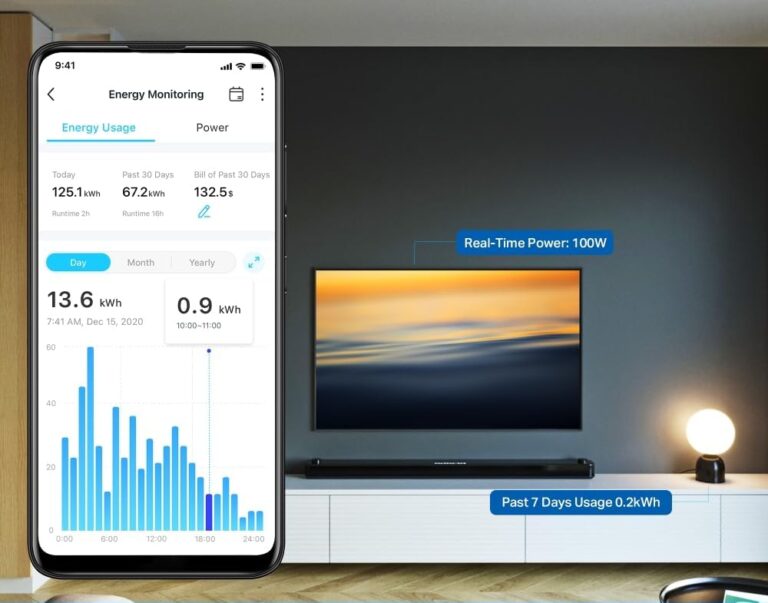
Modern monitoring hardware utilizes high-speed microchips to sample system data multiple times per minute. This real-time measurement allows property owners to eliminate assumptions regarding solar array performance and hardware conversion efficiency. Having access to exact energy data allows you to track changing generation patterns across shifting seasons, identify system faults early, and make informed choices about adding future battery cells or extra solar panels to your framework.
Indoor Smart Plugs: The Smart Home Choice
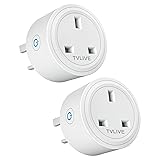
For most UK households, indoor smart plugs are the most convenient solar energy monitors. By plugging your 800W micro-inverter into one of these devices, you can view your real-time generation and historical data directly on your smartphone. We recommend the TP-Link Tapo P110 for its intuitive cost-estimation features or the Meross Smart Plug for those who prefer local offline control. These solar energy monitors are the easiest way to transform a standard socket into a smart energy hub, ensuring you never miss a moment of free generation.”


App Quality & Monitoring
- The Tapo Advantage: The Tapo app provides the cleanest interface for seeing daily, monthly, and yearly solar generation “histograms.”
- Safety First: All our picks are rated for a full 13A load, ensuring they can safely handle the continuous output of an 800W solar kit without overheating.
- Connectivity: These devices require a 2.4GHz WiFi signal. If your solar kit is at the far end of a garden, ensure your signal reaches the plug for consistent data tracking.
Outdoor Solar Energy Monitors for Garden Power
If your setup is based in a garden or on an exposed patio, you need solar energy monitors designed to withstand the British weather. Unlike indoor plugs, these IP44 and IP66 rated smart plugs feature weather-sealed gaskets and heavy-duty housing. The Knightsbridge IP66 is our top pick for harsh environments, offering professional-grade protection and dual-socket monitoring, while the Meross Outdoor Plug is ideal for those already using the Apple HomeKit ecosystem.”


Weatherproofing & Placement
- IP Ratings Explained: We recommend IP66 for high-exposure areas (direct rain) and IP44 for sheltered locations (under a balcony or porch).
- Drainage: Always mount your outdoor plugs at least 30cm off the ground to prevent water ingress from puddles or heavy snow.
- Monitoring Efficiency: These plugs are perfect for tracking the efficiency of your garden battery chargers or pond pumps alongside your generation.
Manual Solar Energy Monitors: Simple & Reliable
f you prefer a standalone solution without the need for a smart home app, manual LCD wattage meters are excellent solar energy monitors. These devices provide a clear, real-time display of your generation, including voltage, frequency, and total kWh saved. We recommend the MECHEER 8-Mode Monitor for its high review count and white backlight, or the KETOTEK Professional for its superior viewing angles and data storage accuracy.


Why You Need Solar Energy Monitors
- Maximising ROI: y using solar energy monitors, you can see exactly when your panels are producing peak power. This allows you to run high-energy appliances for free during those windows, which is a key recommendation for UK energy savings from industry experts
- System Health Check: A sudden drop in wattage on your monitor can alert you to shaded panels, bird droppings, or a faulty connector before it impacts your long-term savings.
- Energy Awareness: Tracking your generation with solar energy monitors creates a more energy-conscious household, helping you understand your ‘base load’ and where you can trim further grid usage.
Technical Telemetry Specification Matrix
Evaluating tracking equipment requires assessing telemetry resolution, communication protocols, and physical current tolerances. Installing a monitor with slow data updating or loose sensor tolerances will lead to inaccurate consumption reporting, which distorts your daily financial savings data. You must analyze the core operating limitations of your tracking hardware to ensure proper compatibility with your main household distribution setup.
| Technical Telemetry Metric | Current Transformer Clamp Monitors | Inline RS485 Modbus Smart Meters |
|---|---|---|
| Data Sampling and Refresh Rate | Refreshes telemetry data every single second to three seconds for instant live application updates | Continuous processing providing sub second true data streaming straight to automation systems |
| Measurement Precision Class | Class one tracking accuracy with roughly one percent maximum measurement reading variance | Class zero point five precision delivering laboratory grade accuracy under zero point five percent variance |
| Maximum AC Current Capacity | Handles standard single phase home loads up to one hundred amps continuous maximum current draw | Available in direct variants up to one hundred amps or via external transformers for heavy commercial lines |
| Primary Communication Links | Local two point four gigahertz wireless link or low energy Bluetooth connection configurations | Hardwired twisted pair shielded lines utilizing industrial standard serial data networks |
Sizing and Integration Protocol Matrix
| System Installation Scale | Ideal Telemetry Hardware Choice | Physical Cable Integration Rule |
|---|---|---|
| Compact Plug and Play Systems up to 800W | Thirteen amp smart plugs with integrated power monitoring circuits | Direct socket integration with no physical wire alteration or main consumer unit work required |
| Domestic Array Systems up to 4kW | Single split core current transformer clamp wireless monitors | Single sensor clamp wrapped cleanly around the main incoming twenty five millimetre live service wire |
| Heavy Hybrid Installations up to 10kW | Multi channel current transformer hubs or hardwired inline Modbus meters | Separate clamp links dedicated to the main service line and individual hybrid inverter output lines |
| Commercial Infrastructure over 10kW | Three phase hardwired smart meters with external current transformers | Requires full isolating panel coordination to pass three separate heavy power busways through individual sensors |
The Physics of Current Transformer Clamps
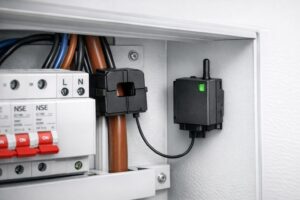
When Alternating Current flows down your main household electricity lines, it creates a fluctuating magnetic field proportional to the electrical current draw. The split core current transformer senses this shifting magnetic field and creates a tiny, safe secondary current inside its own internal windings. The tracking transmitter module reads this secondary current step down and converts it into precise wattage metrics, allowing you to view your property power usage on your app screen.
Production vs Consumption Dynamics
Tracking Household Base Load and Vampire Draws [Expand]
Real-Time Net Metering Metrics Explained [Expand]
Analyzing Peak Daily Load Profiles [Expand]
Maximising UK Smart Export Guarantee Yields
Strategic Time of Use Tariff Coordination [Expand]
Smart Load Shifting for High Energy Appliances [Expand]
Automating Diversion to Hot Water Storage Cylinders [Expand]
Integrating Monitors with Inverters and Protectors
Your monitoring instruments must track the precise performance parameters of your primary power conversion hardware. Placing data sensors along these specific input and output paths allows you to monitor live conversion metrics and calculate exactly how well your system handles incoming energy. To cross-reference these monitoring parameters with your main power conversion units and track multi-stage battery charging phases in real time, see our comprehensive analysis on Solar Inverters and Chargers.
Finally, your data transmitters and communication links must be physically shielded from environmental electrical faults. Nearby lightning strikes can create high-voltage transient overvoltages along long data cables, scrambling your telemetry signals or destroying your sensor microchips. Installing dedicated surge protection modules directly inside your combiner units safeguards your delicate telemetry equipment from surge damage. For a complete breakdown on placing sacrificial varistor cartridges to isolate your tracking loops from transient spikes, explore our deep-dive on Solar Surge Protectors.
FAQ
Do basic generation meters track how much electricity I am exporting under the Smart Export Guarantee? [Expand]
- No, generation meters only log total power produced.
- They do not record directional grid export numbers.
- Tracking export returns requires inline smart meter hardware.
- Connect your setup to Solar Inverters and Chargers.
- This automatically coordinates battery charging using cheap tariffs.
What is a current transformer (CT) clamp and how does it work? [Expand]
- A CT clamp measures magnetic fields around live wires.
- It clips cleanly around your main incoming electricity cable.
- The sensor calculates household power flux values in real-time.
- It requires zero dangerous physical cutting into bare copper.
Why does my monitoring app display different data than my utility bill? [Expand]
- Clamp sensors carry minor geometric calculation variance margins.
- Slight data delays occur across slow local Wi-Fi bridges.
- Utility smart meters record absolute billing data directly.
- Treat your app logs strictly as tracking guidance assets.
Can I integrate third-party data monitors with my existing solar array layout? [Expand]
- Yes, if your hardware inverter supports open Modbus lines.
- Platforms link directly via local RS485 communication ports.
- Ensure data wires use shielded Solar Cables and Connectors.
- This shields telemetry loops from external electromagnetic noise corruption.