Meta Tracking Pixel

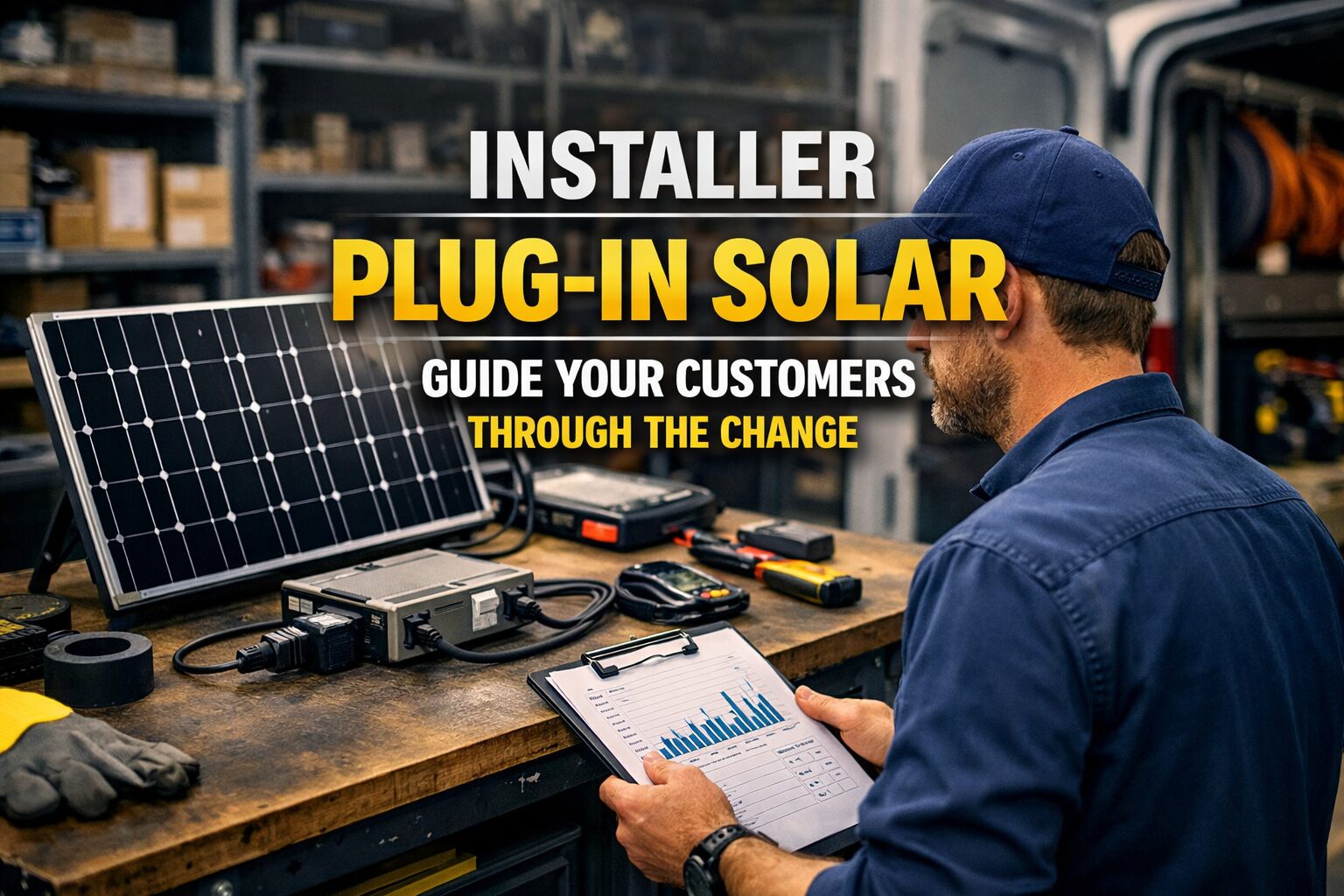
Plug-In Solar UK Installers Guide: What Your Customers Are Already Asking

Plug-In Solar UK Installers Guide: What Your Customers Are Already Asking

Plug-In Solar UK Installers Guide - what your customers are already asking
For UK Installers and Electricians

Plug-In Solar UK Installers Guide: What Your Customers Are Already Asking

Your customers are already in Facebook groups. They are reading about the government consultation. They are watching videos about German balcony solar. They are asking whether they can buy a kit from Amazon and plug it in themselves. Some of them have already tried.

They are going to call you. The question is whether you are ready for that conversation and whether you can turn it into work.

The plug-in solar market is not open yet. No product currently on sale in the UK meets the government's interim product specification. The policy response is expected 22 July. Compliant products are not expected before late 2026 at the earliest. But the customer interest is here right now, today, and the installers who get ahead of it will own the market when it does open.

This guide covers what the consultation means for your liability and your opportunity, what to tell customers who are already asking, and how to keep revenue moving while the market waits for compliant products.

About This Guide
Published 18 June 2026. Written for UK solar installers, electricians and MCS-registered contractors. Based on the three documents published by DESNZ on 16 June 2026 including the Plug-In Solar Device Interim Product Specification Version 1.0.

What the Government Consultation Actually Means for You

On 16 June 2026, the Department for Energy Security and Net Zero launched a formal consultation on plug-in solar. It proposes amending the Plugs and Sockets (Safety) Regulations 1994 and introducing an interim product specification that every compliant UK product must meet. The consultation closes 30 June. A policy response is expected 22 July. You can read the full consultation on GOV.UK.

This is not legalisation. It is the start of the process that leads to legalisation. There is an important difference and your customers will not understand it without you.

Your Liability Position Right Now
No product currently on sale in the UK meets the interim product specification. That includes products your customers may bring to you from Amazon. A qualified electrician cannot make a non-compliant product compliant. If you connect a non-compliant product and something goes wrong, you are exposed. Do not install any current plug-in solar product for grid connection regardless of what the customer asks you to do.
What Changes After 22 July
The government policy response on 22 July will confirm the legislative route and finalise the interim product specification. After that, manufacturers can begin building products to the UK spec, completing ENA type testing, and registering on the ENA Connect Direct platform. Only once a product is registered can it legally go on sale. Late 2026 is the earliest realistic date for compliant products to appear.
What This Means for Your Business
The delay is not a problem if you use it correctly. Every customer asking about plug-in solar today is a warm lead for late 2026. The installers who educate customers now, build trust now, and get homes ready now will be first in line when compliant products arrive. The installers who say "come back when it is legal" will lose those customers to someone else.
The Regulatory Picture in Plain English
Y
Plug-in solar is legal in the UK when installed by a qualified electrician under BS 7671 Amendment 4
Y
You can carry out consumer unit checks, RCD assessments and readiness work right now
N
No current Amazon product meets the UK interim specification. Do not connect them to the ring main
N
Compliant products are not expected before late 2026 at the earliest

What to Tell Customers Who Are Already Asking

Customers are confused because the headlines have been misleading. They heard "plug-in solar in shops within months" in March. They are now reading about a government consultation and do not understand why they cannot just buy one. Your job is to explain it clearly, position yourself as the expert, and keep them engaged until compliant products arrive.

When a Customer Says: "I Thought It Was Legal Now"
Tell them: the government has confirmed the direction of travel. The framework is coming. The consultation launched on 16 June sets out exactly what compliant products must do. What is missing is compliant products — nothing currently on sale meets the UK specification. The delay is a regulatory bedding-in period, not a cancellation. Products are expected late 2026.
"This is not a cancellation. The government has published the product specification. Manufacturers now need to build to it. We expect compliant products later this year."
When a Customer Says: "Can I Just Buy One From Amazon?"
Tell them: no product currently on Amazon meets the UK interim specification. They use the wrong plug type, have not been tested to the UK standard, and are not registered on the ENA type test register as required. Buying one and connecting it to the ring main is not legal and could invalidate their home insurance. You are stopping them wasting money on something that will not serve them well.
"I can save you from a mistake here. None of those products are legal for grid connection in the UK right now. Let me tell you what to look for when compliant products arrive."
When a Customer Says: "How Much Will It Actually Save Me?"
The government's own figures are clear. A south-facing 800W system at optimal angle saves around £110 a year. East or west facing vertical saves around £70. But self-consumption rate matters — a customer who is out all day with no battery storage will save less than one who is home or has storage. Set realistic expectations now. A customer who understands the real numbers will not come back angry later.
"The government estimate is £70 to £110 a year. Your actual saving depends on which way your property faces and how much electricity you use during the day. Let me run the numbers for your specific situation."
How to Position Yourself in Every Conversation
Tell every customer three things. We will guide you through what is legal, what is safe, and what is worth waiting for. We will notify you the moment certified UK products are approved. We will stop you wasting money on unsafe imports. That is the promise that builds trust and keeps customers in your pipeline until late 2026.

The Job You Can Sell Right Now: The Plug-In Readiness Check

Every home that will eventually install plug-in solar needs a consumer unit check first. The interim product specification is explicit that homes with older unidirectional RCDs are not suitable for plug-in solar without an upgrade. That means every customer asking about plug-in solar today is a potential consumer unit job before any solar goes in.

This is the opportunity most installers are missing. They are waiting for compliant products before having the conversation. The smart move is to offer a Plug-In Readiness Check now, create a pipeline of assessed customers, and be first in line to complete the install when compliant products arrive.

What a Plug-In Readiness Check Covers
1
Consumer Unit Assessment
Check whether the home has modern RCBOs or older unidirectional RCDs. Identify whether an upgrade is needed before plug-in solar can be safely installed. This is a billable job in its own right regardless of whether solar follows.
2
Circuit Identification
The interim spec requires plug-in solar to connect to a socket circuit, not a lighting circuit or a circuit supplying fixed equipment. Identify which circuits are suitable and document them. This saves time on the eventual install and demonstrates your expertise to the customer.
3
Siting and Shading Assessment
Identify the best location for the panels. Note orientation, angle, shading from neighbouring buildings or trees, and mounting options. A south-facing install at 30 degrees generates around £110 a year. A north-facing shaded install generates significantly less. Give the customer a realistic number before they commit.
4
Socket Location and Cable Routing
Assess where the connection socket will be, how the cable will run from the panels to the socket, and whether an outdoor socket needs fitting. An outdoor weatherproof socket installation is a clean separate job you can complete now while the customer waits for compliant products.
5
Written Readiness Report
Provide a written report covering all of the above with a quote for any upgrade work needed and a confirmed price for the eventual plug-in solar installation. The customer now has a document, a plan, and a relationship with you. When compliant products arrive they are calling you first.
What to Charge
A Plug-In Readiness Check typically takes one to two hours on site. A charge of £49 to £99 is reasonable depending on your area and the complexity of the property. Many installers offer it free to redeem against the eventual installation cost. Either approach creates a committed customer with skin in the game.
The Pipeline Value
Ten readiness checks at £75 each is £750 in immediate revenue. Ten customers with written quotes and a confirmed relationship is a pipeline of ten plug-in solar installations worth £2,000 to £4,000 in late 2026 labour alone. That is the value of acting now rather than waiting.
The Consumer Unit Upgrade Opportunity
A significant proportion of UK homes have older consumer units that will need upgrading before plug-in solar can be safely installed. A consumer unit upgrade typically costs £500 to £1,500 depending on the property. If your readiness check identifies that an upgrade is needed, you have a billable job to do right now, before a single solar panel arrives in the UK. That is real revenue from the plug-in solar opportunity today.

Customers are confused because the headlines have been misleading. They heard "plug-in solar in shops within months" in March. They are now reading about a government consultation and do not understand why they cannot just buy one. Your job is to explain it clearly, position yourself as the expert, and keep them engaged until compliant products arrive.

When a Customer Says: "I Thought It Was Legal Now"
Tell them: the government has confirmed the direction of travel. The framework is coming. The consultation launched on 16 June sets out exactly what compliant products must do. What is missing is compliant products — nothing currently on sale meets the UK specification. The delay is a regulatory bedding-in period, not a cancellation. Products are expected late 2026.
"This is not a cancellation. The government has published the product specification. Manufacturers now need to build to it. We expect compliant products later this year."
When a Customer Says: "Can I Just Buy One From Amazon?"
Tell them: no product currently on Amazon meets the UK interim specification. They use the wrong plug type, have not been tested to the UK standard, and are not registered on the ENA type test register as required. Buying one and connecting it to the ring main is not legal and could invalidate their home insurance. You are stopping them wasting money on something that will not serve them well.
"I can save you from a mistake here. None of those products are legal for grid connection in the UK right now. Let me tell you what to look for when compliant products arrive."
When a Customer Says: "How Much Will It Actually Save Me?"
The government's own figures are clear. A south-facing 800W system at optimal angle saves around £110 a year. East or west facing vertical saves around £70. But self-consumption rate matters — a customer who is out all day with no battery storage will save less than one who is home or has storage. Set realistic expectations now. A customer who understands the real numbers will not come back angry later.
"The government estimate is £70 to £110 a year. Your actual saving depends on which way your property faces and how much electricity you use during the day. Let me run the numbers for your specific situation."
How to Position Yourself in Every Conversation
Tell every customer three things. We will guide you through what is legal, what is safe, and what is worth waiting for. We will notify you the moment certified UK products are approved. We will stop you wasting money on unsafe imports. That is the promise that builds trust and keeps customers in your pipeline until late 2026.

How High Efficiency Panels Let You Offer Solar to Customers Who Think They Cannot Afford It

A customer who says your quote is too high is not a lost customer. They are a customer with a budget constraint. High efficiency panels change the maths and open up a conversation most installers walk away from.

The standard small-scale solar install in Great Britain cost a median of £1,595 per kilowatt in 2025 and 2026. For a customer who wants 4kW that is over £6,000. Many customers who enquire about plug-in solar are not asking because they want a small system. They are asking because they cannot afford a full one.

High efficiency panels do not solve the budget problem entirely. But they reduce the number of panels needed to hit a generation target, which reduces mounting costs, labour time, and the overall job cost. For a customer with limited roof space, a north-facing extension roof, or a tight budget, the difference can be the difference between solar being viable or not.

The Maths That Makes the Case
Standard 20% Efficiency Panels
To generate 3kW you need 10 panels at 300W each. That is 10 sets of fixings, 10 panel positions to plan, 10 connections, and a larger mounting frame. More labour, more materials, more time on site.
25% High Efficiency Panels
To generate the same 3kW you need 8 panels at 375W each. Two fewer panels, smaller mounting system, less labour. The panels cost more per unit but the overall job cost is lower. And the customer gets the same output.
For customers with limited roof space the calculation is even stronger. A small south-facing roof that fits 6 standard panels fits the same generation capacity in 4 or 5 high efficiency panels. The customer gets a viable system where they previously had none.

This conversation works for three types of customer. The customer who cannot afford a full standard install. The customer with limited roof or wall space. And the customer who wants the lowest possible maintenance system with the fewest components. In all three cases high efficiency panels are the answer that keeps the job alive.

1
The Budget Customer
Cannot afford a full install at standard prices. Show them that fewer high efficiency panels means a lower total job cost. A 2kW system with four 500W high efficiency panels can come in significantly cheaper than the same output from eight standard panels. Run the numbers and show them the comparison.
2
The Space-Constrained Customer
Has a small roof, a single south-facing wall, or a balcony. Standard panels do not give them enough output to make the investment worthwhile. High efficiency panels maximise what they can generate from the space they have. This turns a marginal install into a viable one.
3
The Future-Proofing Customer
Wants to start small and expand later. High efficiency panels mean fewer panels now with the option to add more later without running out of roof space. The system is expandable without a complete redesign. This is a strong upsell for a customer who is thinking long term.
High Efficiency Solar Panels on Gemshore
We have reviewed the best high efficiency solar panels available in the UK right now including N-Type monocrystalline panels at 25% efficiency from Renogy and ECO-WORTHY. See the full guide and current prices at gemshore.co.uk/solar-solutions/high-efficiency-solar-panels/

What You Can Sell Your Customers Right Now

Your customers are not going to sit on their hands until late 2026. They are interested in reducing their energy bills now. If you do not help them find a solution today, Amazon will. Or Temu will. And they will buy something that does not work properly, potentially creates a risk in their home, and leaves them frustrated with solar energy before the legal market even opens.

The installers who stay relevant this summer are the ones who understand the full picture. Plug-in solar is one part of it. Here is everything a customer can legitimately buy and use right now, and how you can be the person who guides them to the right choice.

Legal Now
Portable Power Stations
A portable power station is a self-contained battery that charges from the mains or from solar panels and runs appliances directly. No grid connection. No electrician needed. No compliance issues. A customer with a BLUETTI Elite 100, a Jackery Explorer 1000 v2 or an EcoFlow DELTA 2 can run their fridge, television, router and phone charging from stored solar power. Their electricity bill drops immediately.
This is the product for customers who want to act now and cannot wait. It is also the gateway product. A customer who buys a portable power station this summer is a customer who will want plug-in solar or a full home battery system next year. Stay in contact with them.
See Full Power Station Guide on Gemshore
Jackery Explorer 240 v2
Jackery
Explorer 240 v2
...
256Wh300WLiFePO4
View on Amazon
BLUETTI Elite 100 V2
BLUETTI
Elite 100 V2
...
1024Wh1800WLiFePO4
View on Amazon
EcoFlow DELTA 2
EcoFlow
DELTA 2
...
1024Wh1800WLiFePO4
View on Amazon
Legal Now
Home Battery Storage
A customer who already has rooftop solar but no battery is losing money every day. Any surplus generation that does not go into storage goes back to the grid at export tariff rates rather than displacing expensive peak-rate electricity. A home battery installation is a clean professional job you can carry out right now. It does not require waiting for any regulatory change.
For customers without existing solar, a standalone home battery charged on off-peak tariffs such as Octopus Go still cuts bills significantly. This is a growing market and an installation you can complete today.
See Full Home Battery Guide on Gemshore
Jackery Explorer 1000 v2
Jackery
Explorer 1000 v2
...
1070Wh1500WLiFePO4
View on Amazon
Anker SOLIX C1000 Gen 2
Anker
SOLIX C1000 Gen 2
...
1024Wh1500WLiFePO4
View on Amazon
EcoFlow DELTA 3 Plus + 220W
EcoFlow
DELTA 3 Plus + 220W Solar
...
1024Wh1500WSolar Included
View on Amazon
Legal Now
Off-Grid Solar Setups
Panels charging a battery directly, running appliances from the battery. No grid connection, no microinverter, no ring main connection. Completely legal right now. This is the setup that suits garden offices, sheds, caravans, garages, and any outbuilding where the customer wants independent power. It is also the gateway system for customers who want to understand solar before committing to a full install.
High efficiency panels make off-grid setups more viable in limited spaces. A 400W high efficiency setup in a small garden can generate meaningful power for a garden office or charging station. This is a job you can quote, complete, and invoice this summer.
See High Efficiency Panels on Gemshore
Renogy 100W Solar Panel
Renogy
100W High-Efficiency Mono Panel
...
100W25% Efficiency
View on Amazon
ECO-WORTHY Bifacial 195W
ECO-WORTHY
Bifacial 195W High Efficiency
...
195WBifacial
View on Amazon
werchtay 300W Solar Panel
werchtay
300W 25% High-Efficiency Module
...
300W25% Efficiency
View on Amazon
The Hybrid Upgrade Path
The most powerful conversation you can have with a customer right now is about the upgrade path. Start with a portable power station or an off-grid setup today. Add plug-in solar when compliant products arrive in late 2026. Add a home battery when the budget allows. Every step is a legitimate job. Every step keeps the customer in your pipeline. And every step builds a home energy system that actually works. That is the offer no one else is making.

Thanks for reading this guide. Since it was published there has been a significant update, on 16 July 2026, to the legal position covered here. Before you go any further, read Plug-In Solar Is Now Legal in the UK: What Changes for the current position. The FAQ below reflects that update.

Frequently Asked Questions

Is plug-in solar legal in the UK now?
💡 Quick AnswerYes. Following the update on 16 July 2026, plug-in solar is confirmed as legal in the UK under SI 2026/848, effective from 27 August 2026. This supersedes the earlier consultation stage covered in the main body of this guide. See our dedicated article for the full detail on what changed.
Does this change what installers should tell customers?
💡 Quick AnswerYes. Installers should now reference the confirmed product specification rather than the earlier consultation language. Customers can be told that a legal framework and product specification are now in force ahead of the 27 August 2026 effective date, rather than being told the market is still awaiting a policy response.
Has the readiness check advice in this guide changed?
💡 Quick AnswerThe core readiness work, consumer unit assessment, circuit identification, siting and cable routing, remains relevant and billable regardless of the legal update. What has changed is the timeline customers should be given, since a confirmed effective date now exists rather than an open-ended wait for a policy response.
Where can I read the full update?
💡 Quick AnswerThe full update is covered in our article Plug-In Solar Is Now Legal in the UK: What Changes, which includes the verified product specification and safety detail confirmed against the official government document.
Gemshore Power is a participant in the Amazon Associates programme. Product links on this page are affiliate links. We may earn a small commission if you purchase through them at no additional cost to you. Prices shown are pulled live from our product database and may vary. We only link to products we have reviewed and verified as available in the UK. Full affiliate disclaimer here.

📅 Last updated: