
Solar Surge Protectors
What are Solar Surge Protectors
Investing in high-quality solar surge protectors is the most cost-effective way to insure your renewable energy system against electrical damage.
Whether you are running a legal 800W plug-in kit or a high-capacity backup battery, lightning strikes and grid fluctuations can cause massive voltage spikes that fry sensitive internal electronics.
We’ve vetted the best-performing UK equipment to ensure your solar surge protectors provide a robust line of defence, keeping your home power setup safe and functional for years.
By proactively installing these high-joule safety devices, you create a vital firewall between the National Grid and your expensive renewable hardware, ensuring maximum energy resilience for your household.
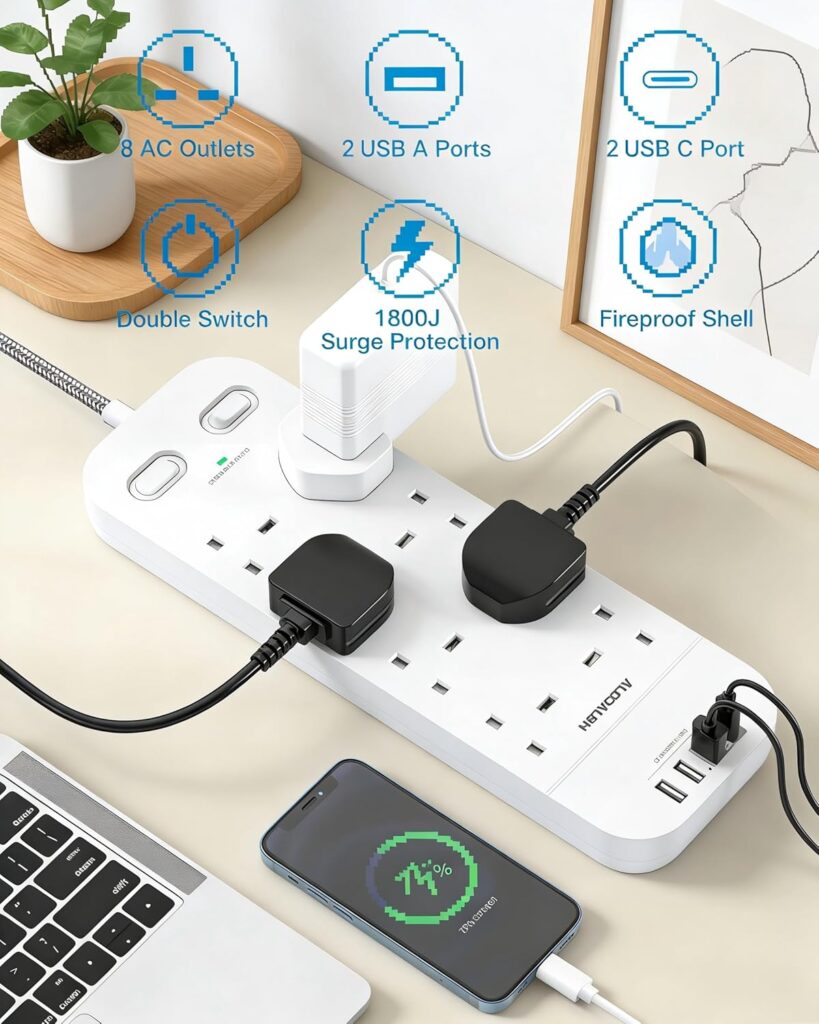
High Joule Surge Protection for Solar & Batteries
When protecting high-value solar surge protectors and home batteries, the ‘Joule rating’ is the most important spec. While most standard UK leads offer a weak 270J of protection, we have curated only heavy-duty units offering 1800 Joules or more. These leads are essential for safeguarding your EcoFlow or Jackery battery units from the high-voltage spikes common in the UK grid, ensuring your 800W setup remains fire-safe and functional.”


Space-Saving Single-Socket Solar Surge Protectors
For a discreet and compact installation, single-socket solar surge protectors allow you to safeguard your 800W micro-inverter directly at the wall outlet. While these compact units typically offer lower Joule ratings (650J–900J) compared to heavy-duty leads, they are ideal for dedicated solar feedback points where space is limited. We have selected the top-rated UK models from Belkin and Masterplug for their proven response times and reliable safety indicators.”


Why 1000 Joules is Non-Negotiable
- What are Joules? A Joule rating tells you how much energy the surge protector can absorb before it fails. For expensive solar surge protectors, a rating of at least 1000J is required to handle larger grid fluctuations.
- The 800W Law: As you bridge the gap between portable and fixed power, the risk of ‘surges’ increases. Using heavy-duty protection ensures your home’s ring main is isolated from external spikes.
- Status Indicators: Surge protection eventually ‘wears out’ after absorbing spikes. Always check the “Protected” LED on your devices; if the light is off, your protection has expired and the unit must be replaced.
Why Joules and RCDs Matter for Solar Safety
- Understanding the Joule Limit: Think of Joules as a ‘sacrificial shield.’ Every time a surge is stopped, the shield gets smaller. By choosing solar surge protectors with a rating of 1000J to 3250J, you ensure your setup can withstand multiple grid fluctuations before the unit needs replacing. High-joule ratings are the first line of defense in maintaining the operational integrity of your high-value solar hardware over its entire lifespan.
- The RCD Advantage: A Residual Current Device (RCD) is a life-saving addition to your solar surge protectors. It constantly monitors the current; if it detects a leak (which can happen in DIY solar kits), it cuts the power in milliseconds to prevent fire or electric shock. This active monitoring is critical for systems that are permanently integrated with your home’s existing electrical ring main.
- Reading the LED Indicators: Most high-quality solar surge protectors feature a “Protected” LED. If this light goes out, it means the internal safety components have been used up protecting your system from a spike. You must replace the unit immediately to maintain your energy security and ensure that your next generation cycle is fully protected from unpredictable grid behavior.
- Compliance & Standards: All our recommended solar surge protectors meet the latest BS 7671 Wiring Regulations standards, ensuring your 800W plug-in setup is safe, legal, and reliable in the UK climate. Following these recognized safety protocols is the only way to guarantee your energy setup remains compliant with UK building and fire insurance requirements.
Optimising Protection:
Safe Placement & Load Management
To ensure your solar surge protectors perform at their peak, always position them as close as possible to the device you are protecting. For 800W kits, this means placing the protector at the primary wall outlet. Furthermore, never exceed the 13A total load limit of a single lead; distributing high-power devices across multiple circuits prevents overheating and ensures your safety equipment remains fully effective during a surge event.
The Technical Threat Profile: Transient Overvoltages
Type 1 vs Type 2 SPD Demarcation Matrix
| Performance Element | Type 1 Surge Protective Device | Type 2 Surge Protective Device |
|---|---|---|
| Primary Defense Mandate | Direct atmospheric strikes and heavy external lightning current dispersion | Indirect induced lightning pulses and grid switching transient isolation |
| Installation Position | Main building entrance boundary or primary external service consumer units | Sub distribution boards and dedicated solar inverter DC combiner boxes |
| Waveform Current Rating | Tested against heavy ten over three hundred and fifty microsecond impulse curves | Tested against fast eight over twenty microsecond transient surge curves |
| Hardware Substitution Rule | Can handle smaller induced spikes but lacks fine voltage clamping limits | Cannot handle direct strikes but offers superior protection for sensitive boards |
Dynamic Selection Parameters Matrix
| Technical Rating Parameter | DC Solar Side Thresholds | AC Grid Side Thresholds |
|---|---|---|
| Maximum Continuous Voltage (Uc) | Must exceed the peak open-circuit voltage of the solar panel string by at least twenty percent | Must comfortably exceed the nominal UK grid standard of two hundred and thirty volts plus ten percent variance |
| Voltage Protection Level (Up) | Must sit well below the maximum terminal voltage tolerance of your hybrid inverter or charge controller input stage | Must safely limit transient spikes below one point five kilovolts to protect standard domestic microchips |
| Nominal Discharge Current (In) | Typically fifteen to twenty kiloamps minimum for reliable protection against repetitive indirect surge pulses | Typically twenty kiloamps minimum to handle standard inductive current loads from grid supply switching events |
| Maximum Discharge Current (Imax) | Forty kiloamps capacity to survive a heavy extreme environmental energy spike without fracturing the housing | Forty kiloamps capacity to absorb major external grid faults before transferring the energy pathway to the ground |
MOV Technology: The Inner Workings
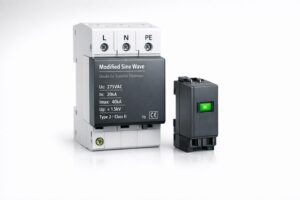
When a massive transient overvoltage pulse hits the circuit, the physical properties of the metal oxide varistor change within nanoseconds. As the incoming voltage breaches the design threshold of the unit, the internal resistance of the MOV drops instantly to near zero. This sudden structural shift opens a massive high-speed drainage pathway, clamping the dangerous electrical wave and shunting the destructive current load safely away into the earth grid before it can breach your sensitive inverter circuitry.
Precise Fixed Placement Architecture & Grounding
The Critical 50cm Lead Length Limitation Rule [Expand]
DC Side Combiner Board Protection Zoning [Expand]
AC Consumer Board Protection Zoning [Expand]
UK BS 7671 Section 712 Compliance Checklist
Mandatory Overvoltage Risk Assessment Criteria [Expand]
Earthing Rod and Bonding Conductor Specifications [Expand]
Sacrificial Status Indicator Inspection Windows [Expand]
Integrating Surge Protectors with Inverters and Cables
FAQ
Where exactly should a Type 2 Surge Protective Device be placed in a residential solar setup? [Expand]
- Install protection devices at both ends of runs.
- Place one unit near your outdoor panel arrays.
- Mount the second near your central processing bay.
- Connect it before your Solar Inverters and Chargers.
- This safely clamps long-run transient voltage spikes early.
What is the difference between Type 1 and Type 2 solar surge protectors? [Expand]
- Type 1 devices shield circuits from direct lightning strikes.
- They are mandatory for homes with external lightning rods.
- Type 2 units handle indirect, transient overvoltage spikes.
- These protect sensitive motherboard microchips from grid switches.
How do I know if my solar surge protector has tripped or failed? [Expand]
- Check the visual inspection windows on the module front.
- A green flag indicates healthy, active circuit protection.
- A red flag proves the internal varistor has blown.
- Replace the cartridge immediately to restore hardware shielding.
Does a solar surge protector require its own dedicated earth connection? [Expand]
- Yes, it must ground to the main consumer earth.
- Keep the grounding wire path under 50cm if possible.
- Longer cables increase overall resistance during a discharge fault.
- Wire everything safely using heavy-duty Solar Cables and Connectors.