Complete Guide
Is Solar Worth It in the UK? The Complete Solar Panels FAQ
Real answers to the questions UK homeowners actually ask about cost, savings, payback period, and everything you need to know before going solar.
Considering solar panels for your UK home but not sure where to start? Below we answer the questions homeowners ask most, from whether solar is genuinely worth it, to real installed costs, payback periods, and how panels actually perform through a British winter.
Every figure here is based on current UK installation data and updated as prices and regulations change. If you're further along and comparing specific hardware, our Solar Solutions guides cover panels, batteries, and inverters in detail.
Is Solar Worth It in the UK
Are solar panels worth it in the UK?
- For most UK homes, solar panels are worth it, with typical payback periods of 6 to 10 years and a 25 to 30 year hardware lifespan.
- The value depends heavily on your roof orientation, household electricity usage, and whether you add battery storage to use more of the power you generate.
- South-facing roofs with minimal shading see the strongest returns, though east and west-facing roofs still perform well.
How much do solar panels cost in the UK?
- A standard residential solar system, typically 4 to 6kWp, costs approximately £5,500 to £9,000 installed as of 2026.
- Adding battery storage typically adds a further £4,000 to £6,000 to the total cost, depending on capacity and battery chemistry.
- System size, panel quality, and installer choice all affect the final price, so getting multiple quotes is worthwhile.
How do solar panels work?
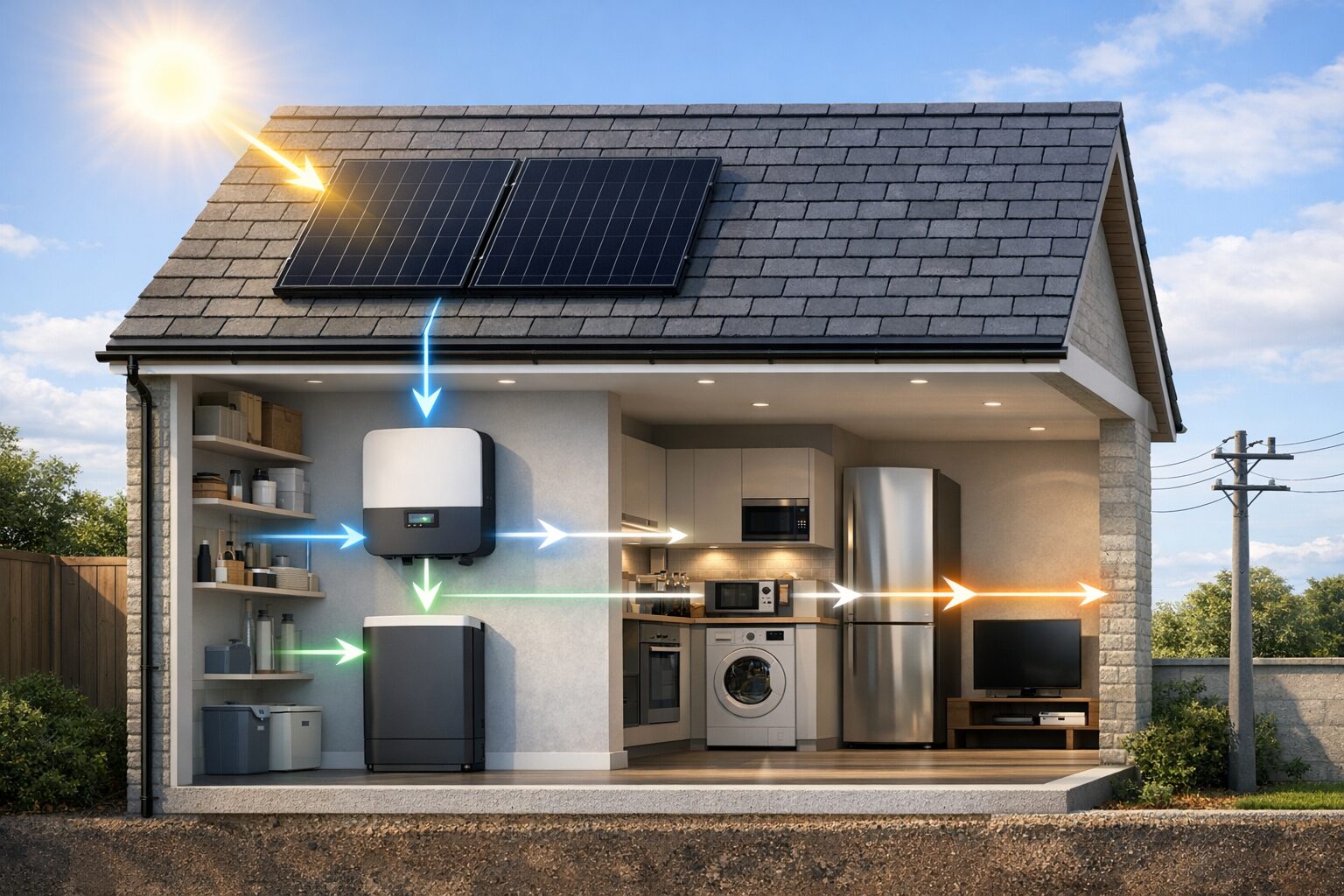
- Solar panels convert sunlight into electricity through photovoltaic cells, typically made from silicon.
- When light hits the cells, it excites electrons and generates a flow of direct current (DC) electricity.
- An inverter then converts this DC electricity into the alternating current (AC) electricity used in UK homes.
Do solar panels work on cloudy days?
- Yes, solar panels generate electricity from daylight, not direct heat or sunshine, so they continue producing power on overcast days.
- Output is lower on cloudy days compared to direct sunlight, typically producing 10 to 25% of peak output.
- The UK's climate still supports effective solar generation, with panels producing meaningful electricity even in winter months.
Do solar panels work at night?
- No, solar panels require daylight to generate electricity and produce no power after dark.
- Homes wanting power overnight from solar generation need a battery storage system to store daytime electricity for evening and night-time use.
- Without a battery, homes draw electricity from the grid as normal once the sun sets.
How many solar panels do I need for my house?
- Most 3 to 4 bedroom UK homes need a system sized between 3.5kWp and 4kWp to cover the majority of daytime electricity use.
- The exact number of panels depends on panel wattage, with most residential panels rated between 350W and 450W each.
- Your household's annual electricity consumption and available roof space are the two main factors in sizing a system correctly.
What is the payback period for solar panels?
- Most UK solar installations pay for themselves within 6 to 10 years through reduced electricity bills.
- The exact payback period depends on system cost, your household's electricity usage, and current energy prices.
- Adding battery storage extends the payback period upfront but increases long-term savings by letting you use more of the electricity you generate.
Can a house run on solar power alone?
- Running a UK home entirely on solar power alone, with no grid connection, is possible but requires a large battery storage system to cover periods of low generation, particularly in winter.
- Most UK homes with solar panels remain grid-connected, using solar generation to reduce their electricity bills rather than eliminate them entirely.
- Full off-grid setups are more common in rural properties without easy grid access than as a cost-saving choice for typical households.
Do I need a solar battery?
- A solar battery is not required for a solar panel system to work, but it significantly increases how much of your generated electricity you actually use.
- Without a battery, any electricity you generate but don't use immediately is exported to the grid, often at a lower rate than you pay to import electricity.
- A battery stores surplus daytime generation for use in the evening, which is when most UK households use the most electricity. See our Solar Batteries guide for real options.
How long do solar panels last?
- Most solar panels come with a 25 to 30 year manufacturer warranty, and often continue generating electricity well beyond that.
- Panel efficiency gradually decreases over time, typically losing around 0.5% of output per year.
- Getting your system checked periodically by a qualified installer helps ensure you're not losing out on generation as the panels age.
Do solar panels increase home value?
- Solar panels can increase a property's value, particularly given the lower running costs they offer to a future buyer.
- The impact on value varies by property type, location, and buyer demand for energy-efficient homes.
- A higher Energy Performance Certificate (EPC) rating, which solar panels typically improve, is increasingly a factor buyers consider.
Are solar panels recyclable?
- Yes, solar panels are recyclable, with most components including glass, aluminium framing, and silicon cells able to be recovered.
- Recycling processes recover up to 95% of materials in some panel types, though availability of specialist recycling facilities varies by region.
- As panels installed during the UK's earlier solar boom reach end of life, recycling infrastructure continues to expand.
Do I need planning permission for solar panels?
- Most UK homes can install roof-mounted solar panels under permitted development rights, without needing full planning permission. See the official Planning Portal guidance for full conditions.
- Listed buildings, conservation areas, and panels that protrude significantly above the roofline can require planning permission.
- Checking with your local planning authority before installation is worthwhile if your property falls into any of these categories.
Can I get government grants for solar panels?
- Solar panel installations in England, Scotland, and Wales currently benefit from 0% VAT on qualifying professional installations until 31 March 2027, rather than a direct cash grant. See the official GOV.UK VAT guidance for full details.
- Some local councils and specific schemes offer additional support, so it's worth checking what's available in your area.
- Eligibility and available schemes change over time, so checking current government guidance before installation is recommended.
What is the Smart Export Guarantee (SEG)?
- The Smart Export Guarantee is a UK government scheme requiring licensed electricity suppliers to pay households for surplus solar electricity exported to the grid. See the official GOV.UK Smart Export Guarantee guidance.
- To qualify, your system typically needs to be MCS-certified and you need a smart meter installed at your property.
- Export rates vary significantly by supplier, so comparing SEG tariffs is worthwhile once your system is installed. A solar energy monitor helps you track exactly how much you're exporting.
Do solar panels work on a flat roof?
- Yes, solar panels can be installed on flat roofs using tilted mounting frames that angle the panels toward the sun for optimal generation.
- Flat roof installations often allow more flexibility in panel orientation compared to fixed-pitch roofs.
- Additional structural checks are typically needed to confirm the roof can support the mounting frames and panel weight.
Can solar panels be installed on a north-facing roof?
- Solar panels can technically be installed on a north-facing roof, but generation is significantly lower than south, east, or west-facing installations.
- North-facing installations are generally not recommended unless no better-oriented roof space is available.
- An installer can advise whether a north-facing roof is still financially worthwhile for your specific property.
Do solar panels need cleaning or maintenance?
- Solar panels are largely self-cleaning in the UK's rainy climate, though a clean once a year can help maintain peak performance.
- Getting your system checked periodically by a qualified installer helps catch any wiring or inverter issues before they affect generation.
- Bird droppings, moss, and heavy dirt buildup are the most common reasons panels need manual cleaning.
Can hail or snow damage solar panels?
- Modern solar panels are tested to withstand hail and are built with tempered glass designed to resist impact damage.
- Light snow generally slides off the angled surface of panels, though heavy accumulation can temporarily reduce generation until it clears.
- Manufacturer warranties typically cover weather-related damage under normal UK conditions.
Should I buy or lease solar panels?
- Buying solar panels outright typically offers better long-term savings, since you keep all the electricity bill savings and any SEG export payments.
- Leasing or rent-a-roof schemes reduce upfront cost but usually mean the savings and export payments go to the leasing company instead.
- Buying is generally the better financial choice if you can afford the upfront cost and plan to stay in the property long-term.
Do I need an MCS-certified installer?
- Using an MCS-certified installer is required to qualify for Smart Export Guarantee payments and is strongly recommended for warranty and safety standards.
- MCS certification confirms the installer meets recognised UK industry standards for solar panel installation.
- You can search for a certified installer directly through the official MCS Find an Installer tool.
Are solar panels noisy?
- Solar panels themselves are completely silent, since they have no moving parts.
- The inverter, which converts the electricity generated into usable power, can produce a faint humming noise, though this is generally very quiet.
- Inverter placement away from bedrooms or living spaces is worth considering during installation if noise is a concern.
Start Here