
Next Gen High Efficiency Solar Panels
Maximum Power, Minimum Space
Fixed high efficiency solar panels are the foundation of a serious residential renewable energy system.
At this power level, systems transition from plug-and-play to professional-grade infrastructure that requires permanent roof mounting and qualified electrical integration.
Our guide helps you select high efficiency solar panels and robust mounting hardware designed to meet UK building regulations and maximize your long-term energy generation.
By investing in these high-capacity modules, you are choosing a solution capable of providing a significant percentage of your daily electricity needs.
This transition requires careful planning and a thorough understanding of how fixed modules interact with your home’s structural integrity and existing electrical circuits to ensure a safe, high-yielding installation for years to come.
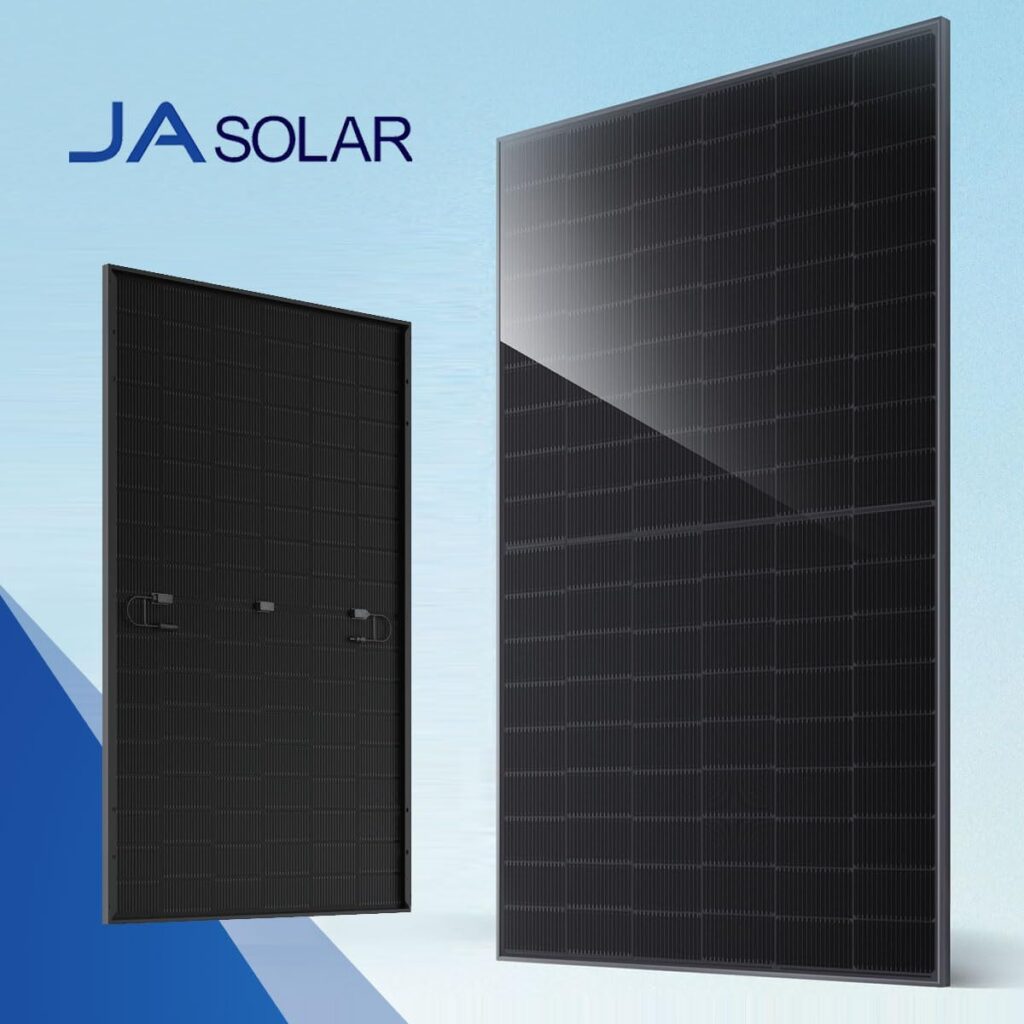
High Efficiency Solar Panels (400W+)
For high-capacity installations using individual modules of 400W or more, we recommend fixed solar panels that utilize N-type Mono-crystalline technology.
These professional-grade modules, such as those from JA Solar, offer module efficiencies above 23%, meaning you generate more power from a smaller physical footprint.
Whether you are installing a single panel for a shed or a large domestic array, choosing modules with a 25-year performance warranty ensures your setup remains energy-secure for decades.
This high efficiency solar panels approach is particularly beneficial for UK properties with limited space, as it allows you to maximize your kilowatt-hour yield without the need for an excessive number of physical modules


| Panel Model | Cell Efficiency | Module Type | Dimensions | Weight |
|---|---|---|---|---|
| JA Solar 440W | 23.3% | N-Type Mono | 1722 x 1134 mm | 22.0 kg |
| JA Solar 450W | 22.5% | Bifacial Glass | 1903 x 1134 mm | 24.5 kg |
| CraigSolar 400W | 21.0% | Standard Mono | 1754 x 1039 mm | 21.5 kg |
Professional Roof Mounting Kits
A permanent installation of fixed high efficiency solar panels requires a robust mounting system. We recommend aluminum rail kits that include stainless steel roof hooks and adjustable clamps. These systems are designed to withstand UK wind loads and ensure your panels remain securely fixed to slate or tile roofs without compromising the structural integrity of your property. Using certified mounting hardware is essential to prevent potential roof leaks and ensures that your high-capacity solar array remains stable during extreme weather conditions for the entire lifespan of the installation.
The Truth About Solar Roof Mounting Kits
Finding a complete, UK-compliant mounting kit for tile or slate roofs on Amazon can be challenging.
Most products listed are either basic Z-brackets for flat surfaces or incomplete kits missing the essential roof hooks required for UK building regulations.
We recommend professional-grade systems from specialist UK distributors for permanent residential installations to ensure your fixed solar panels remain secure against wind loads.
What’s Missing from Standard Kits?
- Certified Roof Hooks: Most ‘budget’ kits on Amazon do not include the heavy-duty stainless steel hooks needed to mount onto UK slate or tile roofs without causing leaks.
- Structural Certification: For a system over 800W, your mounting rails must be rated to handle the ‘uplift’ of storm-force winds.
- Insurance and Warranty Implications: Many home insurance policies require MCS certification for solar installations, and budget DIY systems may void your roof warranty if improper mounting causes damage or leaks.
- Our Recommendation: Use the NuaSol (B0C7WJZDR6) for small DIY projects, but consult an MCS-certified installer for larger roof-mounted arrays.
Investing in high efficiency solar panels is a long-term commitment to energy independence. By choosing modules with over 23% efficiency, you maximize every square inch of your available roof or garden space. While the modules themselves are available for purchase, the integration of these fixed solar panels into your home’s electrical infrastructure must be handled with precision to ensure safety, legal compliance, and eligibility for the Smart Export Guarantee (SEG). This professional approach guarantees that your system is properly optimized for the UK climate, providing a resilient power source that delivers consistent financial returns and carbon reductions throughout its operational life.
Buying Guide
High‑Efficiency Solar Panels (22%+) — Are They Worth It?
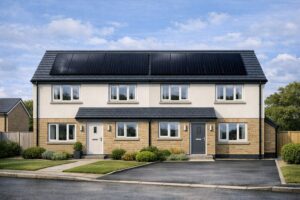
High‑efficiency solar panels can generate up to 20% more power over their lifetime compared to standard panels — making them ideal for small UK roofs, shaded homes, and anyone who wants maximum output from limited space.
These panels use next‑generation cell technology (TOPCon, HJT, and Back‑Contact) to deliver better performance in low light, cold weather, and real‑world UK conditions, not just laboratory tests.
Why This Matters for UK Homes
Most UK homes — especially semi‑detached, terraced, and townhouses — have limited roof area. That means efficiency isn’t a luxury; it’s a space‑saving strategy.
With high‑efficiency panels, you can:
Hit your target system size with fewer panels
Produce more energy during cloudy UK days
Maintain higher output as panels age
Improve long‑term ROI through lower degradation
This is why high‑efficiency panels are one of the highest‑intent solar searches in 2026 — people want to know if the extra cost pays off. And in many cases, it does.
What This Guide Covers
This page gives you a clear, no‑nonsense breakdown of:
The three major high‑efficiency technologies in 2026
How they perform in real UK weather
What efficiency actually means (beyond the % number)
Whether they’re worth the extra cost for your home
How to choose the right panel type for your roof
How to pair them with batteries or plug‑in systems
By the end, you’ll know exactly which panel type fits your home, your budget, and your long‑term goals.
Why High‑Efficiency Panels Make Sense for UK Homes
High‑efficiency solar panels aren’t just “better panels” — they solve the biggest limitation most UK homes face: roof space. If you live in a semi‑detached, terraced, townhouse, or any property with limited south‑facing area, efficiency becomes the difference between:
A system that fits
And a system that works
High‑efficiency panels let you generate more power from the same footprint, which means you hit your target kW size with fewer panels and less roof coverage.
This is the number‑one reason people choose high‑efficiency panels.
A standard 400W panel might need 10–12 panels for a 4kW system
A high‑efficiency 450–500W panel might need 8–9 panels for the same output
Fewer panels =
Less roof clutter
Lower installation complexity
More flexibility around chimneys, dormers, and shading
For many UK homes, this is the deciding factor.
High‑efficiency panels use advanced cell structures that perform better in:
Low light (cloudy days)
Cold temperatures (UK winters)
Diffuse light (north‑facing or shaded roofs)
This means you get more usable energy throughout the year, not just on perfect summer days.
Efficiency isn’t just about day‑one performance — it’s about lifetime yield.
Modern high‑efficiency N‑type panels typically degrade at around 0.4% per year, compared to 0.7% for older P‑type panels.
Over 25 years, that difference adds up to hundreds of extra kilowatt‑hours.
Yes, high‑efficiency panels cost more upfront. But they also:
Produce more energy
Last longer
Lose less performance over time
Increase the value of your home
Reduce the number of panels needed
For many homeowners, the long‑term ROI outweighs the initial cost difference.
High‑efficiency panels are especially useful if your roof has:
Limited space
Multiple angles
Chimneys or skylights
Partial shading
A north‑east or north‑west orientation
In these cases, efficiency isn’t a luxury — it’s a practical necessity.
The Three High‑Efficiency Technologies
You Need to Know in 2026
Not all “high‑efficiency” panels are the same. In 2026, three technologies dominate the premium end of the market — each with different strengths, costs, and real‑world benefits for UK homes.
This section breaks them down in plain English so you can choose the right one for your roof, budget, and long‑term goals.
| Technology | Efficiency Range | Best For | Key UK Benefit |
|---|---|---|---|
| TOPCon | 22% – 25% | Most homes | Excellent low‑light performance |
| HJT | 23% – 26%+ | Premium installs | Best temperature coefficient (keeps output high even in heat) |
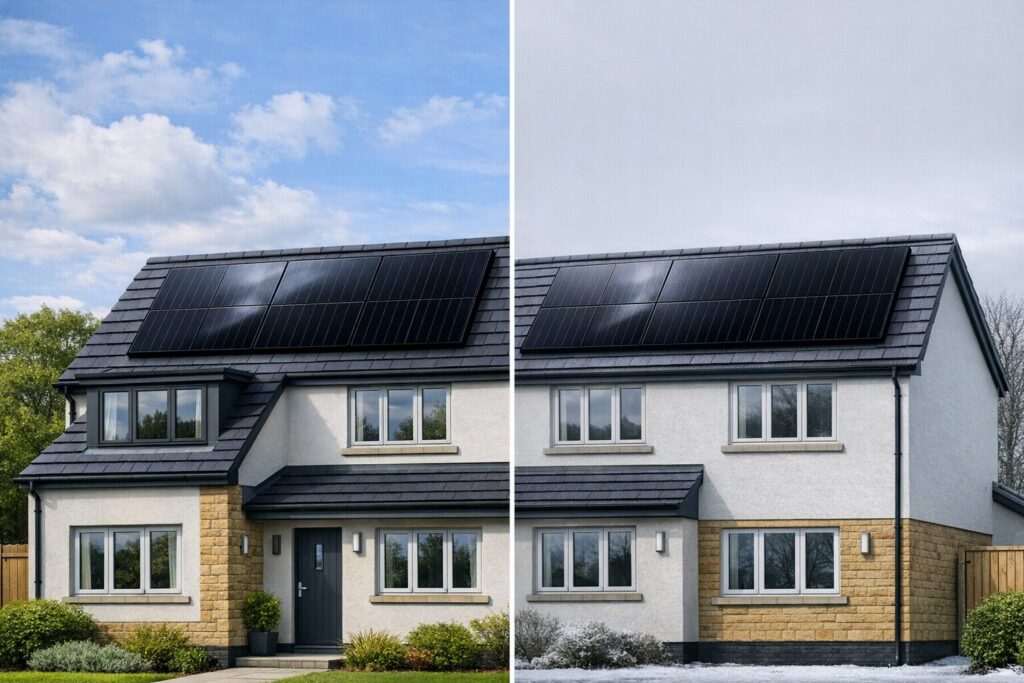
| Back‑Contact | 23% – 24% | Aesthetic‑focused homes | Sleek all‑black look with no visible grid lines |
TOPCon (Tunnel Oxide Passivated Contact)
TOPCon is the mass‑market leader in 2026. It offers the best balance of price, efficiency, and real‑world performance.
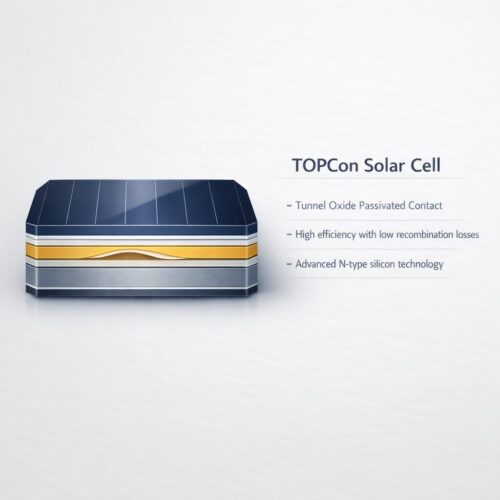
Why it’s good for UK homes
Strong low‑light performance (cloudy days)
High efficiency without premium pricing
Good temperature stability
Widely available from major brands
Who it’s for
Most UK homeowners
Anyone wanting high efficiency without going ultra‑premium
Roofs with mixed orientations or partial shading
HJT (Heterojunction Technology)
HJT panels are the premium performance option. They combine crystalline silicon with thin‑film layers, giving them exceptional stability in changing temperatures.
Why it’s good for UK homes
Best temperature coefficient of any mainstream panel
Higher efficiency ceiling (23–26%+)
Excellent performance in cold and cloudy weather
Lower degradation over time
HJT panels also handle partial shading better because they use more advanced bypass diodes, and pairing them with optimisers (like SolarEdge) helps on chimney‑affected roofs.
Who it’s for
Homeowners wanting maximum lifetime output
Small roofs where every watt matters
Premium installations where performance > price
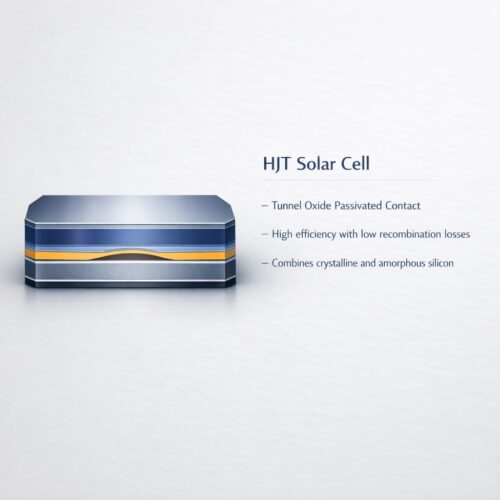
Back‑Contact (BC) Panels
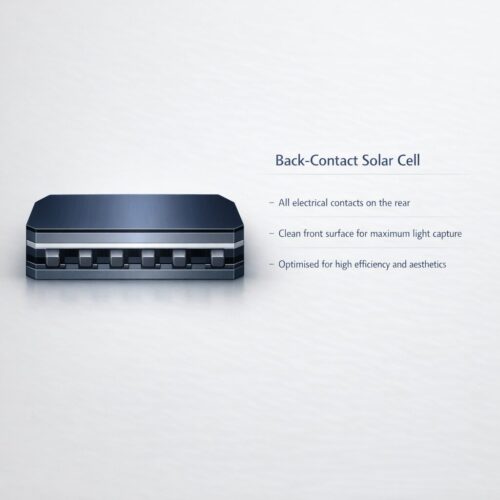
Back‑Contact panels hide all electrical connections on the rear of the cell, giving a pure black, grid‑free front surface.
Why it’s good for UK homes
The cleanest, most modern aesthetic
No visible silver lines
Strong efficiency (23–24%)
Great for homes where appearance matters
Who it’s for
Modern homes
Conservation areas where visual impact matters
Anyone who wants the “all‑black” premium look
Which Technology
Should You Choose?
Here’s the simple rule of thumb:
TOPCon → Best all‑rounder
HJT → Best performance
Back‑Contact → Best aesthetics
If your roof is small, shaded, or awkwardly shaped, HJT or TOPCon will give you the best long‑term value. If you want the cleanest look, Back‑Contact is unbeatable.
Why Real‑World Performance
Matters More Than Lab Numbers
Most panel efficiency ratings are measured under Standard Test Conditions (STC) — perfect sunlight, perfect temperature, perfect angle. The UK… doesn’t offer many “perfect” days.
That’s why real‑world metrics like NMOT, temperature coefficient, and degradation rate matter far more than the headline efficiency percentage.
This section explains what these numbers mean and how they affect your actual yearly output.
NMOT — The Most Important Number You’ve Never Heard Of
NMOT (Nominal Module Operating Temperature) tells you how a panel performs in real outdoor conditions — not a laboratory.
Typical UK NMOT conditions:
800W/m² sunlight
20°C ambient temperature
Light wind
Mounted on a roof
Panels with a lower NMOT run cooler and therefore produce more power throughout the year.
Why high‑efficiency panels win here
N‑type TOPCon and HJT panels generally have:
- Lower NMOT
- Better heat tolerance
- More stable output on warm days
Even in the UK, this adds up to meaningful extra generation.
Temperature Coefficient — How Panels Handle Heat
Every solar panel loses some efficiency as it gets hotter. The temperature coefficient tells you how much power is lost per °C above 25°C.
Typical values:
Older P‑type panels: ‑0.35% to ‑0.45% per °C
Modern TOPCon: ‑0.30% per °C
Premium HJT: ‑0.25% per °C (best in class)
Why this matters in the UK
Even though the UK isn’t hot, panels still warm up under
sunlight.
A better temperature coefficient means:
- More stable output
- Less drop‑off in summer
- Higher annual yield
HJT leads here, which is why it’s the
premium performance choice.
Degradation Rate — How Fast Panels Lose Power Over Time
All panels degrade, but the rate varies massively between technologies.
Typical annual degradation:
Older P‑type panels: ~0.7% per year
Modern N‑type TOPCon: ~0.4% per year
Premium HJT: ~0.25–0.35% per year
What this means over 25 years
A high‑efficiency N‑type panel can retain:
- ~90% of its original output after 25 years
- A standard P‑type panel may drop to:~82–85%
That’s a big difference in lifetime energy production.
The “Kettle Test”
Reminder
Even the best 450W or 500W panel cannot run a kettle on its own. High efficiency doesn’t change the physics — it just means you get more energy from the same space.
What matters is:
System size
Inverter capacity
Battery storage
Roof orientation
Shading
High‑efficiency panels help you reach your target system size with fewer panels, but they don’t replace the need for proper system design.
What This Means for You
If you want:
Maximum output from a small roof
Better performance on cloudy days
Lower long‑term degradation
More stable summer output
Higher lifetime ROI
…then high‑efficiency panels are almost always the smarter choice.
Who High‑Efficiency Panels Are Best For
High‑efficiency panels aren’t for everyone — but for the right home, they’re the smartest long‑term investment you can make.
Here’s exactly who benefits the most.
If you live in a semi‑detached, terraced, townhouse, or any property with a small usable roof area, high‑efficiency panels are almost always the better choice.
They let you reach your target system size with fewer panels, which means:
Less roof coverage
Fewer mounting points
Easier layout around chimneys and skylights
More flexibility with awkward roof shapes
This is the number‑one reason UK homeowners choose them.
High‑efficiency N‑type panels (TOPCon and HJT) handle:
Cloudy days
Diffuse light
Shaded mornings/evenings
North‑east / north‑west orientations
…better than older P‑type panels.
If your roof isn’t perfect, efficiency helps smooth out the dips.
Because high‑efficiency panels degrade more slowly, they keep producing strong output for decades.
If you plan to stay in your home long‑term, the extra upfront cost often pays for itself through:
Higher lifetime generation
Lower degradation
Better performance in winter
Higher property value
This is the “buy once, buy right” option.
Back‑Contact (BC) panels offer the cleanest all‑black look with no visible grid lines.
They’re ideal for:
Modern homes
Renovations
Conservation areas
Anyone who wants a premium, minimalist appearance
If looks matter, BC panels are the top choice.
If you want:
A 4kW system on a small roof
A 5kW+ system on a medium roof
Maximum output for EV charging
A system that pairs well with a battery
…high‑efficiency panels help you hit those numbers without running out of space.
Quick Math (4kW System)
High‑efficiency panels (22%+): 8–9 panels
Standard panels (19%): 12 panels
Same output. Fewer panels. Ideal for small UK roofs.
High‑efficiency panels pair extremely well with batteries because they:
Produce more usable energy in winter
Charge batteries earlier and later in the day
Maintain higher output as they age
If you’re planning a battery in the next 1–3 years, efficiency gives you more to store.
Who Doesn’t Need High‑Efficiency Panels?
You might not need high‑efficiency panels if you have:
A large, unshaded south‑facing roof
Plenty of space for 12–16 standard panels
A tight budget
No plans for a battery
In those cases, standard panels can still deliver excellent value.
How This Fits Into Your Wider Solar Setup
High‑efficiency panels work best when they’re part of a complete, balanced home‑energy system.
If you want to get the most out of every watt, here are the next steps worth exploring.
Pair With a Battery for Maximum Value
High‑efficiency panels generate more usable energy throughout the day — especially in low light — which makes them ideal for charging a modular home battery.
If you want to store excess energy for evenings or winter, see our guide: Home Solar Batteries
If You Have a Small Roof, Efficiency Matters Even More
Limited roof space is the number‑one reason people choose high‑efficiency panels. If you’re working with a compact layout, check our guide to system sizing: Solar Systems Over 800W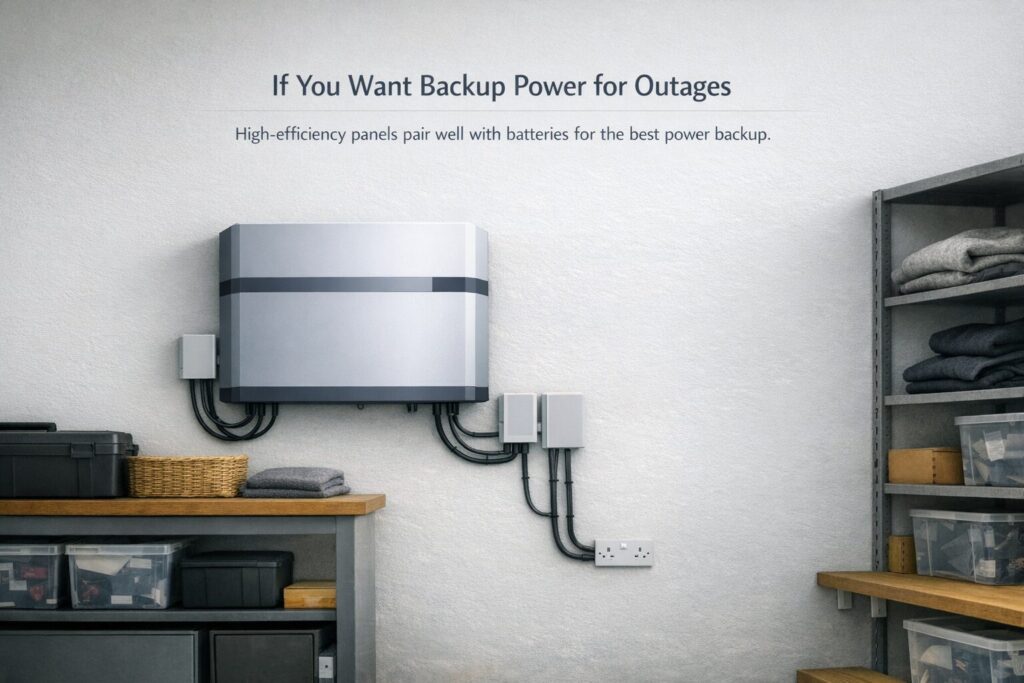
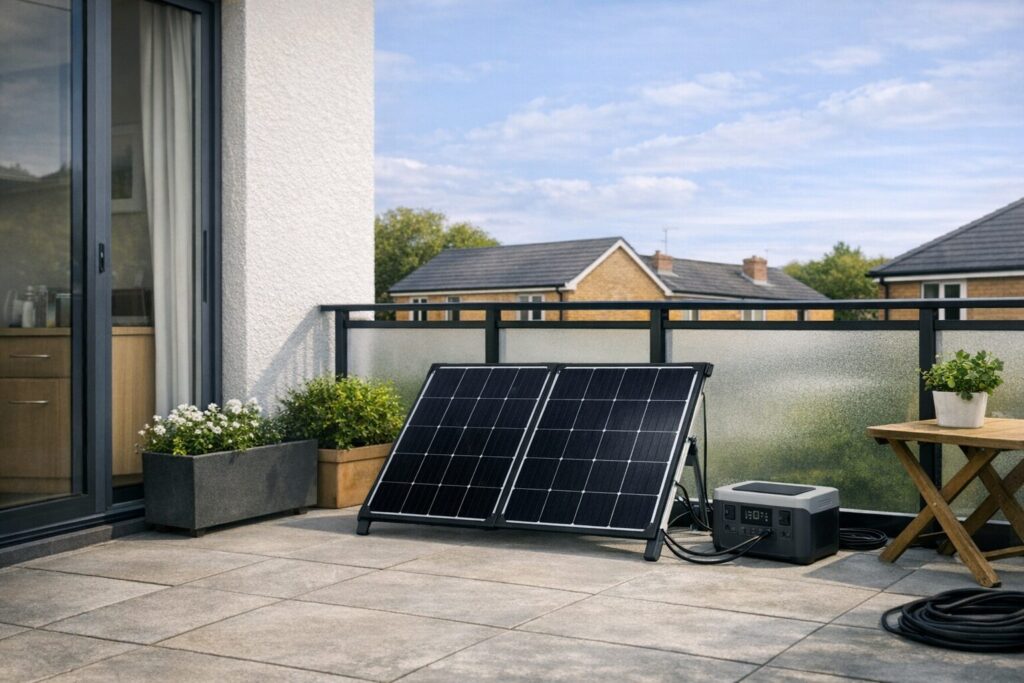
If You Can’t Install Roof Panels at All
Renting? Flat?
No permission for roof mounting? You can still generate solar power using plug‑in systems.
See our full guide:
Plug‑In Solar Systems
If You Want Backup Power for Outages
High‑efficiency panels pair well with portable power stations or home backup units.
If resilience is your priority, explore: Backup Power Options
How High‑Efficiency Solar Panels Are Installed
High‑efficiency panels are fitted exactly the same way as standard panels — the difference is simply that you need fewer panels to reach your target system size.
A typical installation is fast, tidy, and designed to minimise disruption.
Who Installs Them
High‑efficiency panels must be installed by an MCS‑certified solar installer if you want:- 0% VAT
- SEG payments
- Insurance‑backed warranties
- Grid‑connection approval
What’s Required Before Installation
Your installer will carry out:- A roof survey (strength, angle, shading)
- A system design (panel layout + inverter choice)
- A DNO pre‑check (G98 or G99)
- A structural check if needed (rare for most UK homes)
0% VAT on Solar Panels in the UK (2026 Rules)
High‑efficiency solar panels qualify for the UK’s 0% VAT rate, as long as they are professionally installed as part of a fixed home solar system. This applies to:
Solar panels (including high‑efficiency TOPCon, HJT, BC)
Inverters
Mounting equipment
Batteries (when installed at the same time as the panels)
Labour and installation costs
This VAT relief is guaranteed until 31 March 2027, making high‑efficiency systems more affordable during this window.
What Qualifies for 0% VAT
To receive the 0% VAT rate, your installation must:
- Be carried out by an MCS‑certified installer
- Be permanently fixed to your home
- Include both equipment and installation (supply‑only does not qualify)
If you buy panels on their own and install them yourself, VAT jumps back to 20%.
No. Plug‑in solar systems are classed as portable appliances, not fixed installations, so they remain at 20% VAT.
Yes — but only if the battery is installed at the same time as the solar panels.
If you add a battery later as a standalone upgrade, it currently falls under 20% VAT.
Because high‑efficiency panels cost more upfront, the 0% VAT rule removes a significant chunk of the price difference — making premium systems more accessible for UK homeowners.
Do You Need Permission for High‑Efficiency Solar Panels?
Yes — every grid‑connected solar system in the UK must be approved by your Distribution Network Operator (DNO). This applies to all panel types, including high‑efficiency systems.
The good news: Your installer handles the entire process for you.
G98 — Fast Approval for Most Homes
Most domestic solar systems fall under G98, which covers:- Systems up to 3.68kW per phase
- Standard home installations
- Most high‑efficiency panel setups
G99 — Required for Larger Systems
If your system is:- Over 3.68kW per phase, or
- Includes a large battery, or
- Uses advanced hybrid inverters
Who Handles the Paperwork?
Your MCS‑certified installer handles:
- G98 notification
- G99 application (if required)
- All technical documentation
- Final commissioning paperwork
You don’t need to contact the DNO yourself.
Why This Matters for High‑Efficiency Panels
Because high‑efficiency panels produce more power per panel, it’s easier to reach:- 4kW
- 5kW
- 6kW+
Can You Earn Money Back With High‑Efficiency Panels?
Yes — if your system is MCS‑certified and connected to the grid, you can earn money by exporting unused solar energy through the Smart Export Guarantee (SEG). High‑efficiency panels help you export more because they generate more surplus power, especially in summer.
What Is the Smart Export Guarantee (SEG)?
SEG is a government‑backed scheme where energy suppliers pay you for every kilowatt‑hour you export back to the grid. You can choose any supplier’s SEG tariff — it doesn’t have to be the same company that provides your electricity.Typical SEG Rates in 2026
Rates vary by supplier, but most fall between:
- £0.04 – £0.20 per kWh
- Premium “tracker” tariffs can pay more when wholesale prices rise
High‑efficiency systems often export more consistently, which increases your annual return.
How to Apply for SEG
To qualify, you need:
- An MCS certificate
- A DNO approval letter (G98 or G99)
- A smart meter capable of half‑hourly export readings
Your installer provides the first two; your energy supplier handles the smart meter.
Once approved, payments are usually made monthly or quarterly.
How Much Can You Earn?
A typical UK home with a 4–5kW high‑efficiency system might export:
- 800–1,500 kWh per year
- Depending on usage, battery size, and roof orientation
At 10p per kWh, that’s £80–£150 per year — more with premium tariffs.
Why High‑Efficiency Panels Help
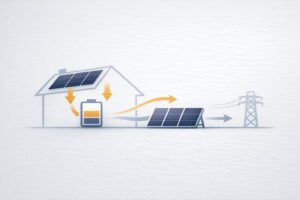
Because they generate more power per square metre, you’re more likely to:
Fill your battery earlier
Export more in summer
Earn more from SEG over the system’s lifetime
It’s not life‑changing money — but it’s a solid, reliable bonus.
What Warranties You Get With High‑Efficiency Panels
High‑efficiency panels come with some of the strongest warranties in the solar industry. Because they use N‑type cells and premium construction, manufacturers back them with longer guarantees than older P‑type panels.
This covers the physical panel itself — materials, build quality, and manufacturing defects.
Typical coverage for high‑efficiency panels:
15–25 years
Premium HJT and Back‑Contact panels often offer 25 years as standard
This is significantly longer than older 10–12 year warranties.
This guarantees how much power the panel will still produce after decades of use.
Typical performance guarantees:
TOPCon: ~89–90% output after 25 years
HJT: ~90–92% output after 25 years
Back‑Contact: ~88–90% output after 25 years
These are among the best in the industry.
Inverters usually have shorter warranties than panels.
Typical coverage:
5–10 years as standard
Often extendable to 15–20 years for a fee
Hybrid inverters (solar + battery) usually sit at the higher end.
If you pair your high‑efficiency panels with a battery, you’ll also get a battery warranty.
Typical coverage:
10 years
Guaranteed cycle life (e.g., 6,000 cycles)
Guaranteed usable capacity (e.g., 70–80% after 10 years)
Your MCS‑certified installer provides a separate warranty covering:
Workmanship
Mounting
Electrical connections
System commissioning
Typical coverage:
2–5 years
Often backed by an insurance‑backed guarantee (IBG)
This protects you even if the installer stops trading.
Manufacturers are confident in N‑type technology because it:
Degrades more slowly
Handles heat better
Performs better in low light
Has fewer long‑term failure points
So they offer longer, stronger guarantees — a major advantage over older panel types.
Frequently Asked Questions
Do high‑efficiency panels really produce more power? [Expand]
- Yes, they yield 10% to 20% more lifetime energy.
- Premium cell architectures maximize generation on small UK roofs.
- They gather extra power during low-light winter mornings cleanly.
- Study your total generation limits in our Solar Systems Over 800W framework.
Are high‑efficiency panels worth the extra cost? [Expand]
- Yes, they drastically save physical installation space.
- You hit target system sizes using fewer structural modules.
- Fewer arrays reduce your upfront mounting rail hardware requirements.
- Compare entry choices via our simple Plug-In Solar Power manual.
Do high‑efficiency panels work better in UK weather? [Expand]
- Yes, advanced N-type cells capture diffuse, indirect daylight.
- They maintain excellent conversion performance on overcast winter days.
- Their advanced temperature coefficients prevent hot summer power dips.
- Map incoming current using our comprehensive Solar Inverters manual.
What's the difference between TOPCon, HJT, and Back‑Contact? [Expand]
- TOPCon hardware offers the optimal mass-market pricing balance.
- Heterojunction (HJT) provides absolute premium low-light tracking capabilities.
- Back-Contact technology ensures a seamless, pure black aesthetic finish.
- All configurations route electricity to active home distribution systems.
Will high‑efficiency panels reduce my energy bills more? [Expand]
- Yes, because they generate more consistent year-round power.
- They provide higher electricity yields during darker seasons.
- This continuous generation minimizes expensive grid baseload standing charges.
- Review full household integration options inside Home power Options.
Do high‑efficiency panels last longer? [Expand]
- Yes, premium N-type silicon suffers minimal annual degradation.
- They retain over 90% power capacity after 25 years.
- Older P-type variations degrade significantly faster over time.
- Their long lifecycle reliably feeds home backup infrastructure setup.
Do I need a battery to benefit from high‑efficiency panels? [Expand]
- No, but adding cells helps store daytime generation surplus.
- High-efficiency tracking fills up storage packs early on winter days.
- This combination ensures consistent 24-hour off-grid operational safety coverage.
- Check your storage capacity matching using our solar batteries overview.
Are all‑black panels less efficient? [Expand]
- No, modern all-black manufacturing bypasses historical efficiency losses.
- Back-Contact versions hide structural busbars to enhance conversion space.
- They reach up to 24% cell conversion ratings smoothly.
- This guarantees ultra-clean roof layouts without cutting down system power.
How many high‑efficiency panels do I need for a 4kW system? [Expand]
- You typically require only 8 to 9 premium panels.
- A standard, lower-rated system requires 12 panels minimum.
- Fewer components streamline installation paths across restricted roof shapes.
- Verify required panel output parameters with our Solar Inverters manual.
Can high‑efficiency panels work with my existing inverter? [Expand]
- Yes, provided total system string voltage fits inverter limits.
- Check maximum input ratings before swapping existing arrays out.
- Modern high-amp configurations remain widely compatible across leading brands.
- Confirm precise layout voltages inside our Solar Inverters manual.