Meta Tracking Pixel

Plug-In Solar Power -
What Works Today and What Is Coming in July 2026

Germany balcony solar versus UK house - plug-in solar 2026

Germany built a million balcony solar systems.

The UK joins in 2026.

Right Now Today
Off-Grid Solar - Works Today
No electrician. No permissions. No fuse box work.
Coming July 2026
Plug-In Grid-Tie - Legal from July
BSI certification arrives. Feed power back through a socket.
Always Requires Electrician
Above 800W or SEG Cashback
Professional install needed for grid export payments.

Plug-In Solar Power in the UK - The Honest 2026 Guide

Germany has over one million balcony solar installations. Households buy a complete kit from a supermarket shelf, mount the panels on a balcony railing or garden fence, plug the inverter into a wall socket and start cutting their electricity bill the same afternoon. No electrician. No planning permission. No roof work.

The UK catches up in July 2026 when BS 7671 Amendment 4 makes plug-in grid-tie solar legal for the first time. Until then, you can run a complete off-grid solar system today - generating and storing your own power without touching your home's mains circuit.

This guide covers both. What works right now, what is coming in July, what the German market looks like, and exactly what to buy at every budget.

800W
Legal limit for plug-in solar from July 2026. No electrician required below this threshold.
1M+
German balcony solar installations already operating. The UK is following the same proven model.
£0
Electrician cost for off-grid solar today or plug-in grid-tie from July 2026 under 800W.

Ready for plug in solar power without the crazy roof costs or weeks of installers?

New LiFePO4 plug‑in systems change everything – small, quiet units you simply plug into a wall socket, feed with a couple of balcony or garden panels, and start cutting your bills straight away.

They store energy for when you actually need it! so you keep saving at night , not just when the sun is shining.

And because they’re portable and modular, you can start small, move them if you move home, and expand your plug‑in solar as your budget and confidence grow. and the law permits.

The Coming 800W Law Change & Reality Check

The regulatory framework governing domestic green energy generation across the United Kingdom is experiencing its most historic policy shift in decades. Under the formal introduction of BS 7671 Amendment 4 (Chapter 708), the UK is officially legalising small-scale “plug-and-play” solar setups by raising the micro-generation limit to a definitive 800W ceiling. 

This crucial change completely strips away the old, restrictive 300W threshold, which reclassed plug-in systems as minor electrical hobbies rather than viable household bill-reduction tools. By legally establishing an 800W appliance classification, the new code removes the mandatory requirement for expensive commercial electricians, invasive building modifications, or advance permissions from local Distribution Network Operators (DNOs).

Official Rollout DateRegulatory Milestone and Market Impact
15 April 2026 Wiring Regulations Published: Core safety frameworks for sub-800W socket connections formally established under BS 7671 Amendment 4.
July 2026 Product Certifications: BSI product safety standard publishes. Major retailers cleared to stock certified over-the-counter DIY kits. First UK-legal plug-in systems expected on sale.
2 October 2026 Grid Framework Enforcement: Relaxed G98 Connect and Notify online registration becomes fully active across all national DNO networks. All new electrical installation work must comply with Amendment 4.

The VAT Rules

One of the most vital financial details UK buyers must navigate is the strict tax treatment surrounding plug-in hardware. Plug‑in solar systems do not qualify for the UK government’s 0% VAT energy incentive. 

The 0% VAT rate is legally reserved for fixed, permanent rooftop solar installations that are hard-wired directly into a property’s core consumer unit by an MCS‑certified professional. 

Because plug-in kits are engineered to connect via a standard 13A plug, HM Revenue and Customs classifies them strictly as standalone consumer appliances rather than permanent building materials.

Consequently, every plug-in kit carries the standard 20% UK VAT rate. This distinction is a major point of confusion for buyers, but it is a critical reality check for project budgeting. Even with the 20% VAT included, these consumer-grade systems still represent the absolute lowest upfront entry cost into solar generation because they completely bypass the massive engineering contractor fees, structural scaffolding costs, and administrative expenses associated with traditional, professionally managed residential solar projects.

DIY Plug-In Solar AppliancesFixed Rooftop Solar Systems
20% Standard UK VAT Rate
Classified as standalone consumer retail appliances because they use a standard 13A wall plug.
0% Incentive VAT Rate
Classified as permanent building structural materials.
£0 Installation Fees: Completely bypasses expensive engineering contractor fees and scaffolding costs. Massive Upfront Fees: Requires mandatory professional installation and sign-off by an MCS-certified electrician.

Germany vs UK:
Shifting to a Mainstream Appliance Model

The decision to transition the UK grid to an 800W appliance model is driven entirely by the overwhelming success of Germany’s “Balkonkraftwerk” (balcony power plant) initiative. Over the last several years, Germany has normalized plug-in solar technology as a standard, everyday household product. 

German consumers can walk into mainstream high street supermarkets, discount retail chains, and local DIY hardware stores to purchase certified, pre-packaged 600W to 800W generation kits straight over the counter for an accessible price point ranging between €399 and €799.


By treating plug-in solar as a simple consumer appliance rather than a major industrial engineering project, Germany successfully added millions of localized micro-generation loops to its domestic grid, significantly lowering national fossil-fuel reliance during peak daylight hours. 

The UK’s regulatory shift is specifically engineered to replicate this frictionless, high-volume retail approach. Aligned with Germany’s proven safety record, the updated UK codes remove the administrative friction for consumers, making entry-level green generation an affordable reality for the average high street buyer.

What Plug-In Solar Can DoWhat Plug-In Solar Cannot Do
Offsets Constant Baseloads: Wipes out background power drain from appliances like fridges, freezers, and internet routers. Cannot Power Heavy Loads: High-wattage heating elements (kettles, ovens, showers) pull too much instant current.
Lowers Daytime Imports: Drastically drops your reliance on grid electricity during peak solar generation hours. Shuts Down During Outages: Micro-inverters turn off instantly if the grid fails due to anti-islanding safety rules.
Protects Renter Flexibility: Non-permanent mechanical mounts are easy to dismantle and pack up when moving. No Export Income: These kits do not qualify for Smart Export Guarantee (SEG) cash payments from suppliers.

The EcoFlow STREAM Range - Off-Grid Today, Grid-Tie Ready for July 2026

The EcoFlow STREAM range is the most advanced off-grid solar storage system available on Amazon UK today. All three units include LiFePO4 batteries, built-in micro-inverters and expandable storage. They work right now as standalone off-grid power systems - and when UK BSI certification arrives in July 2026 they are designed to become fully legal plug-in grid-tie systems without any hardware upgrade needed. That makes them the smartest buy-now, future-ready choice in this category.

ModelSolar InputBase StorageMax StorageAC OutputPriceStatus
STREAM Ultra2.8kW
(4 MPPT)
1.92kWh21kWh800W£1,299
May 2026
Off-grid today
Grid-tie July 2026
STREAM Pro
Editor's Pick
2.3kW
(3 MPPT)
1.92kWh11.52kWh1200W£899
May 2026
Off-grid today
Grid-tie July 2026
STREAM Max900W1.92kWh11.52kWh2300WOut of Stock
Check Amazon
Off-grid today
Grid-tie July 2026

Prices correct at May 2026. Always check current price on Amazon.
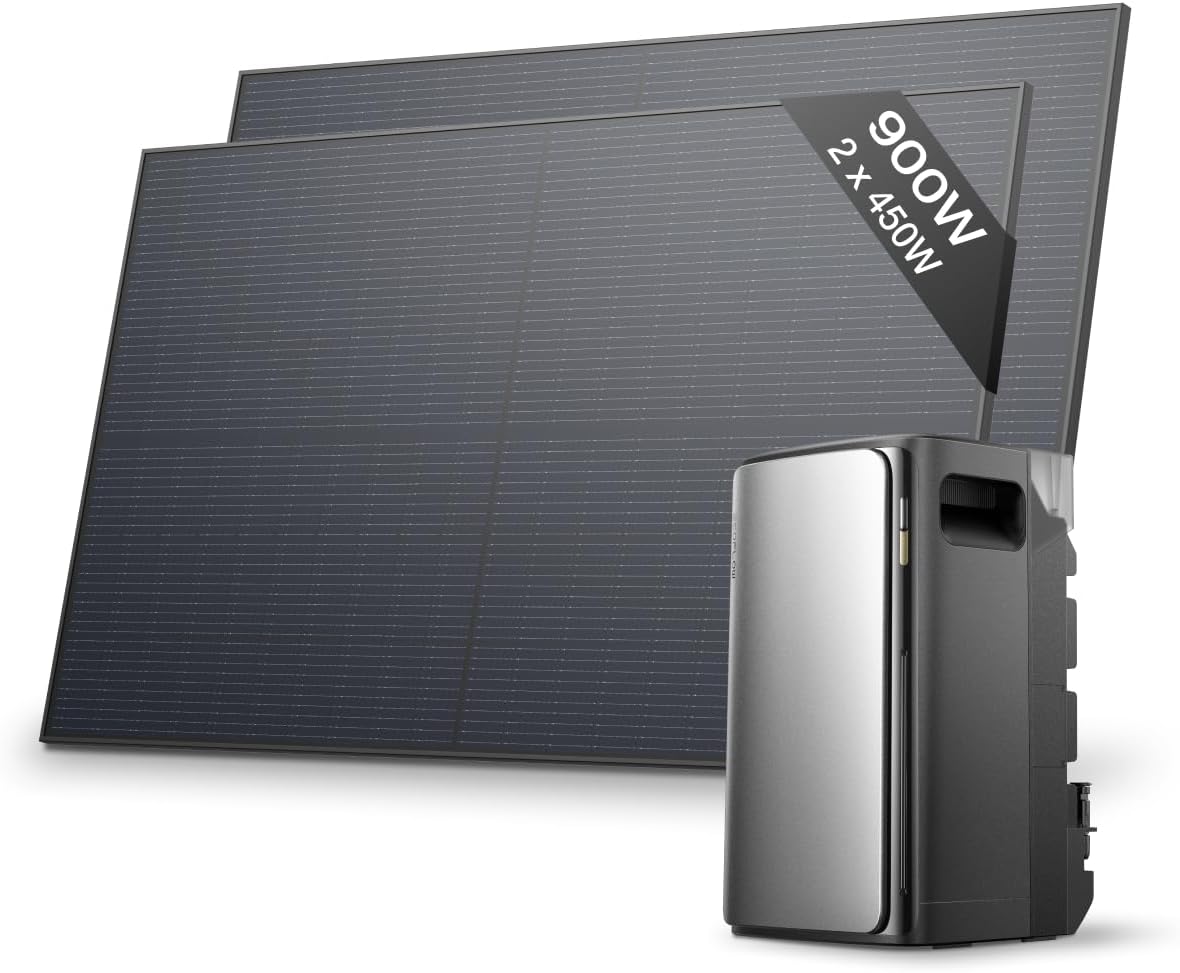
EcoFlow STREAM Ultra 1.92kWh

EcoFlow STREAM Ultra 1.92kWh

Maximum solar input with 4 MPPT channels. Best for properties with space for multiple panels and maximum daytime generation.

£1,299 May 2026
Check Price on Amazon
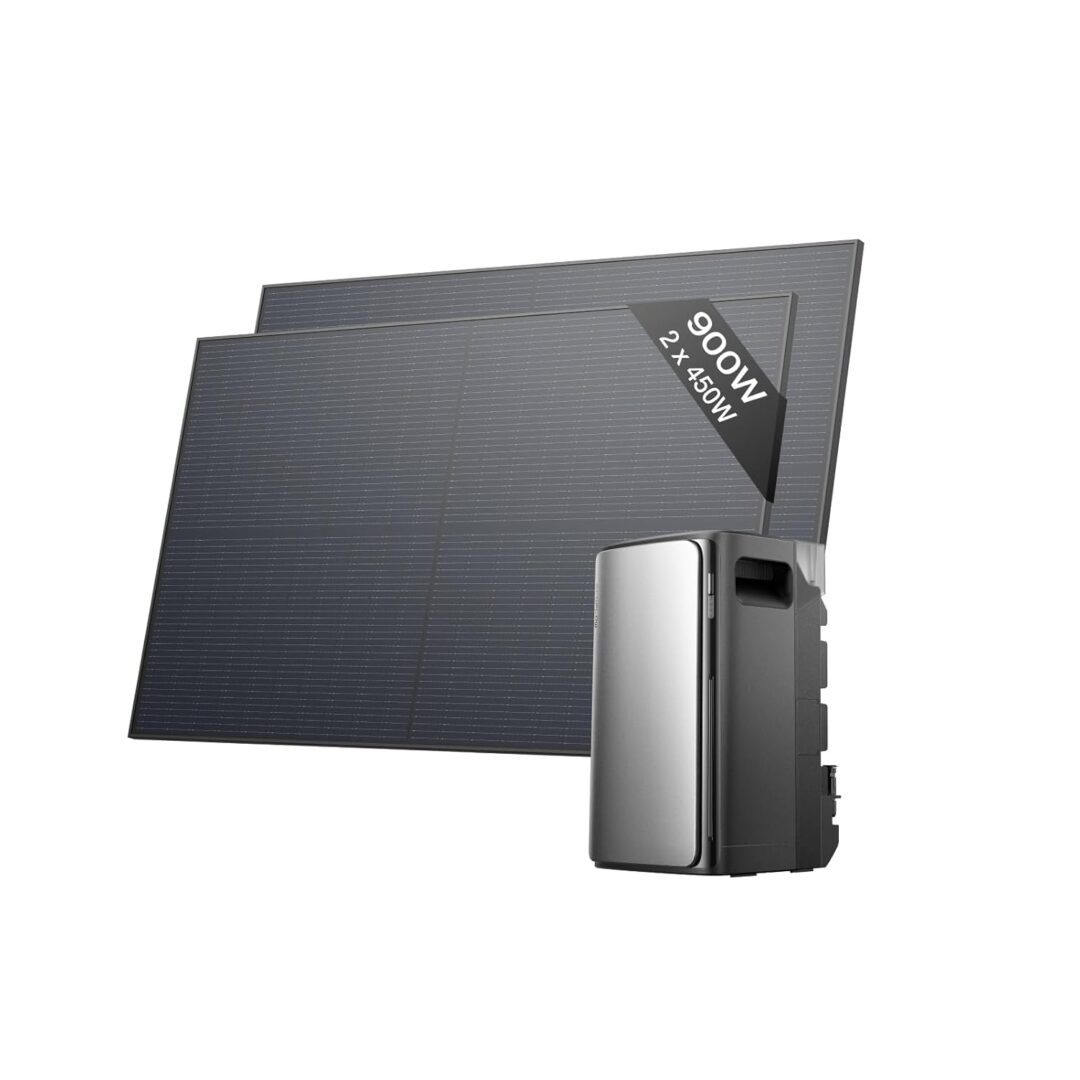
EcoFlow STREAM Max

EcoFlow STREAM Max

Highest AC output at 2300W for running power hungry appliances. Best choice for larger households with high daytime energy demand.

Currently Out of Stock
Check Availability on Amazon

The EcoFlow STREAM Range - Off-Grid Today, Grid-Tie Ready for July 2026

The EcoFlow STREAM range is the most advanced off-grid solar storage system available on Amazon UK today. All three units include LiFePO4 batteries, built-in micro-inverters and expandable storage. They work right now as standalone off-grid power systems - and when UK BSI certification arrives in July 2026 they are designed to become fully legal plug-in grid-tie systems without any hardware upgrade needed. That makes them the smartest buy-now, future-ready choice in this category.

ModelSolar InputBase StorageMax StorageAC OutputPriceStatus
STREAM Ultra2.8kW
(4 MPPT)
1.92kWh21kWh800W£1,299
May 2026
Off-grid today
Grid-tie July 2026
STREAM Pro
Editor's Pick
2.3kW
(3 MPPT)
1.92kWh11.52kWh1200W£899
May 2026
Off-grid today
Grid-tie July 2026
STREAM Max900W1.92kWh11.52kWh2300WOut of Stock
Check Amazon
Off-grid today
Grid-tie July 2026

Prices correct at May 2026. Always check current price on Amazon.

EcoFlow STREAM Ultra 1.92kWh

EcoFlow STREAM Ultra 1.92kWh

Maximum solar input with 4 MPPT channels. Best for properties with space for multiple panels and maximum daytime generation.

£1,299 May 2026
Check Price on Amazon
EcoFlow STREAM Max

EcoFlow STREAM Max

Highest AC output at 2300W for running power hungry appliances. Best choice for larger households with high daytime energy demand.

Currently Out of Stock
Check Availability on Amazon

Choosing Your Setup: Power Flow & System Sizing

A plug‑in solar system functions as a direct, real-time supplement to your home wiring with absolutely zero modification required to your existing consumer unit or main fuse board. 

The integration process follows a simple, automatic energy loop: your outdoor solar panels capture daylight and generate raw DC electricity whenever there is visible light—even under the heavily overcast, cloudy skies common during a British winter. 

This raw current flows down safe, weather-resistant cabling into your compact micro-inverter, which instantly transforms it into 230V AC electricity fully synchronized with the voltage and frequency of your household supply grid.

By plugging the micro-inverter directly into a standard 13A domestic wall socket, your home loop is supplied locally. Because this local solar electricity is physically closer to your appliances than the incoming power grid, your home automatically consumes the solar energy first. 

Any instant deficit is seamlessly topped up by the utility grid with zero disruption to your devices. However, any excess solar power generated beyond your home’s immediate background demand will leak back to the grid for free unless captured by a portable battery station.

System Size FootprintTarget Household ProfileTypical Annual Bill SavingsRealistic Payback Horizon
200W Micro Kit
(1 Compact Panel)
Low Baseload - Flats or small apartments empty during the day. £40 to £70 / year 4 to 6 Years
400W Entry Kit
(1 Large or 2 Small Panels)
Moderate Baseload - Standard terrace properties with steady smart setups. £80 to £120 / year 5 to 7 Years
600W Intermediate Kit
(2 Balanced Panels)
Steady Baseload - Average semi-detached running home office tech. £120 to £180 / year 3 to 5 Years
800W Maximum Appliance Kit
(2 Premium High-Power Panels)
High Baseload - Large families, active server loops, or high daytime energy uses. £180 to £240 / year 3 to 4 Years

Use out Power Calculator -
Check the Figures for Yourself


By entering your actual utility provider tariff rates and property layout, our system calculates your custom financial return on investment based on critical real-world efficiency factors:

  • System Size footprints: Toggle between a 200W Micro Kit, 400W Entry Kit, 600W Intermediate Kit, or a 800W Maximum Appliance Kit to see how much power your space can produce.
  • Property Orientation & Pitch Angles: Instantly factor in localized solar efficiency penalties for South, East/West, or North installations on pitched roofs, ground mounts, or vertical walls.
  • Target Household Baseload Profiles: See how your personal daytime energy consumption—whether you have a low baseload flat, a moderate terrace setup, a steady home office, or a high baseload battery storage system—directly impacts your annual solar bill savings and realistic payback horizon.
  • Adjust the input parameters on the calculator to discover your custom generation data and see how fast your plug-in solar kit will pay for itself

Plug-in Solar Savings Calculator

Estimate your annual savings with different panel configurations from 200W up to 800W. Based on regional UK production data models.

Est. Annual Generation 0 kWh
Est. Annual Savings £0.00
Payback Period 0 Years
Variable CategorySelection OptionModel Assumption ValueSource Baseline & Context
Base Regional YieldOptimal Location Baseline850 kWh per year per 1 kWpPVGIS European Database average for Central England.
System Hardware200W Micro Kit0.20 kWp (200W peak)Standard single compact or balcony solar panel.
System Hardware400W Entry Kit0.40 kWp (400W peak)Standard modern single large residential solar panel.
System Hardware600W Intermediate Kit0.60 kWp (600W peak)Standard dual balanced panel configuration setup.
System Hardware800W Maximum Kit0.80 kWp (800W peak)Standard dual premium high-power panel layout.
Directional ImpactSouth Orientation1.00 (0% penalty)Optimal baseline orientation for maximum solar capture.
Directional ImpactSoutheast / Southwest0.95 (5% penalty)Minor tracking loss based on morning/afternoon curves.
Directional ImpactEast / West Orientation0.85 (15% penalty)Reduced exposure curves outside peak noon generation windows.
Directional ImpactNortheast / Northwest0.75 (25% penalty)Heavy angle shadow penalties away from winter sun paths.
Directional ImpactNorth Orientation0.65 (35% penalty)Shaded/indirect ambient sky radiation baseline.
Tilt Angle ImpactOptimal 37.5°1.05 (5% production boost)The exact ideal peak angle for maximum UK annual generation.
Tilt Angle ImpactPitched Roof 20-30°1.00 (0% penalty)Ideal standard year-round architectural pitch for the UK climate.
Tilt Angle ImpactFlat / Ground Mount 0-10°0.90 (10% penalty)Lower angle tracking losses and standard panel dust settling.
Tilt Angle ImpactVertical Wall Mount 70-90°0.70 (30% penalty)Good winter sun tracking but heavy summer capture loss.
Home UtilizationLow Baseload40% of generation retainedFlats or small apartments largely empty during peak daytime hours.
Home UtilizationModerate Baseload50% of generation retainedStandard terrace properties with steady background appliance footprints.
Home UtilizationSteady Baseload65% of generation retainedAverage semi-detached homes running active daytime home office tech.
Home UtilizationHigh Baseload / Battery85% of generation retainedActive server loops or systems paired with a 2 kWh battery pack.
Utility BaselineStarting Electricity Rate24.5p per kWhMirrors the active Ofgem National Electricity Price Cap.

Who Stands to Gain the Most?

Plug‑in solar kits are uniquely accessible because they bypass the practical and financial hurdles of traditional rooftop installations [1.1]. They are specifically engineered to provide immediate value to four distinct target demographics:

Renters and Tenants Click to Open
Non-permanent mechanical frames allow you to deploy green energy loops on balconies or patios without altering the building structure. This gives you the total freedom to pack up and take the entire kit with you when your lease ends. While small kits fall squarely under UK Permitted Development rights, you must ensure your array does not physically project past defined property lines or cause structural boundary disputes with landlords.
Flat and Apartment Owners Click to Open
For leaseholders completely lacking roof access or scaffolding permissions, compact balcony rail mounts or fence-hung arrays offer a legal way to generate independent power locally. However, you must review your building leasehold bylaws first. Hanging heavy panels over external communal balcony railings typically requires formal management company sign-off to ensure communal safety compliance.
No-Roof Homeowners Click to Open
If your main property orientation suffers from heavy shade, complex hip roof shapes, or old structural rafters, you can bypass rooftop limits entirely by utilizing available space on a sunny shed, garage, or patio floor. Be brutal about shading risks - placing panels where overhanging trees or chimneys block direct southern sunlight during peak daylight hours will destroy your financial return.
Steady Daytime Households Click to Open
Properties running continuous background equipment such as remote work laptops, smart home servers, or medical care systems get the fastest financial return by consuming 100% of their generation instantly. If your home sits completely empty during the day with no base load running, your investment payback stalls because unused energy leaks to the grid with zero payment.

The Micro-Inverter Explained - How It Works and How It Connects

Solar panels generate DC electricity - the same type that comes from a battery. Your home runs on AC electricity - the type that comes from the wall. A micro-inverter is the small device that sits between your panels and your home circuit, converting DC into AC and synchronising it perfectly with your mains supply. Without it, your panels cannot power anything in your home.

How Power Flows Through a Plug-In Solar System

Solar PanelsDC electricity generated
Micro-InverterDC converted to 230V AC
Wall SocketStandard 13A plug connection
Home CircuitPowers your appliances first
Grid Top-UpAny deficit filled automatically

What to Look For When Buying a Micro-Inverter

SpecificationWhat It MeansWhat to Look For
Output PowerMaximum AC watts the inverter feeds into your home800W is the UK legal limit from July 2026
MPPT ChannelsNumber of independent panel inputs2 MPPT means 2 panels can face different directions independently
Anti-IslandingSafety cutoff if mains power failsMandatory - protects engineers working on the grid during outages
IP RatingWeatherproof protection levelIP65 minimum for outdoor UK installation
CertificationSafety and grid compliance standardVDE-AR-N 4105 now. UK BSI standard from July 2026
WiFi MonitoringApp-based real time performance trackingUseful but not essential - helps track output and identify faults
Important - UK Legal Position on Micro-Inverters

The micro-inverters below are available on Amazon UK today and are VDE certified for the German market. They can be used legally in the UK right now for off-grid applications - charging power stations and running isolated circuits. They cannot legally be plugged into your home mains circuit for grid-tie use until UK BSI certification publishes in July 2026. At that point, VDE certified inverters from established brands are expected to qualify automatically.

Micro-Inverters Available on Amazon UK Today
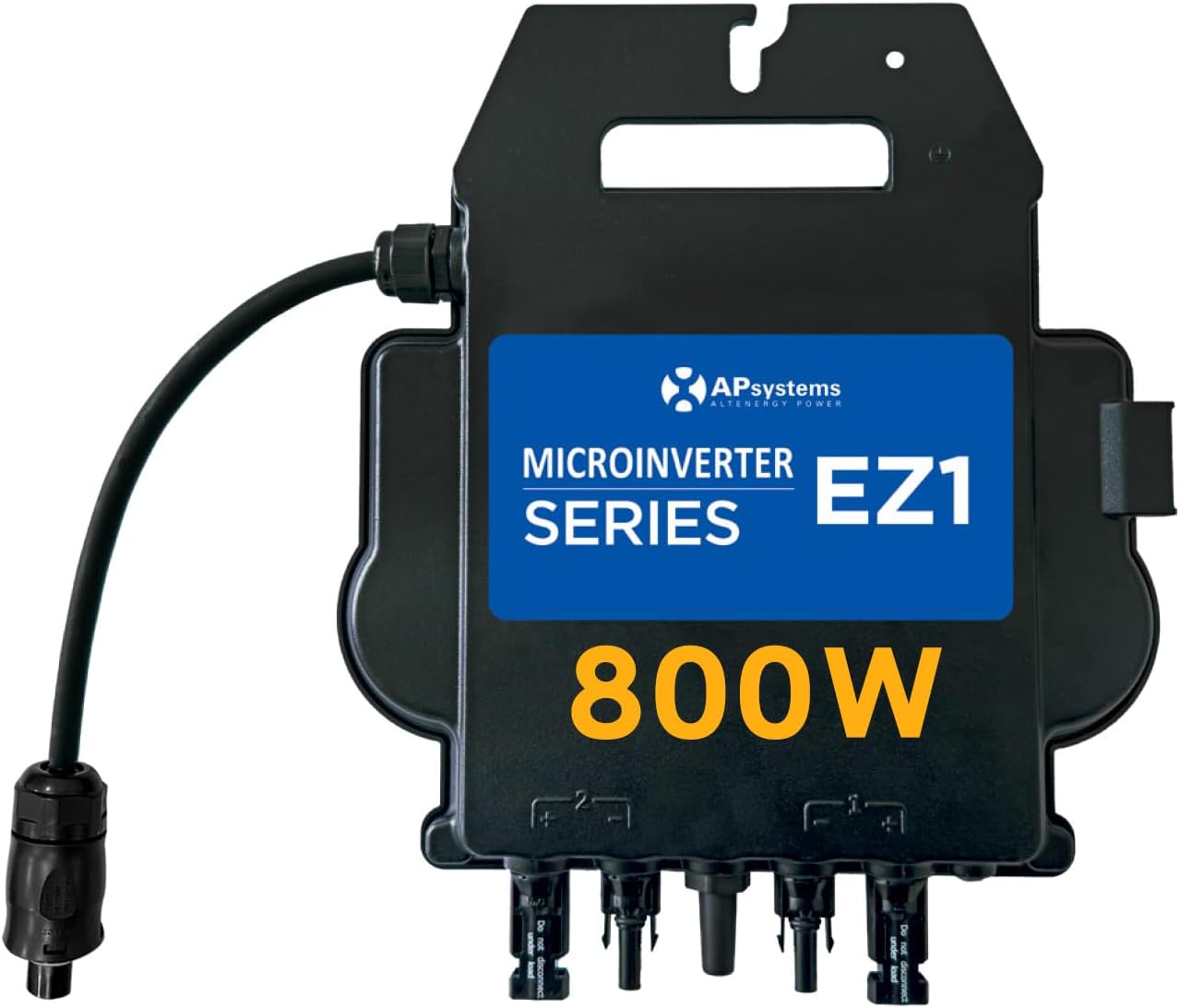
APsystems EZ1-M 800W micro-inverter

APsystems EZ1-M 800W

Industry standard micro-inverter used in thousands of German balcony installations. Dual MPPT, WiFi and Bluetooth monitoring, VDE certified. 12 year warranty. The most proven plug-in solar inverter available.
£120.40 May 2026
Check Price on Amazon
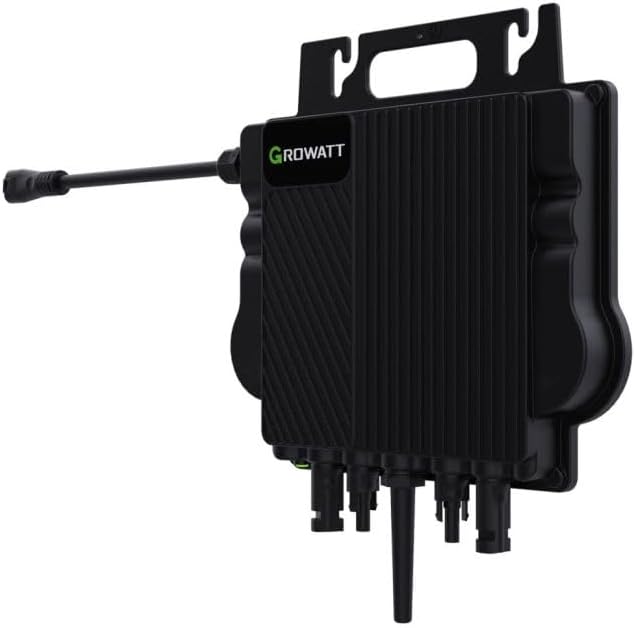
Growatt NEO 800M-X micro-inverter

Growatt NEO 800M-X

Popular alternative to APsystems with free app updates and dual MPPT. IP67 rated for full weatherproofing. Growatt is one of the largest inverter manufacturers in the world with a strong UK service network.

£123.89 May 2026
Check Price on Amazon

Before You Buy Anything - Your Fuse Box and Wiring Safety Check

Plug-in solar is genuinely safe when installed correctly. But before you spend a penny, spend five minutes checking your home's existing electrical setup. An older property with aged wiring or an outdated fuse box needs a quick check before you add any new load to a circuit - even a small one. This is not scaremongering. It is just common sense that could save you from a real problem.
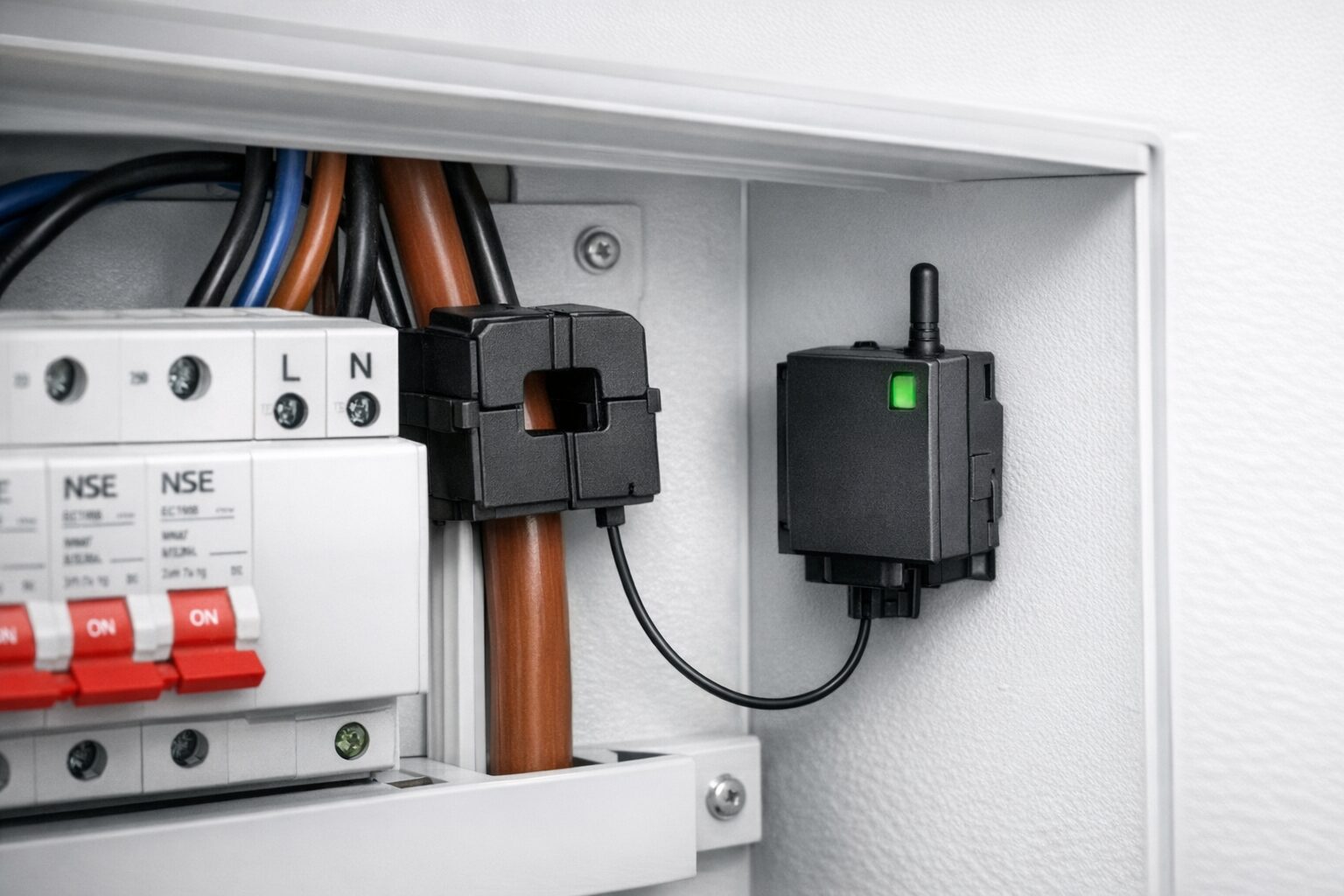
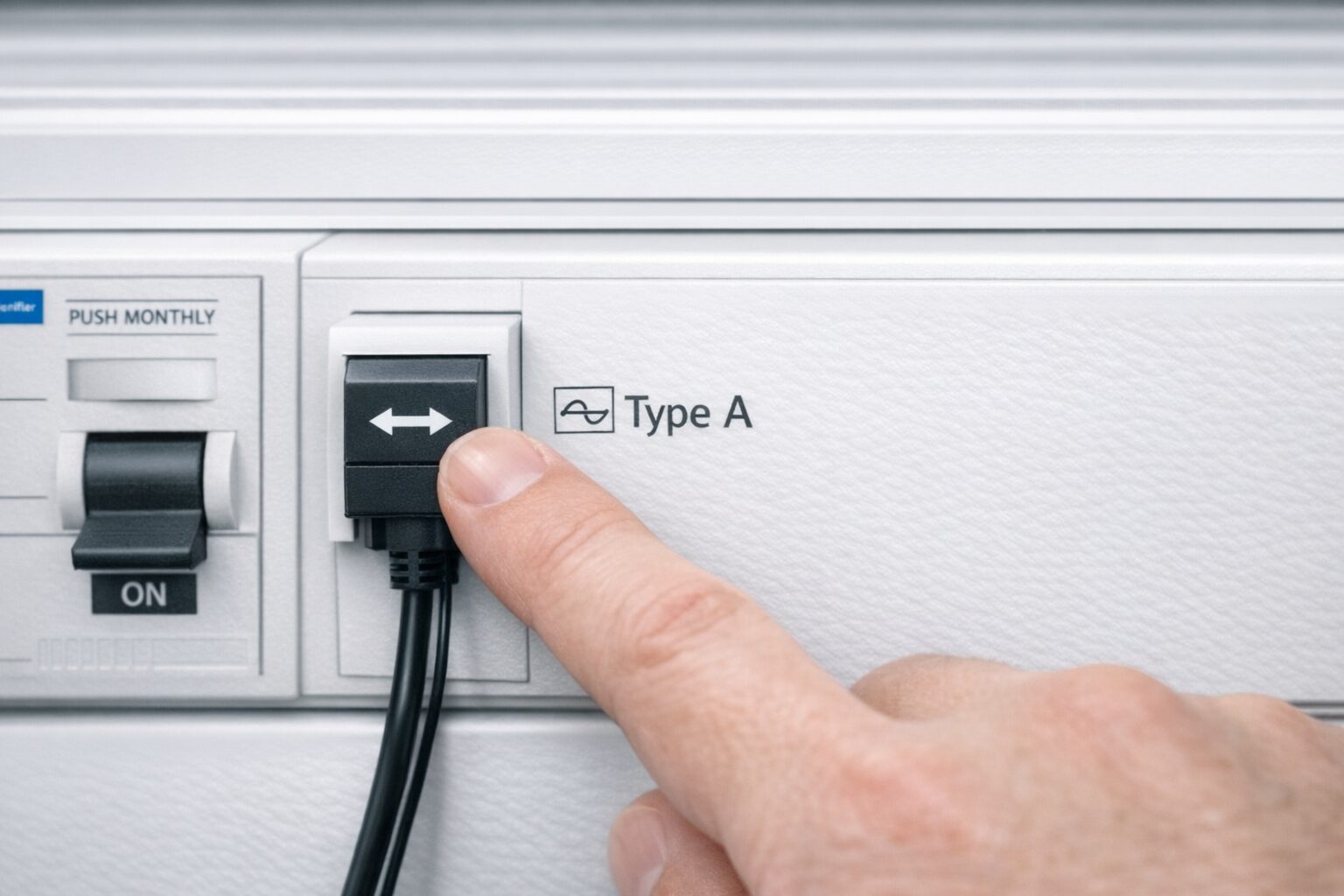
Modern consumer unit fuse box with RCD protection
Modern Consumer Unit - MCBs and RCD Protection
RCD residual current device protection
RCD - Residual Current Device - Essential Protection

What to Look For in Your Fuse Box

Open your consumer unit cover and look at what is inside. You are checking for three things - the type of protection fitted, the age of the unit, and whether your circuits are clearly labelled.

StatusWhat You SeeWhat It Means
GOModern consumer unit with MCBs and RCD or RCBO protectionYour home has up to date protection. MCBs are the small switches in a row. RCD is the wider switch usually labelled - it trips instantly if a fault is detected. You are good to proceed.
GOCircuits are clearly labelled - kitchen, lights, sockets etcYou can identify exactly which circuit your chosen socket sits on. This helps you avoid overloading a single ring main.
CHECKConsumer unit has MCBs but no visible RCD switchOlder but not dangerous. You have circuit breaker protection but no residual current protection. Adding an RCD is a straightforward job for an electrician and costs around £80 to £150. Worth doing before adding any new equipment.
CHECKSome circuits are unlabelled or labels are unclearNot dangerous but you need to identify your circuits before proceeding. Plug a lamp into the socket you plan to use and trip each MCB in turn until it goes off. Label it clearly before you start.
CHECKProperty built before 1990 with original wiringOlder wiring uses smaller cable cross-sections that can run warmer under continuous load. A plug-in solar system feeding continuously into an older socket is worth a quick visual check. Look for any discolouration around sockets or signs of heat damage on cables.
STOPOld ceramic fuse box with rewireable fusesThis is a pre-1960s installation. Do not add any new load to this system. Call an electrician before proceeding. Rewireable fuse boxes offer minimal protection and are a known fire risk under continuous load.
STOPAny signs of burning, scorching or melted plastic around sockets or the consumer unitDo not touch anything. This indicates a pre-existing fault. Call an electrician immediately - this is nothing to do with solar and needs fixing regardless.
STOPAluminium wiring - silver coloured cables rather than copperAluminium wiring was used in some UK properties in the 1960s and 1970s. It requires special consideration before adding any new load. Call an electrician for advice before proceeding.

Understanding Your Ring Main

What Is a Ring Main

Most UK homes have their sockets wired in a loop - the cable leaves the consumer unit, runs around the house connecting all the sockets, and returns to the consumer unit. This is the ring main. A typical ring main is protected by a 32A MCB and can handle up to 7,200W of total load across all sockets on that circuit.

Why It Matters for Plug-In Solar

A plug-in solar system feeds power into the ring main through a socket. It does not add load - it reduces it. Your solar system is effectively working in reverse, pushing power into the circuit rather than drawing from it. This is inherently safe on a modern ring main but it does mean you should always use a socket that is part of a properly protected ring circuit - not a spur or an extension lead.

Quick Pre-Installation Checklist

✓ Modern consumer unit with MCB protection
✓ RCD or RCBO protection fitted
✓ Circuits clearly labelled
✓ Socket is part of a ring main - not a spur
✓ No signs of heat damage or discolouration
✓ No extension leads in the connection path
✓ Outdoor socket is weatherproof rated if used
✓ Wiring is copper not aluminium

If you are in any doubt about the condition of your wiring or consumer unit, a single hour with a qualified electrician for a visual inspection costs around £60 to £100 and gives you complete confidence before you invest in any solar equipment.

Fire Risk, Electrocution Risk and Cable Safety - What You Must Know

Plug-in solar systems are genuinely low risk when installed correctly. They operate on low DC voltages with short cable runs - very different from a full rooftop system. But low risk is not zero risk. These are the specific hazards to understand before you connect anything.

Fire Risk - What Causes It

Extension leads are the single biggest fire risk in plug-in solar. Running continuous solar feedback current through a standard multi-plug extension creates severe electrical resistance and localised heat. Never use an extension lead. Always connect directly to a permanent wall socket.

Uninsulated or mixed connectors allow water ingress which triggers short circuits. Always use factory-sealed MC4 locking connectors for all outdoor wiring. Never mix connector brands.

Damaged insulation from wind friction on loose cables can cause shorts over time. Secure all outdoor cable slack with UV-stabilized zip ties anchored firmly behind your panels.

Electrocution Risk - What Causes It

Back-feeding a battery incorrectly is the most dangerous installation error. Never connect the AC output of a micro-inverter into standard storage sockets to force-charge a battery. Unsynchronised AC current causes immediate catastrophic inverter blowout and can melt component hardware.

Missing anti-islanding protection is a serious risk to utility engineers. If your inverter does not cut out when mains power fails, live current can back-feed into the grid. Always verify your inverter carries G98 certification and built-in anti-islanding protection.

Non-weatherproof installations create shock risk over time. Your micro-inverter must carry IP65 minimum rating. Any outdoor socket used must be weatherproof rated.

Technical Safety, Quality and Warranty - Six Point Guide
  1. Outdoor Cabling and Low Fire-Risk Logic Always use factory-sealed heavy-duty MC4 locking solar connectors for all outdoor transmission lines. Plug-in solar systems carry an exceptionally low inherent fire risk because they operate on low DC voltages with short cable runs. However, water ingress from uninsulated connections or loose wiring can still trigger short circuits. Use UV-stabilized zip ties to secure all cables firmly behind your panel frames.
  2. Mains Socket Connections and Extension Restrictions Your micro-inverter must connect directly into a dedicated permanent outdoor socket or a primary household wall outlet. Strictly avoid standard multi-plug household extension leads. Forcing high-wattage continuous solar feedback current through standard indoor extension paths creates severe electrical resistance, component melting and localised fire hazards.
  3. Micro-Inverter Engineering Compliance and Casing Ensure your micro-inverter carries full G98 certification. Certified hardware includes four built-in automatic safety protections - over-voltage, over-current, temperature protection and anti-islanding cutoff. If your home loses grid power during an outage, the inverter turns off within milliseconds to protect engineers on external lines. The housing must carry IP65 or higher weatherproof rating with integrated cooling channels.
  4. Battery Integration - The One Rule You Must Not Break When pairing panels with a portable power station, your panels must connect directly to the power station's dedicated DC solar input ports. Never attempt to connect the AC output of a micro-inverter into standard storage sockets to force-charge a battery. Back-feeding unsynchronised AC current causes immediate catastrophic inverter blowout and melts component hardware.
  5. Hardware Warranty Lifespans and Void Triggers Premium solar panels carry a 10 to 25-year linear performance warranty. Micro-inverters carry a 5 to 12-year manufacturer warranty. Your coverage is instantly voided by pinched cable connections, continuous moisture into plug seals, use of uncertified third-party components or heavy structural bending stress to the panel frame.
  6. Routine Visual Audits and Maintenance Conduct a visual inspection at least twice a year. Check that all mounting frames and rail brackets remain tight and unshifted by seasonal winds. Keep panel faces clear of heavy dust and bird droppings as surface dirt shadows individual cells and cuts output. If you are installing into an older property with aged ring mains, pay a qualified electrician to inspect your local socket conditions before powering up for the first time.
Quick Cable Safety Checklist
  • Use Certified MC4 Connectors Only - Always use factory-sealed locking connectors. Water ingress triggers direct short circuits.
  • Never Use Standard Extension Leads - Plug your inverter directly into a dedicated wall outlet to avoid fire risk.
  • Verify G98 Engineering Compliance - Guarantees automatic anti-islanding protection to keep grid engineers safe.
  • Secure All Outdoor Cable Slack - Anchor loose wires with UV-stabilized zip ties to prevent insulation tearing.
  • Conduct Regular Visual Audits - Inspect mounting brackets and cells twice a year for structural movement.

What You Can Buy on Amazon UK Today - Off-Grid Solar That Works Right Now

You do not need to wait for July 2026 to start generating your own solar power. Every product below works today, legally, without an electrician and without touching your fuse box. They generate solar power and store it in a battery. You plug your appliances directly into the unit and use that power straight from the battery. To be clear - these systems do not plug into your home mains circuit. That is the plug-in grid-tie step that becomes legal in July 2026. What these do right now is give you clean, free solar power wherever you need it.

Budget Entry - Panels Only

The lowest cost way to start generating solar power today. Panels and charge controller included. No battery - pairs with any 12V leisure battery you already own or purchase separately.

ECO-WORTHY 240W solar panel kit

ECO-WORTHY 240W Solar Panel Kit

2x120W mono panels, 30A PWM charge controller, Z brackets and extension cables included. Generates approximately 0.96kWh per day. Perfect starting point for a shed, garage, small cabin or boat. Add a leisure battery and you have a complete off-grid setup for under £250 total.

£149.99 May 2026
Check Price on Amazon
Complete Off-Grid Kits - Panels, Battery and Inverter Included

Everything in one box. Fixed installation kits for sheds, garages, garden offices, boats and motorhomes. Best daily output per pound spent.
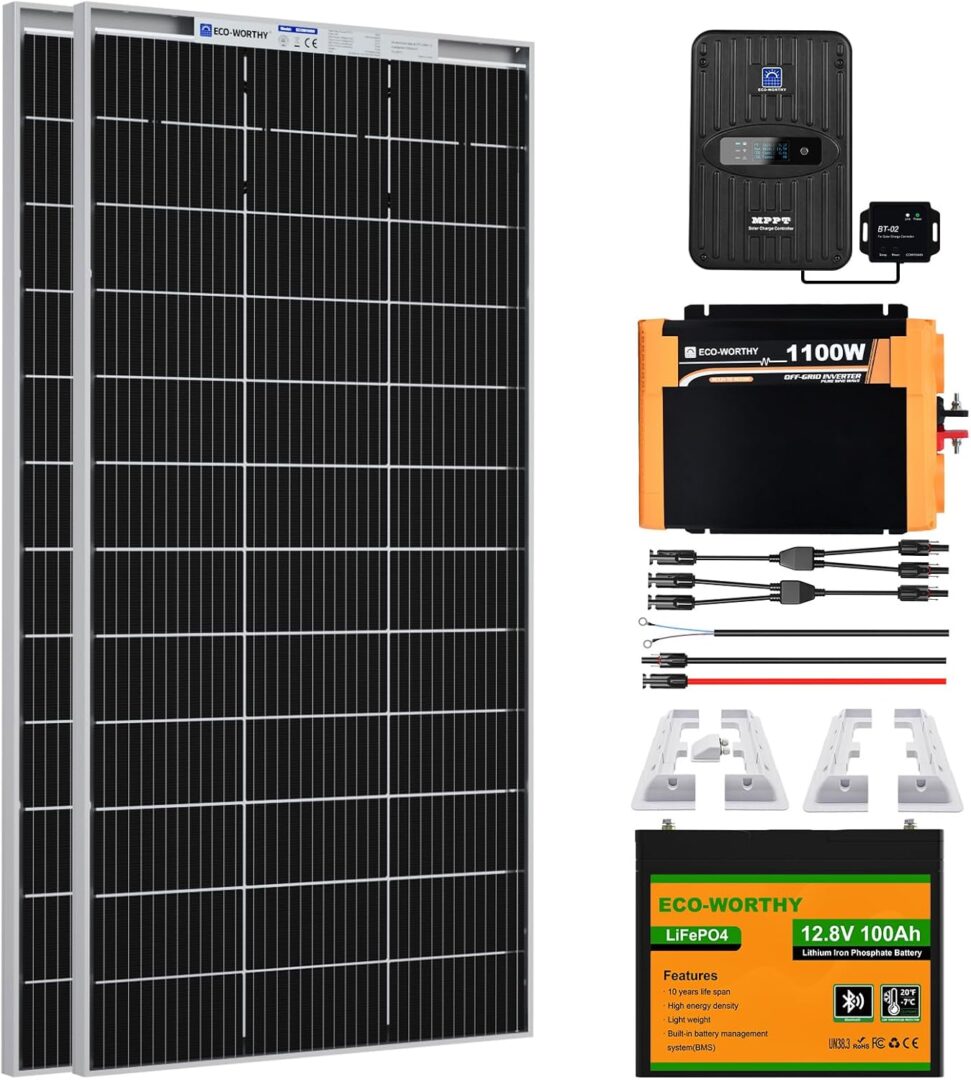
ECO-WORTHY 390W off-grid solar kit with battery

ECO-WORTHY 390W Complete Kit

2x195W bifacial panels, 100Ah LiFePO4 battery, 40A MPPT controller and 1000W inverter. Generates 1.56kWh per day. Complete off-grid solution for home backup, motorhomes and boats.
£649.99 May 2026
Check Price on Amazon
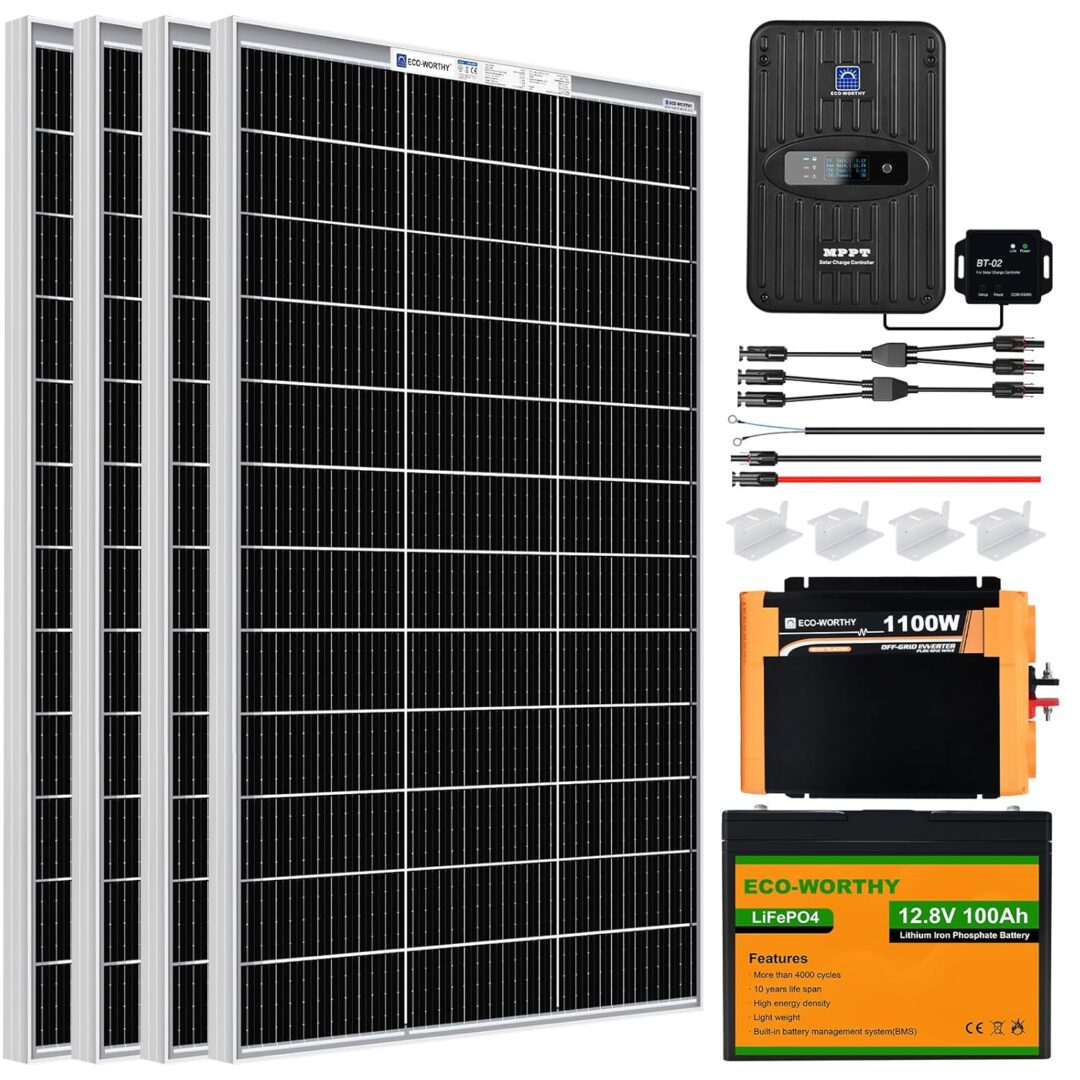
ECO-WORTHY 480W bifacial solar kit

ECO-WORTHY 480W Bifacial Kit

4x120W bifacial panels, 100Ah LiFePO4 battery, 40A MPPT controller and 1100W inverter. Generates 2kWh per day. Bifacial panels capture reflected light for up to 20% more output.
£659.99 May 2026
Check Price on Amazon
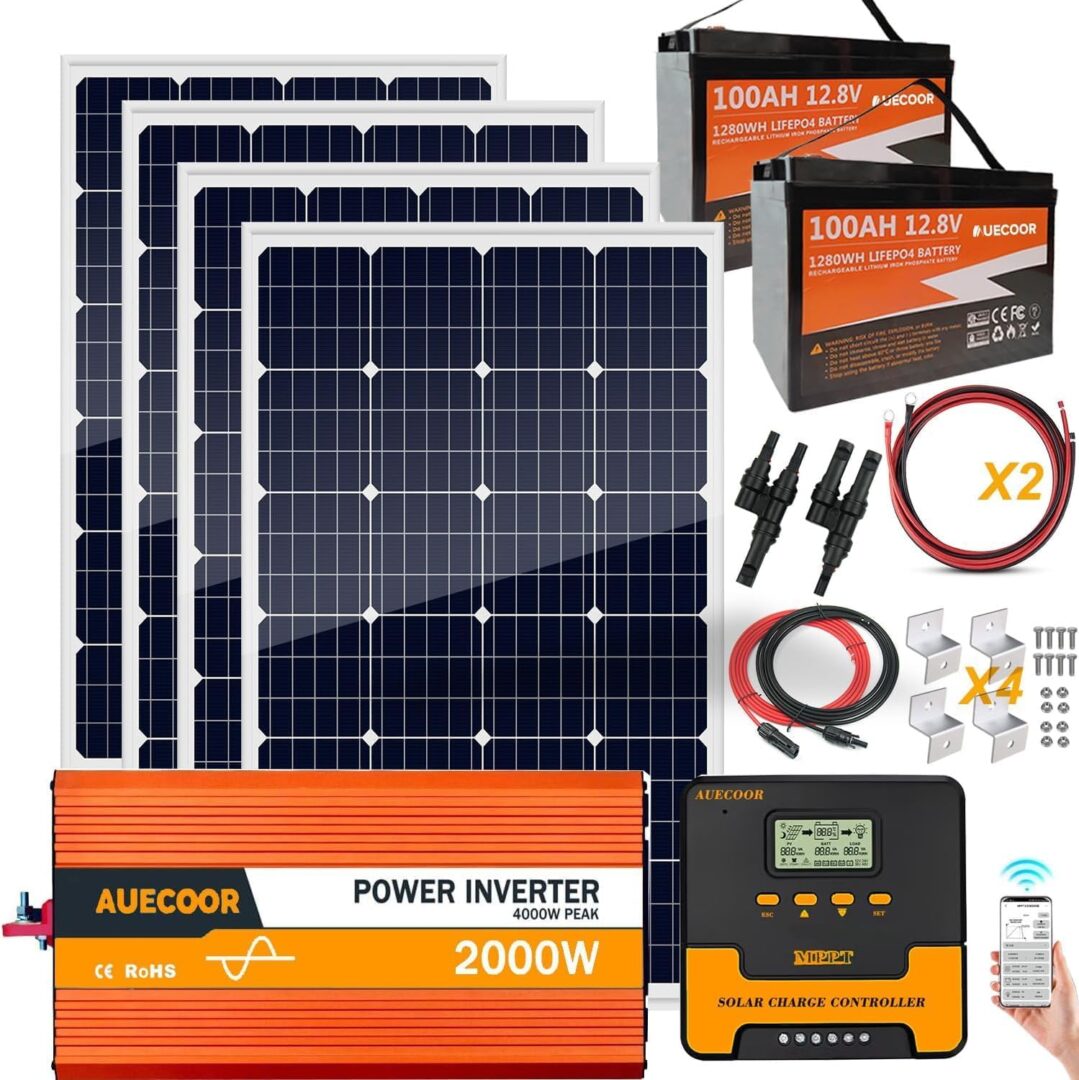
AUECOOR 1.92kWh complete RV solar kit

AUECOOR 1.92kWh Complete RV Kit

4x120W mono panels, 2x100Ah LiFePO4 batteries, 2000W inverter and MPPT controller. Double the battery storage of the 390W and 480W kits. Best choice for serious off-grid use.

£849.00 May 2026
Check Price on Amazon
Portable Power Stations - Take Your Solar Anywhere

All-in-one portable units with built-in battery, inverter and solar input. No fixed installation needed. Use indoors, outdoors, in the garden, on a campsite or as home backup during a power cut.
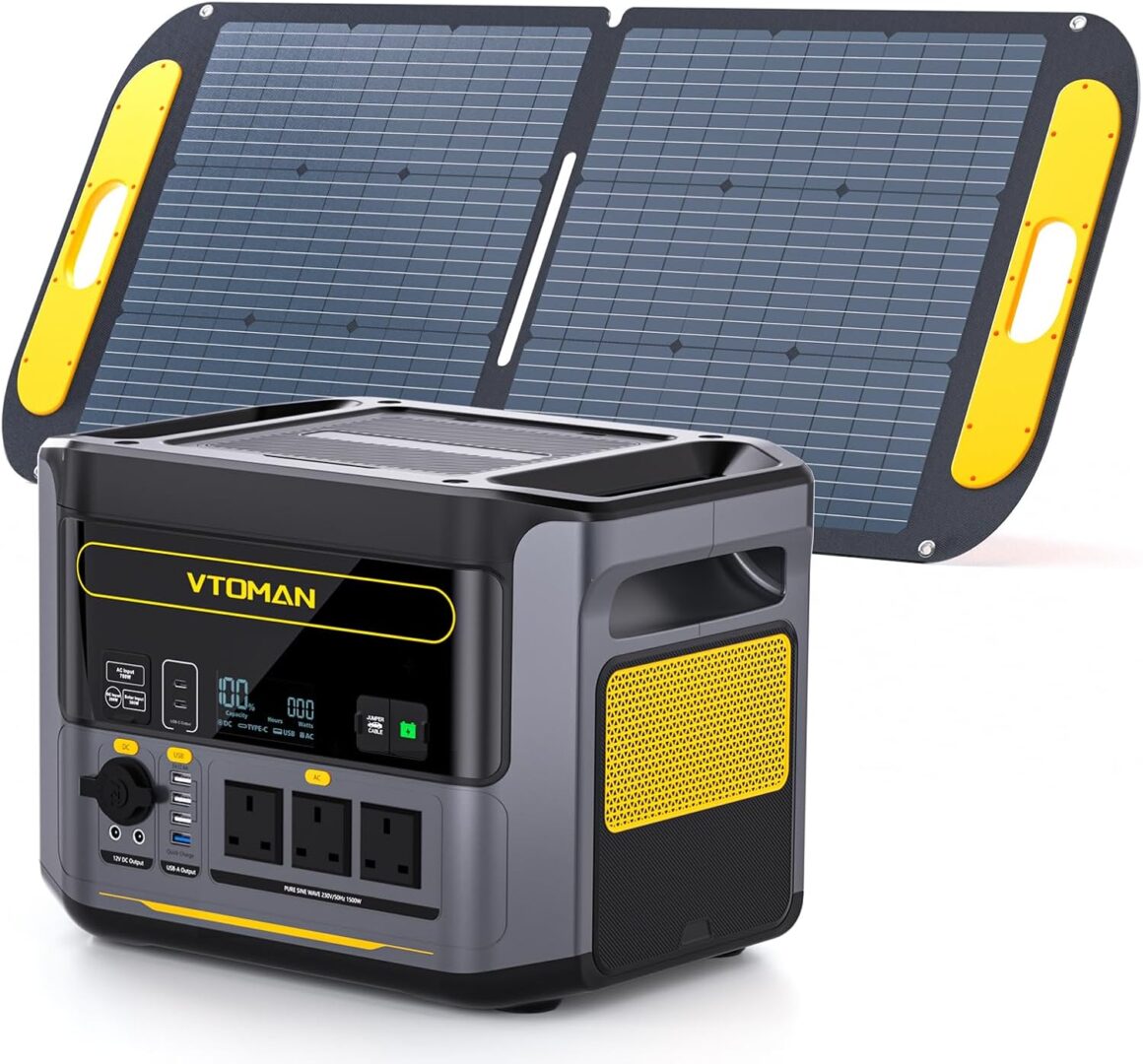
VTOMAN 1000W solar generator with 110W panel

VTOMAN 1000W + 110W Panel

828Wh LiFePO4 battery, expandable to 2376Wh. 0-80% charge in one hour. 2000W peak AC output. Compact entry level bundle with 110W panel. Best for camping and light backup use.
£469.99 May 2026
Check Price on Amazon
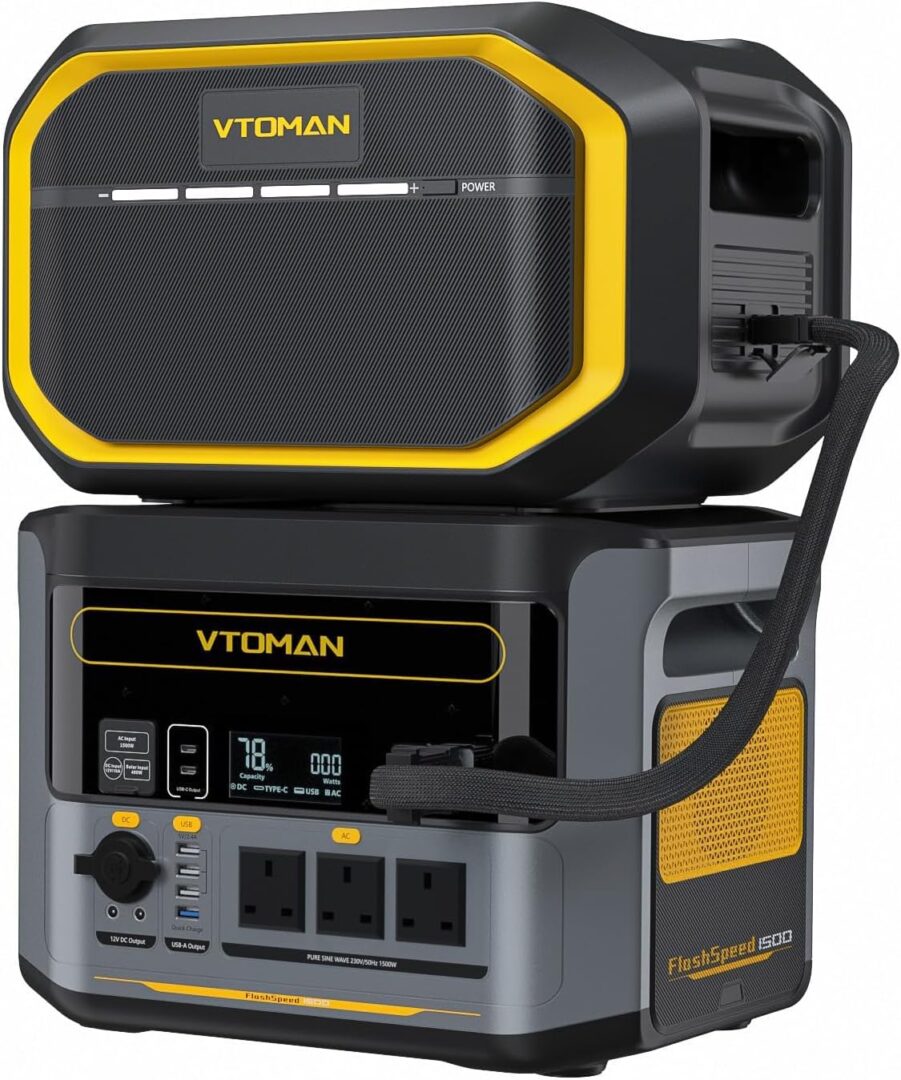
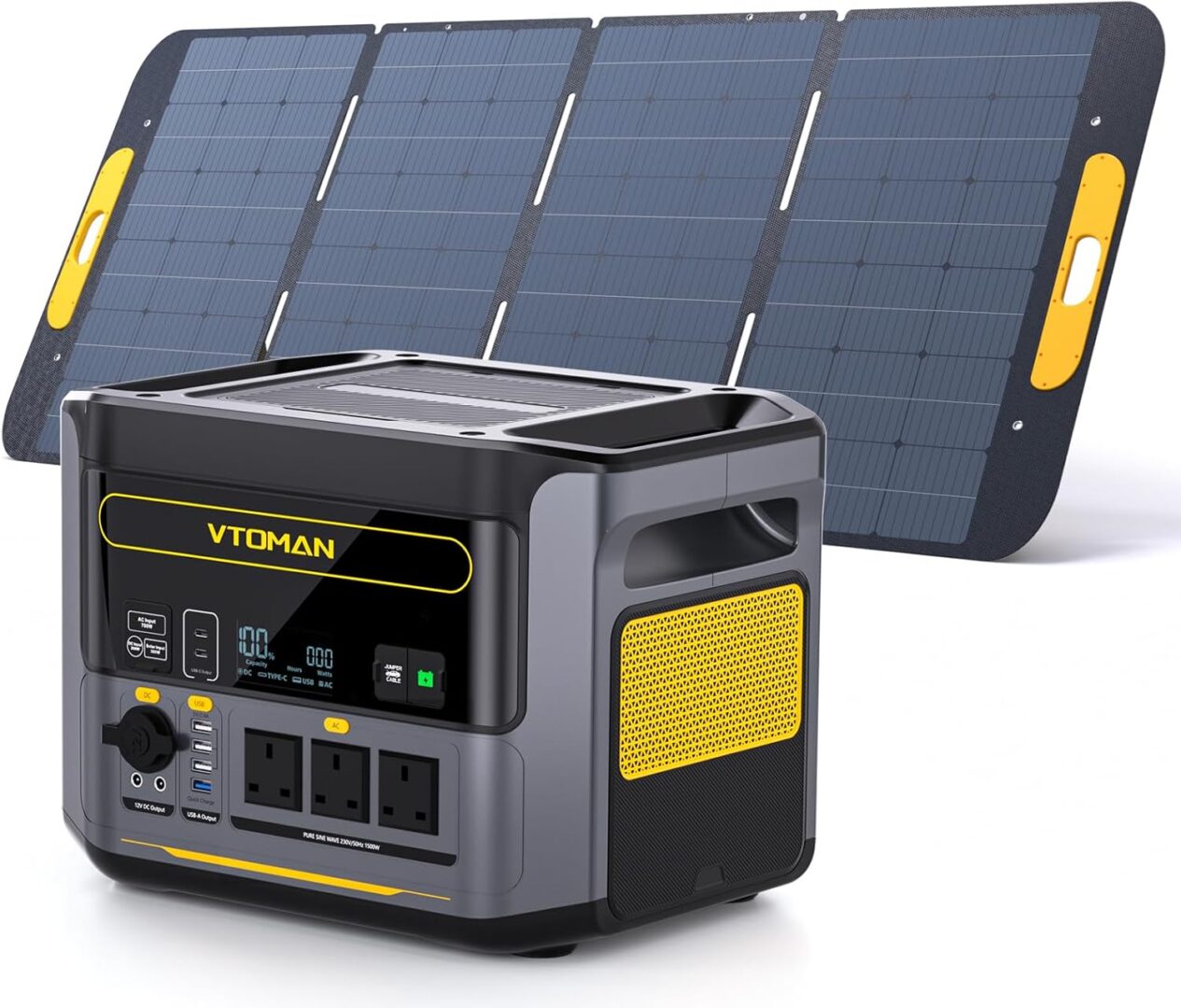
VTOMAN FlashSpeed 1500 portable power station

VTOMAN 1000W + 400W Panel

1548Wh LiFePO4 battery, expandable to 3096Wh. 0-80% charge in one hour. 3000W peak AC output. Heavy-duty expandable bundle with 12 outputs. Best for home outages and camping use

£769.99 May 2026
Check Price on Amazon

Brands to Watch for the UK Launch

These are the three German market brands most likely to arrive in the UK when BSI certification publishes in July 2026. None are on Amazon UK yet but all have active European operations and established product ranges. Bookmark their websites now - they will almost certainly be the first to announce UK availability.

MARSTEK

Founded 2009 - Energy Storage Specialist
One to Watch

MARSTEK has been manufacturing energy storage systems since 2009 and launched the MARSTEK brand in 2020 when founder Peter developed their own lithium iron phosphate laminate cells. They claim to have launched the world's first home micro-solar battery storage system and have been active at major European solar exhibitions throughout 2025 and 2026 including Solar Solutions Amsterdam.

Their current range covers the B2500 balcony storage system, the Jupiter C and Jupiter C Plus all-in-one units, and the VENUS range of wall-mounted home storage systems. The marstek.eu website is currently showing a "big change is coming" teaser screen which strongly suggests a UK market announcement is imminent.

MARSTEK products sell out rapidly on Amazon Germany. Check marstek.eu directly for current stock and any UK launch announcements.

SUNSHARE

Founded 2023 - Backed by Sungrow
Sungrow Backed

SUNSHARE is a young brand but carries serious industrial weight behind it - it was founded in 2023 as a dedicated balcony solar division of Sungrow, one of the world's largest inverter manufacturers with over 25 years of solar industry experience. That backing means SUNSHARE has access to manufacturing scale, quality control and distribution infrastructure that most newer brands simply do not have.

Their Ray Lite range is currently one of the bestselling balcony solar kit lines on Amazon Germany, available from €223 for a 400W entry system up to €349 for a full 800W kit with bracket. Their newer Glory range introduces semi-solid state battery technology borrowed from the EV industry - a genuine technical step forward for home storage safety.

SUNSHARE has been showcasing at major European trade shows including Solar Solutions Dusseldorf and IFA Berlin. A UK launch backed by Sungrow's European distribution network would be straightforward to execute.

Solarway

Founded 2007 - European Service Network
Established Brand

Jiaxing Solarway New Energy Co. has been manufacturing solar off-grid power conversion equipment since 2007, making them one of the more established manufacturers in this sector. They are headquartered in Zhejiang Province, China, with a dedicated after-sales service centre in Leipzig, Germany - a meaningful commitment to the European market that goes beyond simply listing products on Amazon.

Their current bestseller on Amazon Germany is the Solarway 890Wp kit - 2x445W bifacial panels with a Hoymiles HiFlow 800W inverter at €369.99. The bifacial panel specification and Hoymiles inverter pairing is a strong combination. The use of the market-standard Hoymiles HMS-800W inverter rather than a proprietary unit is a sensible choice that gives buyers access to Hoymiles' established support network.

With seven years of European market experience and an established German service operation, Solarway is well positioned to move into the UK market quickly once BSI certification is in place.

Want to know the moment UK certified systems go on sale? Sign up below and we will email you as soon as BSI certified plug-in solar systems arrive on Amazon UK. One email. No spam.

Plug-In Solar Frequently Asked Questions

Plug‑in solar systems make the absolute most sense for households wanting predictable daytime bill savings with minimal upfront installation effort and maximum long-term flexibility [1.1]. If you are a renter who wants to take your solar kit with you when you move, or a flat owner lacking scaffolding roof access, these standalone consumer appliances offer an ideal entry point into clean generation [1.1]. To clear up common grid connection, legal boundaries, and hardware setup queries, review our comprehensive answers below [1.1].

Get legally accurate answers regarding grid compliance, safety regulations, and hardware boundaries in the UK.

Q1. Is plug‑in solar legal in the UK in 2026?

No, plugging a commercial solar kit directly into a standard 13A household wall socket to feed power back into your home is currently illegal in the UK.

While European countries like Germany permit over-the-counter balcony kits up to 800W, British Wiring Regulations (BS 7671) strictly forbid connecting any power-generating inverter to a standard domestic ring main via a standard plug loop. Forcing feedback current backward through a standard socket introduces serious electrical overload risks, violates the Electricity Safety, Quality and Continuity Regulations, and will instantly void your home building insurance.

To operate a small-scale generation kit legally and safely in the UK, the inverter cannot use a standard wall plug. It must be permanently hard-wired into its own dedicated radial circuit and independent circuit breaker inside your main consumer unit by a qualified electrical contractor, followed by an official G98 notification filing with your Distribution Network Operator (DNO).

Q2. Do I need to notify my DNO (Distribution Network Operator)?

Yes, you must notify them, but it is a simple post-installation administrative filing under the UK G98 "De Minimis" engineering rules. Because generation systems under 800W do not threaten wider network stability, you do not need to seek advance permission or pay administrative fees prior to setting up your hardware. Instead, you simply complete a basic online form to inform your local utility network operator within 30 days of powering up the system. Running an unregistered grid-tied system is highly discouraged as it impacts local grid balancing calculations.

Q3. Can I get paid for excess energy exported to the grid (SEG)?

No, DIY plug-in kits do not qualify for Smart Export Guarantee (SEG) cash payments from energy suppliers. UK regulations state that to secure an active SEG export contract, the generation hardware must carry a formal installation sign-off certificate issued by an MCS-certified technician. Because plug-in kits are consumer-installed appliances, any unused solar electricity overflows back through your smart meter onto the external grid lines for free. This reality makes accurate baseload matching essential.

Q4. Do plug‑in solar kits work during a grid power cut?

No, these systems cannot provide emergency power backup during a domestic blackout. Grid-tied micro-inverters rely entirely on built-in anti-islanding safety features to function. If the primary incoming utility grid drops voltage, the micro-inverter automatically shuts down its output circuit within milliseconds. This mandatory protection prevents the system from accidentally back-feeding live solar current down the street lines, safeguarding utility engineers who are physically handling grid wires to make repairs.

Q5. Can I plug a solar kit into an outdoor extension lead?

Absolutely not. This is a vital physical safety constraint that must never be broken. Running a continuous high-wattage solar generation loop through loose, multi-plug extension blocks or unspooled reel cables introduces severe electrical resistance. This localized resistance leads to extreme component heat buildup, wire casing degradation, and a direct domestic fire hazard. The inverter cable must be connected directly into its own dedicated radial circuit termination point.

Q6. Can I add a portable battery storage unit later?

Yes, premium plug-in ecosystems are fully modular and built to scale over time. You can deploy a standalone panel kit initially to offset immediate daytime imports, and later route those same panel lines directly into a compatible hybrid battery station (like an EcoFlow Delta configuration). The station stores your daylight surplus and passes it through the micro-inverter into your home ring main during the evening, significantly improving your financial return.

Q7. Do I need permission from my landlord or freeholder?

If you do not own the freehold of the property, you must cross-reference your active tenancy agreement or leasehold bylaws. While non-invasive garden patio frames do not modify the building's physical masonry structure, hanging heavy solar arrays over the external edge of communal balcony railings or shared shared structural walls typically requires formal landlord or property management group sign-off to ensure communal liability compliance.

Q8. How long do these plug‑in hardware systems last?

Commercial-grade hardware bundles built with robust tempered glass faces and heavy anodized aluminum support rails carry structural lifespans ranging from 15 to 25 years. Micro-inverters are rugged, solid-state electronic devices featuring zero moving parts to wear out; they typically come backed by extensive manufacturer product warranties lasting between 5 and 12 years, providing long-term operational peace of mind.

Q9. Will a plug‑in kit completely clear my electricity bill?

No, a plug-in solar kit capped at the legal 800W ceiling is strictly designed to target, suppress, and displace your household's baseline daytime energy imports. While it handles background appliances like routers and fridges perfectly, it lacks the massive current capacity required to power heavy domestic heating elements, including electric ovens, power showers, kettles, or tumble dryers, which will continue to pull additional top-up power from the main grid loop.

Q10. What happens to the power if I am not using it?

Get Notified When UK Plug-In Solar Arrives

BSI certified plug-in solar systems are expected on sale in the UK from July 2026.

We will send you one email the moment certified systems go on sale on Amazon UK. No spam. No newsletter. Just the one notification you actually want.

By signing up you agree to receive one notification email from Gemshore. You can unsubscribe at any time. Your data is handled in accordance with our privacy policy.

Explore Our Power Guides

Plug-in Solar & Heat Pump Savings Calculator

Estimate your annual solar savings, and see the real running cost of a heat pump against gas, oil, LPG, or electric heating, based on what you actually spend now.

This slider estimates generation from panel wattage. The kits below are the real off-grid solar and battery kits currently available, sized differently to this estimate. Check each listing for full specs.

Est. Annual Generation 0 kWh
Est. Annual Solar Savings £0.00
Solar Payback Period 0 Years

Off-Grid Solar Kits Available Now

These kits charge from the sun for camping, backup power and portable use. Plug-in solar is not yet legal to connect directly to UK household wiring while the BSI standard remains unconfirmed.

Plug-in solar kits are shown for off-grid and portable battery charging. Connecting a plug-in solar system directly to UK household wiring is not yet legal, as the BSI standard has not been confirmed at time of writing. Boiler Upgrade Scheme figures confirmed by the Department for Energy Security and Net Zero, 26 June 2026. The £9,000 oil and LPG rate applies to vouchers claimed between 21 July 2026 and 31 March 2027. Gas and electric heating households remain on the standard £7,500 rate. Heat pump running costs assume a coefficient of performance of 3.2, gas boiler efficiency of 85%, oil and LPG boiler efficiency of 88%, and typical UK fuel prices of 6.3p/kWh for gas and an averaged 7.5p/kWh for oil and LPG. These are representative estimates, not a property-specific quote, and do not account for individual heat loss, radiator sizing, or flow temperature. Speak to an MCS-certified installer for an exact figure. This calculator does not reflect any proposed future policy that has not yet been confirmed.

What Nesta's own numbers actually show

Nesta modelled the bill impact of solar, battery storage and heat pumps back in January 2026, using April 2026 forecast prices. The pattern holds regardless of which reforms land when. Every low carbon combination beats a standard dual fuel home on a standard tariff.

Household setupAnnual billSaving vs dual fuel
Dual fuel, standard tariff£1,668
Heat pump only£1,387£281
Solar only£1,047£621
Solar and battery£919£749
Heat pump and solar£721£947
Heat pump, solar and battery£667£1,001

Source: Nesta, 20 January 2026. Modelled for a medium 2 to 3 bedroom home, April 2026 forecast prices.

The heat pump only row is the one worth sitting with. Adding a heat pump on its own saves £281 against a gas boiler, but it is the smallest saving on the table. Add solar to the same heat pump and the saving triples to £947. That is not a coincidence. A heat pump is the single biggest new electricity load most homes will ever add, and solar is what lets you generate a meaningful share of that load for free instead of buying all of it from the grid.

What Nesta is now asking Burnham's team to do

On 18 July 2026, the day Burnham became Labour leader, Nesta published new analysis aimed directly at his incoming team. Four measures, they say, would cut the typical bill by £130 a year and push the electricity to gas price ratio down from 3.56 to a historic low of 2.73, low enough to make heat pumps the cheaper option on the market.

MeasurePrice ratioAnnual saving
Status quo3.56
Abolish gas standing charge3.18£22
+ Remove remaining RO and FiT levies2.98£64
+ Reduce VAT on electricity to zero2.84£103
+ Forgive electricity debt (all four)2.73£130

Source: Nesta, 18 July 2026. Modelled using the Ofgem price cap for July to September 2026. Proposal under consideration, not confirmed policy.

Only the first measure, abolishing the gas standing charge, costs the Treasury nothing and could plausibly appear in an early announcement. The three measures that actually reduce the price of electricity, and therefore make heat pumps cheaper to run, cost £3.2 billion a year and are more likely to wait for the autumn budget.

Why cheaper electricity does not undercut solar

If electricity gets cheaper, does self-generated solar power become less valuable? A little, per unit. But the reforms Nesta is proposing are specifically designed to push more households onto heat pumps, and a heat pump is a bigger electricity load than almost anything else in a typical home. More demand in the house means more of your own solar generation gets used directly instead of exported for a lower rate. The table above already shows this in practice. That is why the heat pump and solar combination saves £947 a year, not the £281 plus £621 you would get by simply adding the two savings together.

Get ready for the demand, today

Full plug-in solar that connects straight to your wall socket is not legal in the UK yet. The BSI standard it depends on has not been confirmed. But you do not need to wait to start generating your own power. Portable solar and battery kits let you charge devices, run a home office, or build up backup power today, off-grid, entirely legally, so you are already in the habit and already equipped by the time the wiring rules catch up.
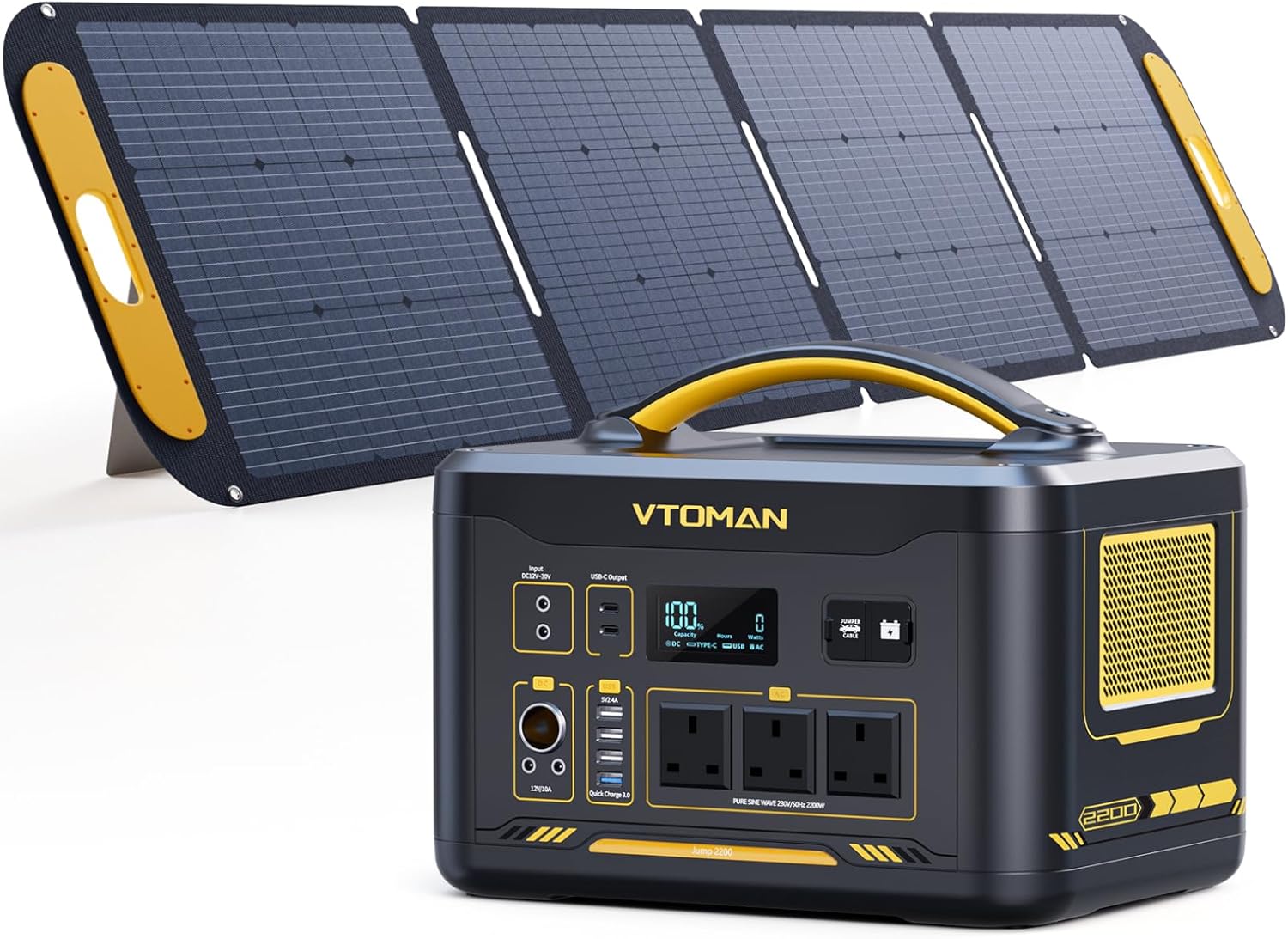
VTOMAN Jump 2200 with 200W Solar Panel
£699.99
View Kit
EcoFlow Stream Pro with 900W Solar Panels
£899
View Kit
EcoFlow STREAM Max with 2x450W Panels
£949
View Kit

Prices correct at time of writing and subject to change. Check the listing for the current price before buying.