
Best Solar Batteries
for UK Homes in 2026
Fifteen portable power stations tested and ranked across four capacity tiers. Every unit on this page uses LiFePO4 chemistry, carries a minimum two-year warranty, and is safe for indoor residential use. No NMC cells. No petrol. No fumes.
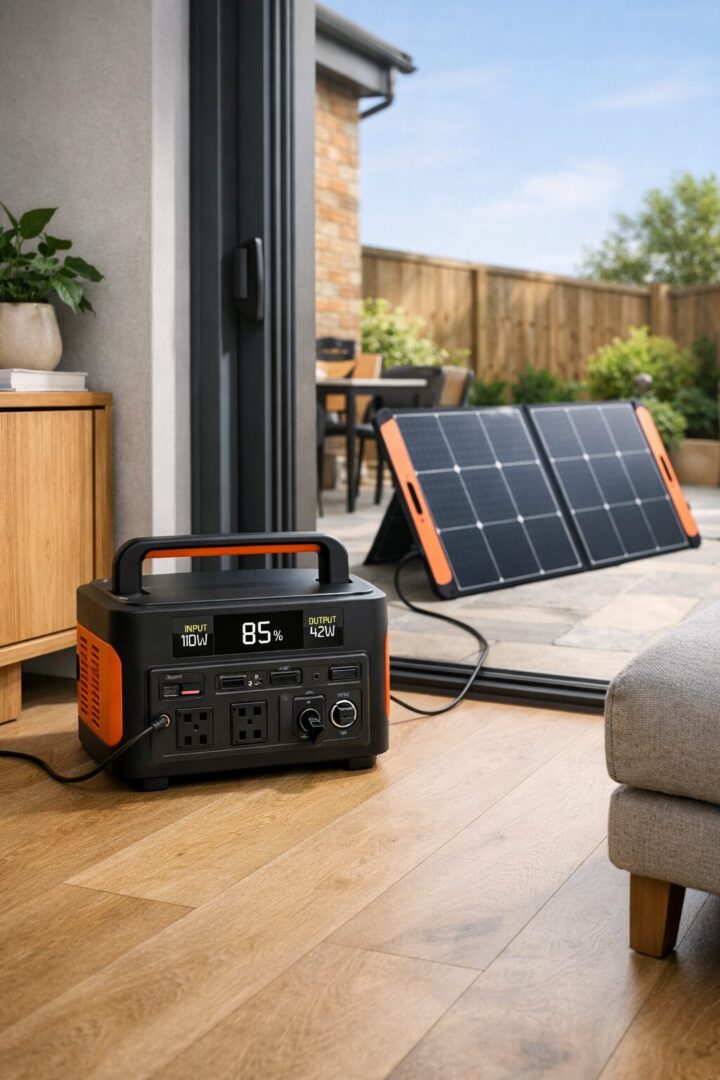
A solar battery is a portable energy storage unit that takes power from solar panels, the mains, or a vehicle socket and holds it in a lithium cell bank until you need it. In the United Kingdom, that matters more than it did five years ago. Energy prices remain high under the Ofgem price cap, grid outages are increasingly reported, and plug-in solar has become a practical route to cutting bills without a full roof installation.
This page covers portable and plug-in solar batteries — Jackery, EcoFlow, BLUETTI, Anker, and DJI style units. It does not cover fixed wall systems such as the Tesla Powerwall, which require DNO notification under G99 regulations and a certified installer. If you are comparing options, see our full home power options guide.
We have organised the page into four capacity tiers so you can move directly to the size range that fits your use case. Each tier includes product cards, a side-by-side comparison table, and a guide to who each tier is right for.
Gemshore Editorial Standard: LiFePO4 Chemistry Only
Every product on this page uses Lithium Iron Phosphate (LiFePO4) battery chemistry. Unlike standard NMC lithium-ion cells, LiFePO4 does not enter thermal runaway under normal operating conditions, making it the correct choice for indoor residential use in UK homes. For a full explanation of why this matters, see our solar power station safety guide. No NMC or NCA chemistry units are listed here.
Households Preparing for Power Cuts
A solar battery keeps routers, lighting, medical devices, and phone chargers running during a grid outage — silently, without fuel, and without the carbon monoxide risk of a petrol generator.
Households Using Plug-In Solar
A battery paired with an 800W plug-in array stores excess daytime generation for evening use. See our plug-in solar guide for system sizing detail.
Households on Flexible Tariffs
Charging overnight on a tariff such as Octopus Go at rates below 10p per kWh and discharging during peak hours above 24p per kWh can deliver meaningful annual savings without any solar input at all.
How a Solar Battery Works
Input
Solar Panel
Sends DC power via MC4 or proprietary connector
Storage
LiFePO4 Battery
Stores energy as DC. BMS monitors temperature, voltage and current
Conversion
Inverter
Converts DC to 230V AC. Continuous rating determines what you can run
Output
Your Devices
AC sockets, USB-A, USB-C, 12V DC — standard UK plugs throughout
Page Contents
How to Choose the Right Solar Battery
Choosing the right solar battery comes down to three questions. What do you want to power. How long do you want to run it. How do you plan to charge it. Answer those three and the right capacity tier becomes obvious. The sections below will help you work through each one before you reach the product tiers.
For most UK households, a one to two kilowatt-hour unit with a 1500W to 2000W continuous inverter covers the majority of outage and bill-saving use cases. If you need to run a kettle, a washing machine, or a microwave alongside everything else, you need to be in Tier 2 or above. The inverter wattage figure — not the capacity — is the number that determines what you can actually plug in.
01
What do you want to power?
List your essential devices and their wattage. A router draws 10W to 20W. A laptop draws 45W to 100W. A fridge draws 100W to 200W. A kettle draws 2000W to 3000W. The last one changes everything.
02
How long do you want to run it?
Multiply each device wattage by the hours you need it running. Add them together. That is your daily watt-hour requirement. Add 20 to 30 percent headroom and you have your minimum battery capacity.
03
How do you plan to charge it?
From solar panels, from the mains, or both. Mains charging is faster and predictable. Solar charging is free once the panels are in place. Most households use a combination of both depending on the season.
Why Every Unit on This Page Uses LiFePO4 Chemistry
Standard lithium-ion batteries — the NMC (Nickel Manganese Cobalt) cells found in many cheaper power stations — can enter thermal runaway if damaged, overcharged, or exposed to heat. Thermal runaway is the failure mode responsible for the battery fires that have been widely reported in e-bikes and e-scooters across the UK. The London Fire Brigade has issued specific guidance on lithium battery fire risks in the home.
LiFePO4 (Lithium Iron Phosphate) chemistry does not enter thermal runaway under normal operating conditions. It is thermally stable, delivers 3,000 to 6,000 charge cycles before meaningful degradation, and is the only battery chemistry we recommend for indoor residential use. Every product on this page uses LiFePO4 cells.
Charge Cycles
3,000 to 6,000
Charge Cycles
500 to 1,000
Thermal Runaway
Not under normal use
Thermal Runaway
Possible if damaged
Indoor Use
Safe
Indoor Use
Use with caution
Typical Warranty
3 to 5 Years
Typical Warranty
1 to 2 Years
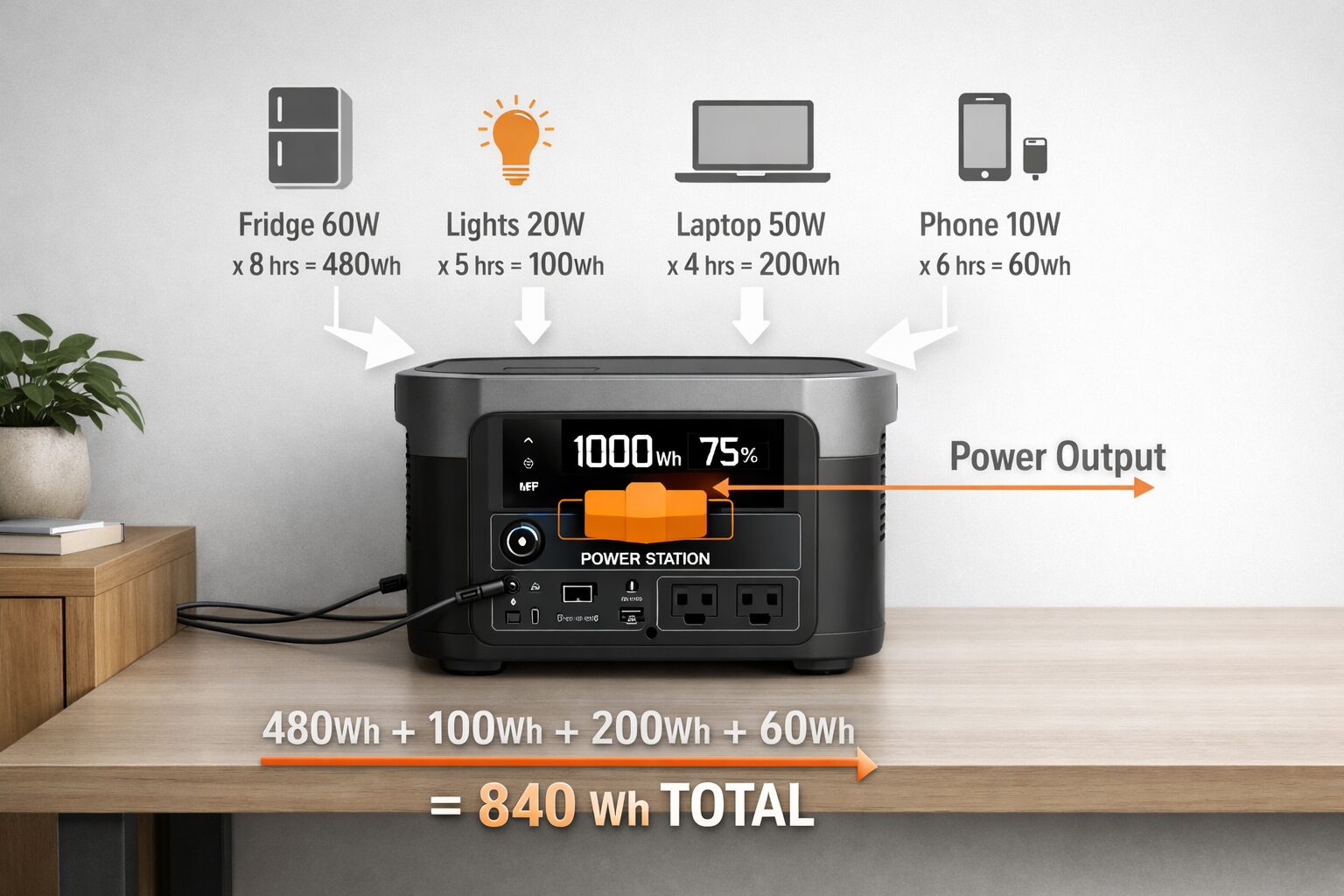
How to Size Your Solar Battery
Start by listing the devices you want to run and their wattage. Multiply each wattage by the number of hours you need it running. A fridge at 150W running for 8 hours is 1200Wh. Add your router, lights, and laptop charging and most households land between 800Wh and 1500Wh for a basic outage kit.
Add at least 20 to 30 percent headroom above your calculated figure. Inverter efficiency losses mean you will not recover 100 percent of the stated capacity from your devices.
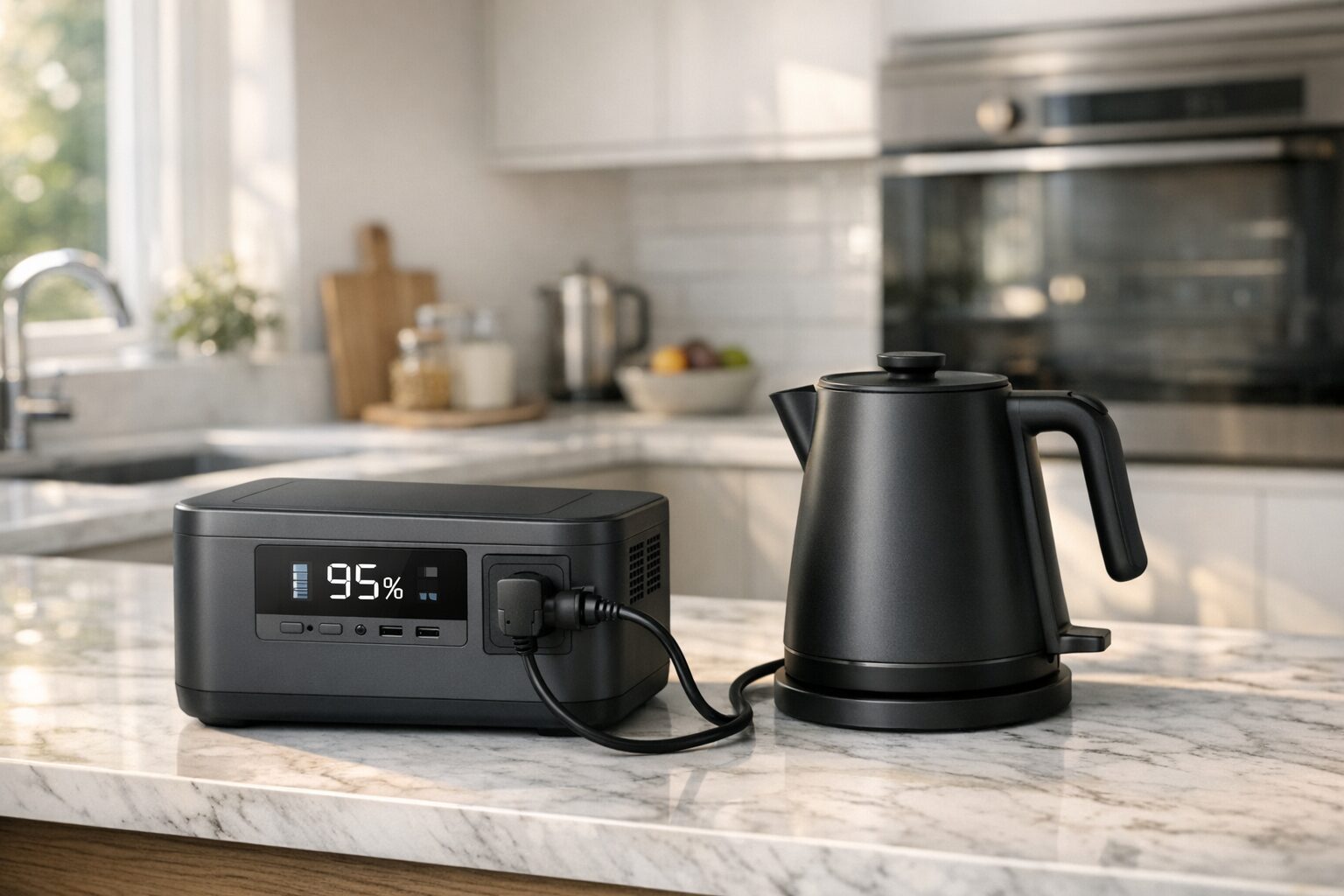
Can Your Battery Make a Cup of Tea?
A standard UK kettle draws between 2000W and 3000W at startup. Any power station with a continuous AC output below 2000W will error out the moment you try to boil water. This is the fastest way to discover you bought the wrong size unit.
If making tea during a power cut matters to you — and in the UK, it probably does — you need Tier 2 or above. Every unit in Tier 2, 3 and 4 clears the 2000W threshold. Tier 1 units are excellent for everything else.
The seven specifications below are the ones that actually matter when comparing units. Manufacturers lead with capacity figures but inverter output and charge speed are equally important for real-world use.
1. Capacity — Watt-Hours (Wh) The fuel tank
Watt-hours (Wh) is the total amount of energy the battery stores. A 1000Wh battery holds one kilowatt-hour of energy. Running a 100W device continuously will drain it in approximately 10 hours, accounting for inverter efficiency losses of around 10 to 15 percent.
Capacity tells you how long you can run things. It does not tell you what you can run — that is determined by the inverter output rating. A 2000Wh battery with a 500W inverter cannot run a kettle regardless of how much capacity remains.
2. Inverter Output — Watts (W) The engine size
Continuous watts (W) is the maximum power the unit can deliver through its AC sockets at any one moment. If the combined draw of everything you plug in exceeds this figure, the unit will shut down or error out.
This is the most important specification for practical use. A 1000Wh unit with a 2000W inverter can run a kettle briefly. A 2000Wh unit with a 1000W inverter cannot. Always check the continuous wattage figure against your highest-draw appliance before buying.
3. Surge Power (Peak Watts) Short-term tolerance
Surge or peak watts is the maximum power the unit can handle for a very brief period — typically half a second to two seconds — at startup. Motors and compressors draw significantly more power at startup than during normal running.
Surge ratings are not a sustainable operating figure. Do not use surge wattage to determine whether a unit can run an appliance. Use the continuous wattage figure. The surge rating exists to handle motor startup spikes without the unit tripping out.
4. LiFePO4 Battery Chemistry Safety and longevity
Lithium Iron Phosphate (LiFePO4) is the safest lithium battery chemistry for indoor residential use. It does not enter thermal runaway under normal conditions, delivers 3,000 to 6,000 charge cycles before capacity degrades to 80 percent, and is thermally stable across a wide temperature range.
| Chemistry | Cycle Life | Thermal Runaway | Indoor Safe |
|---|---|---|---|
| LiFePO4 | 3,000 to 6,000 | No — under normal use | Yes |
| NMC Lithium-Ion | 500 to 1,000 | Possible if damaged or overcharged | Use with caution |
5. Charge Speed How fast it fills
Charge speed is expressed as a time to full charge from empty, or as an input wattage figure. A 1000Wh unit with a 1000W AC input will charge in approximately one hour from the mains. Units with slower chargers may take four to six hours for the same capacity.
Fast charging matters most if you are running the unit regularly and need it topped up quickly between uses. For emergency backup that sits charged and ready, charge speed is less critical. Several units in Tier 2 and above feature one-hour fast charge from mains — check the product spec cards for individual figures.
6. Solar Input (Maximum Watts) Panel compatibility
Maximum solar input is the highest wattage the unit can accept from connected solar panels. Connecting a 400W panel to a unit with a 200W solar input limit will not cause damage — the unit will simply cap the intake at 200W and charge no faster than if you had connected a 200W panel.
For UK conditions, a 200W panel on a south-facing mount can generate between 150kWh and 200kWh annually. Pairing a 1000Wh battery with a 200W panel input limit is a practical match for most plug-in solar setups. See our plug-in solar guide for full panel sizing detail.
7. Ports and Outputs What you can plug in
AC sockets take standard UK 13A plugs. Most units carry two to four AC outlets. USB-A ports handle phones, tablets, and small accessories. USB-C Power Delivery ports charge laptops directly at up to 100W without needing an AC socket. 12V DC outputs power car-standard accessories and some medical devices.
For home outage use, the number and type of AC sockets matters most. For travel or van use, the 12V DC and USB-C outputs become more relevant. Check the product spec cards for the full port layout of each unit.
Tier 1: Essential Backup — Under 600Wh
These units are built for the essentials. Routers, laptops, LED lighting, phone charging, and low-draw medical devices. If your priority is keeping communications, lighting, and basic safety equipment running during a grid outage — without noise, without fuel, and without the fire risk of a petrol generator — this is the tier to start with.
All four units use LiFePO4 chemistry, carry between two and five year warranties, and are safe to run overnight without supervision. At this capacity level, do not expect to run a kettle or a microwave. These units are not designed for high-draw appliances. For that, see Tier 2. What they do exceptionally well is keep a household's digital and safety infrastructure running quietly for hours on a single charge.
Gemshore Editorial Standard: LiFePO4 Chemistry Only
Every product on this page uses Lithium Iron Phosphate (LiFePO4) battery chemistry. Unlike standard NMC lithium-ion cells, LiFePO4 does not enter thermal runaway under normal operating conditions, making it the correct choice for indoor residential use in UK homes. No NMC or NCA chemistry units are listed here.

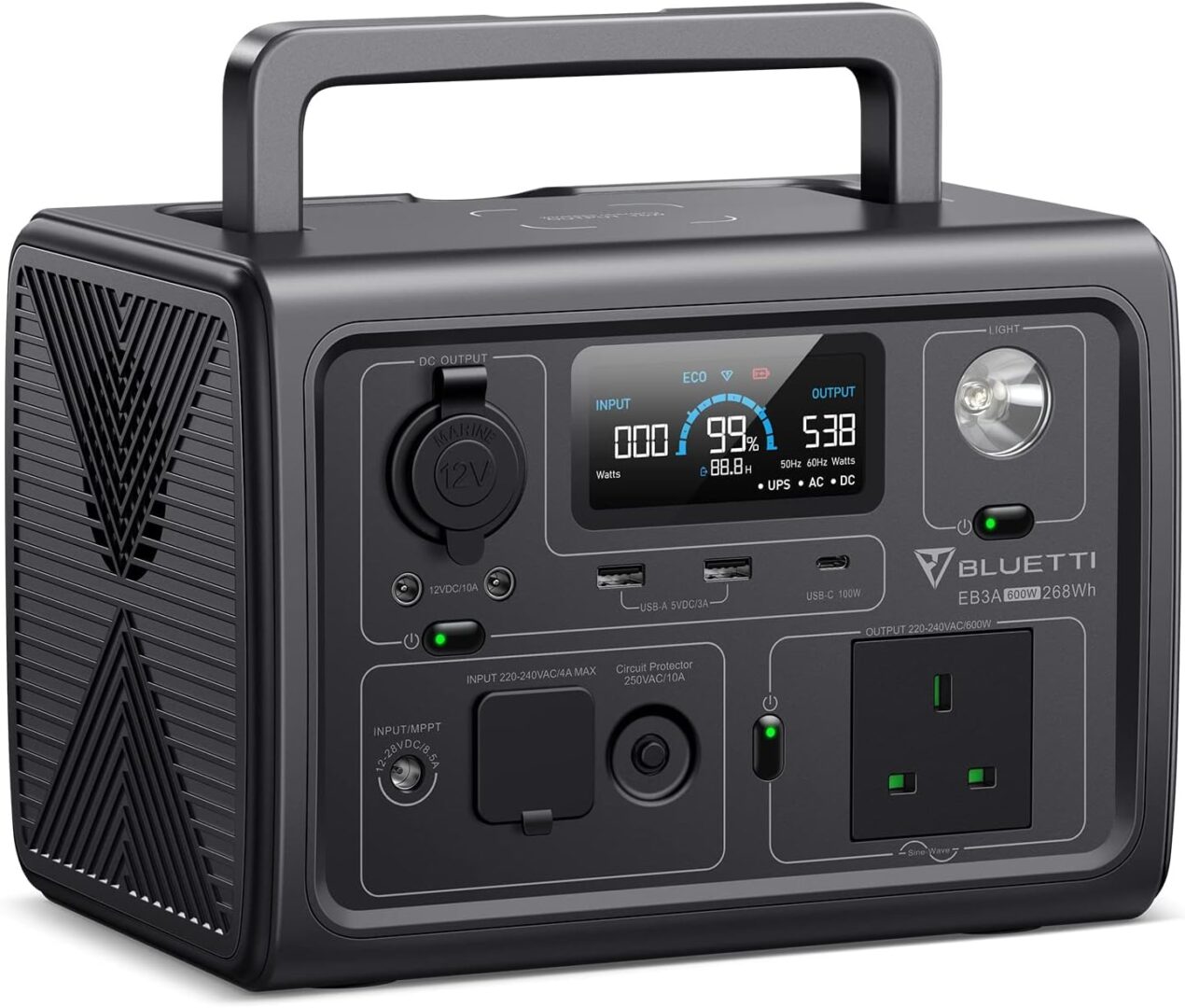
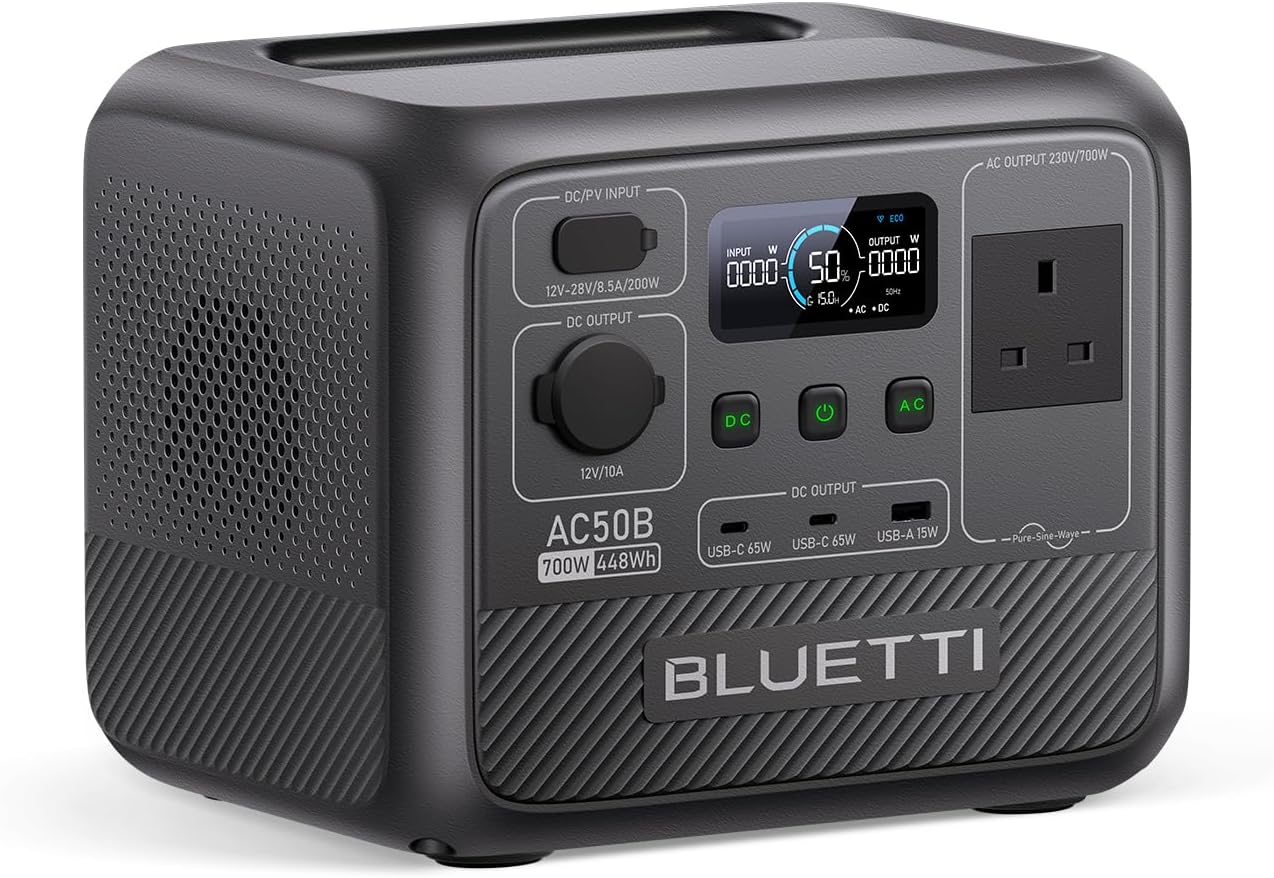
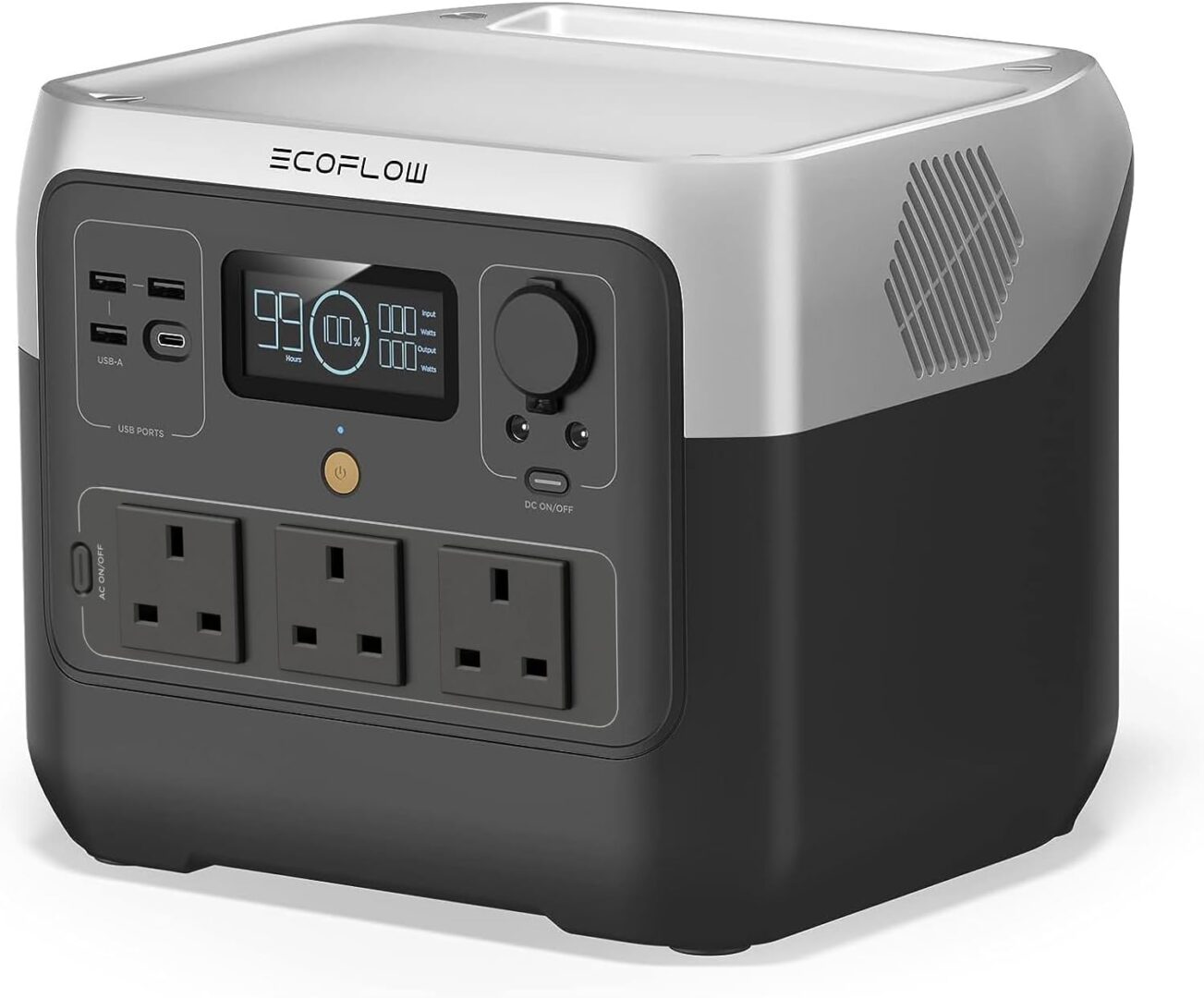
Tier 1 — Side by Side Comparison
| Product | Price | Capacity | AC Output | Weight | Warranty | Buy |
|---|---|---|---|---|---|---|
| EcoFlow RIVER 3 | £169 | 245Wh | 300W / 600W | 3.5kg | 5 Years | Buy Now |
| BLUETTI EB3A | £219 | 268Wh | 600W / 1200W | 4.6kg | 2 Years | Buy Now |
| BLUETTI AC50B | £299 | 448Wh | 700W / 1050W | 6.7kg | 5 Years | Buy Now |
| EcoFlow RIVER 2 Pro | £349 | 768Wh | 800W / 1600W | 7.8kg | 5 Years | Buy Now |
AC Output shown as Continuous W / Peak Surge W. All units LiFePO4 chemistry. Solar panel not included with any Tier 1 unit. Prices correct at 25/05/26 — verify on Amazon before purchase.
Battery Longevity and Cycle Life — What to Expect from Tier 1
3,000+
Minimum charge cycles before 80% capacity
8+ yrs
Lifespan at one full cycle per day
5 yr
Warranty on EcoFlow RIVER 3 and RIVER 2 Pro
0
NMC or NCA chemistry units on this page
LiFePO4 batteries at this capacity level are built to last well beyond the warranty period under normal household use. The majority of Tier 1 owners will not use their unit for a full charge cycle every day — most use cases involve occasional outage backup or supplementing a small plug-in solar array. At that rate of use, a well-maintained LiFePO4 unit will outlast several generations of the devices it powers.
Heat is the primary enemy of battery longevity at any chemistry. Store and operate Tier 1 units away from direct sunlight and heat sources. Do not leave them discharged for extended periods. Most units include a battery management system that handles the rest automatically. For more detail on safe storage and operation, see our solar power station safety guide.
Tier 1 covers a wide range of household situations. The four profiles below cover the most common use cases we see from UK buyers at this capacity level.
Renters and Flat Dwellers Without Roof Access Good fit
If you live in a flat or rented property without access to a roof or garden, Tier 1 units paired with a balcony or window-mounted solar panel represent one of the very few practical routes to generating and storing your own electricity. A 245Wh to 448Wh unit paired with a 100W panel kept on a south-facing balcony will offset a meaningful portion of your daily device charging load without requiring any structural changes to the property.
These units are portable, require no installation, and can be taken with you when you move. They do not require DNO notification or landlord permission to operate as a standalone appliance. For panel mounting options that do not breach tenancy agreements, see our plug-in solar guide.
Home Office and Remote Workers Strong fit
For households where one or more people work from home, a grid outage is not just an inconvenience — it is a lost working day. A Tier 1 unit positioned under a desk or in a home office can keep a laptop (45W to 100W), a broadband router (15W), and a monitor (20W to 40W) running continuously for several hours through any outage that would otherwise cut the working day short.
The EcoFlow RIVER 2 Pro at £349 and 768Wh is the strongest Tier 1 option for home office use, providing enough capacity to run a full home office setup for four to six hours. For setups that also include a NAS drive, network switch, or second monitor, the combined draw may push requirements into Tier 2 territory — particularly if you also want to run a kettle during the outage.
Households Wanting Basic Outage Protection Strong fit
For households whose primary concern is keeping communications and lighting running during a grid outage, Tier 1 delivers everything needed. A 400Wh to 768Wh unit will run a broadband router (15W) for 20 or more hours, keep LED lighting running across several rooms for a full evening, charge phones and laptops repeatedly, and power low-draw medical devices such as CPAP machines throughout the night.
The units in this tier are light enough to move between rooms, quiet enough to sleep next to, and do not require any ventilation or fuel management. They sit charged and ready indefinitely — top them up every few months if not in regular use and they will be at full capacity when needed.
Plug-In Solar Users Wanting Evening Storage Partial fit
If you already have or are planning an 800W plug-in solar array and want to store excess daytime generation for evening use, Tier 1 capacity will store a portion of your daily generation but is unlikely to cover your full evening load. An 800W array on a good UK summer day can generate 2kWh to 3kWh. A 768Wh battery stores less than half of that before it is full.
For serious solar storage that captures the majority of your daily generation, Tier 2 or Tier 3 is the more appropriate match. Tier 1 works well as a starting point or as a secondary storage unit alongside a larger battery. The EcoFlow RIVER 2 Pro at £349 is the strongest option in this tier for solar pairing, with an 800W AC output and 768Wh capacity.
Households on Flexible Energy Tariffs Limited fit
Charging a Tier 1 unit overnight on a flexible tariff such as Octopus Go at rates below 10p per kWh and discharging during peak hours can generate a saving — but at this capacity level the financial return is modest. A 500Wh unit cycled daily in this way saves approximately £25 to £35 per year on electricity costs before accounting for any degradation in cycle efficiency.
The financial case for tariff arbitrage improves significantly with larger capacity. If bill savings through tariff cycling is your primary motivation, Tier 3 or Tier 4 capacity will deliver a meaningfully better return on the same number of daily cycles.
Tier 2: Home Office — 600Wh to 1200Wh
Tier 2 is where the page changes character. The units here are not just backup devices — they are capable enough to maintain a near-normal household during a grid outage. With continuous AC outputs ranging from 1500W to 2600W, every unit in this tier clears the kettle threshold. You can boil water, run a microwave, keep a fridge running, and power a full home office setup simultaneously.
Two of the four units ship with solar panels included, giving you a complete off-grid charging solution from the box. If you are pairing a battery with a plug-in solar array and want to store meaningful daytime generation, Tier 2 is the first capacity level where that pairing makes strong financial sense. All four units use LiFePO4 chemistry and carry a minimum three-year warranty.
The Kettle Test — Why Inverter Rating Matters at This Tier
A standard UK kettle draws between 2000W and 3000W at startup. Any power station with a continuous AC output below 2000W will error out when you try to boil water. All four units in this tier clear that threshold, with the DJI Power 1000 V2 delivering 2600W continuous — the highest output in its capacity class. If running high-draw appliances during an outage is a priority, always check the continuous wattage figure in the spec card, not the peak surge figure. For a full explanation of the difference, see Section 2.

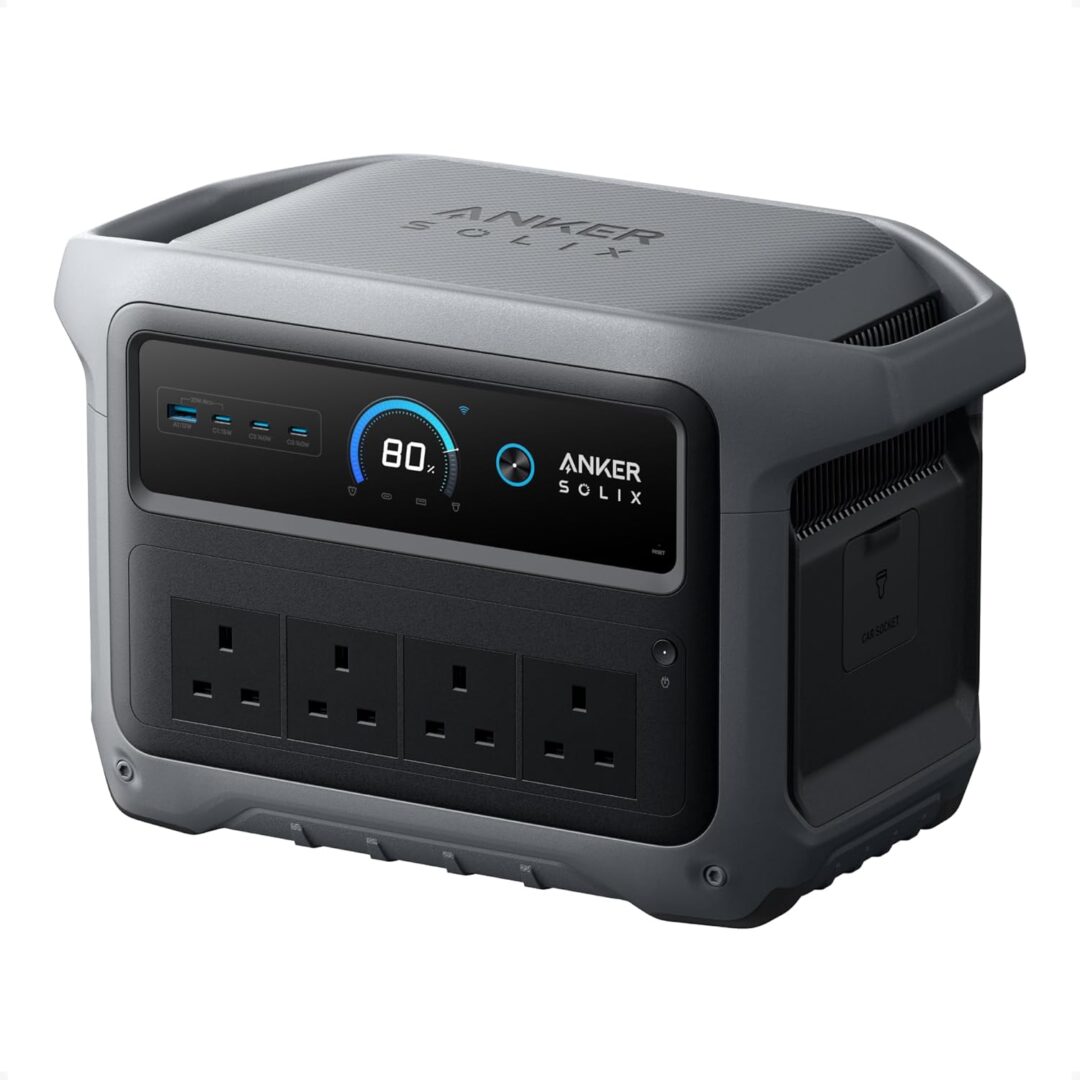
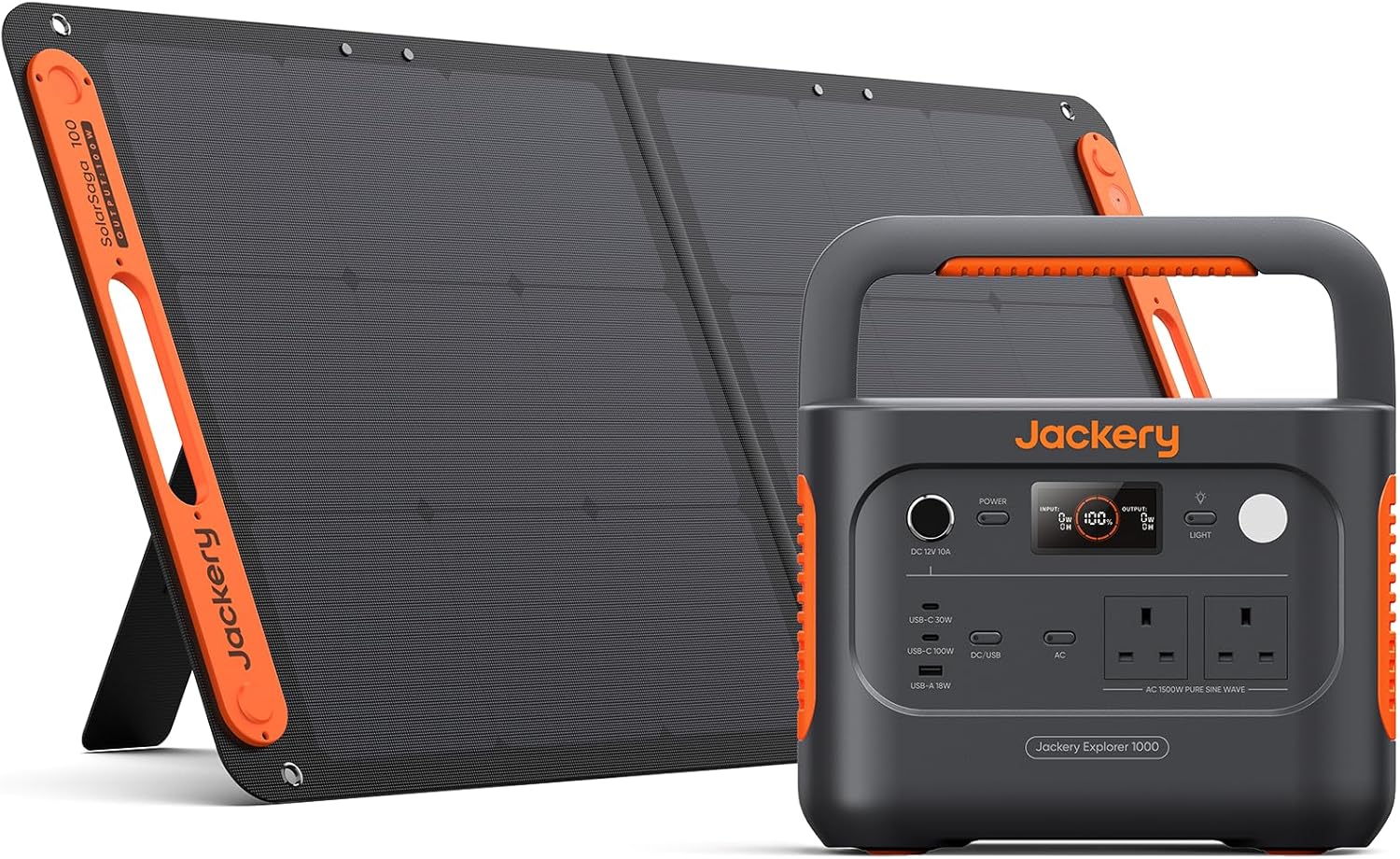

Tier 2 — Side by Side Comparison
| Product | Price | Capacity | AC Output | Weight | Warranty | Solar | Buy |
|---|---|---|---|---|---|---|---|
| DJI Power 1000 V2 | £459 | 1024Wh | 2600W continuous | 11.3kg | 3 to 5 Years | Not Included | Buy Now |
| Anker SOLIX C1000 Gen 2 | £499 | 1024Wh | 2000W / 3000W | 11.3kg | 5 Years | Not Included | Buy Now |
| Jackery Explorer 1000 v2 + 100W | £569 | 1070Wh | 1500W / 3000W | 10.8kg | 5 Years | 100W Included | Buy Now |
| Jackery Explorer 1000 Plus | £699 | 1264Wh | 2000W / 4000W | Not specified | 5 Years | Not Included | Buy Now |
AC Output shown as Continuous W / Peak Surge W where available. All units LiFePO4 chemistry. Prices correct at 25/05/26 — verify on Amazon before purchase.
Understanding Inverter Output at Tier 2 — What You Can Actually Run
The step up from Tier 1 to Tier 2 is not just a capacity increase — it is an inverter output increase that fundamentally changes what you can plug in. At this tier, continuous AC outputs start at 1500W and reach 2600W. That range covers the majority of UK household appliances outside of electric showers, ovens, and tumble dryers.
The wattage draw figures below are approximate UK averages. Actual draw varies by model and age of appliance. Always check the label on your specific appliance if you are sizing a battery for a particular device. For high-draw appliances with motor startup spikes, check the surge wattage figure on the unit as well as the continuous figure.
Tier 2 is the most popular capacity level for UK households stepping beyond basic outage protection. The five profiles below cover the most common buying situations at this price point.
Full Home Office Users — Monitor, Desktop, NAS Drive Strong fit
A full home office setup running a desktop PC (150W to 300W), two monitors (40W to 80W combined), a NAS drive (20W to 50W), a network switch (10W), and a router (20W) draws between 240W and 460W continuously. A 1024Wh Tier 2 unit at that load will run the complete setup for two to four hours — enough to cover the majority of UK grid outages, which average under two hours in duration according to Ofgem published data.
The Anker SOLIX C1000 Gen 2 at £499 includes a 10ms UPS mode, meaning it switches to battery output fast enough to prevent a desktop PC from losing unsaved work during an outage. That feature alone makes it the strongest Tier 2 choice for home office users who cannot afford data loss.
Households Wanting to Run a Kettle During an Outage Strong fit
If the ability to boil a kettle during a power cut is non-negotiable — and for many UK households it is — Tier 2 is the entry point. All four units here clear the 2000W continuous output threshold that a kettle requires. The DJI Power 1000 V2 at 2600W continuous is the strongest performer for high-draw appliance use, despite being the lowest-priced unit in the tier.
Boiling a full kettle consumes approximately 0.1kWh to 0.15kWh per cycle. A 1024Wh battery can boil a kettle six to ten times before requiring recharge — more than enough for a standard outage. For households that also want to run a microwave alongside the kettle, ensure the combined draw does not exceed the unit's continuous output rating.
First-Time Solar Battery Buyers Good fit
For households buying their first solar battery and wanting a complete solution without sourcing a panel separately, the Jackery Explorer 1000 v2 with 100W Solar Panel at £569 is the most straightforward entry point at this tier. Everything you need arrives in one order — battery, panel, and cable. Set the panel on a south-facing windowsill or balcony and the unit begins charging immediately.
The 100W panel included with this bundle will fully recharge the 1070Wh battery in approximately 10 to 12 hours of good UK sunlight — realistic across a full summer day. For faster solar charging or a larger array, the unit accepts up to 400W solar input, meaning additional panels can be added later. See our plug-in solar guide for panel pairing options.
Plug-In Solar Users Storing Daytime Generation Strong fit
Tier 2 is the first capacity level where storing plug-in solar generation makes strong financial sense. A 400W plug-in array on a south-facing UK garden can generate 1.5kWh to 2kWh on a clear summer day. A 1024Wh to 1264Wh Tier 2 battery can absorb the majority of that generation and hold it for evening discharge — offsetting peak-rate grid imports that currently exceed 24p per kWh under the Ofgem price cap.
At that displacement rate, a 1kWh battery cycled daily through solar could save £60 to £90 per year on electricity costs in addition to the outage protection benefit. The financial return improves further in households that also use overnight cheap-rate tariff charging to top up what solar does not fill.
Households on Flexible Tariffs — Octopus Go and Similar Good fit
Charging a 1kWh Tier 2 unit overnight on Octopus Go at approximately 7p per kWh costs around 7p to fill. Discharging that same kilowatt-hour during peak daytime hours at 24p per kWh saves approximately 17p per cycle. Cycled daily, that is roughly £62 per year in bill savings from tariff arbitrage alone — before accounting for any solar input.
At Tier 2 capacity, the tariff arbitrage case becomes financially meaningful. The Jackery Explorer 1000 Plus at 1264Wh delivers the highest daily saving potential in this tier, with enough capacity to displace a significant portion of a typical household's evening electricity draw. For larger households or higher daily consumption, Tier 3 capacity will deliver a proportionally stronger return.
Tier 3: Family Backup — 1200Wh to 2500Wh
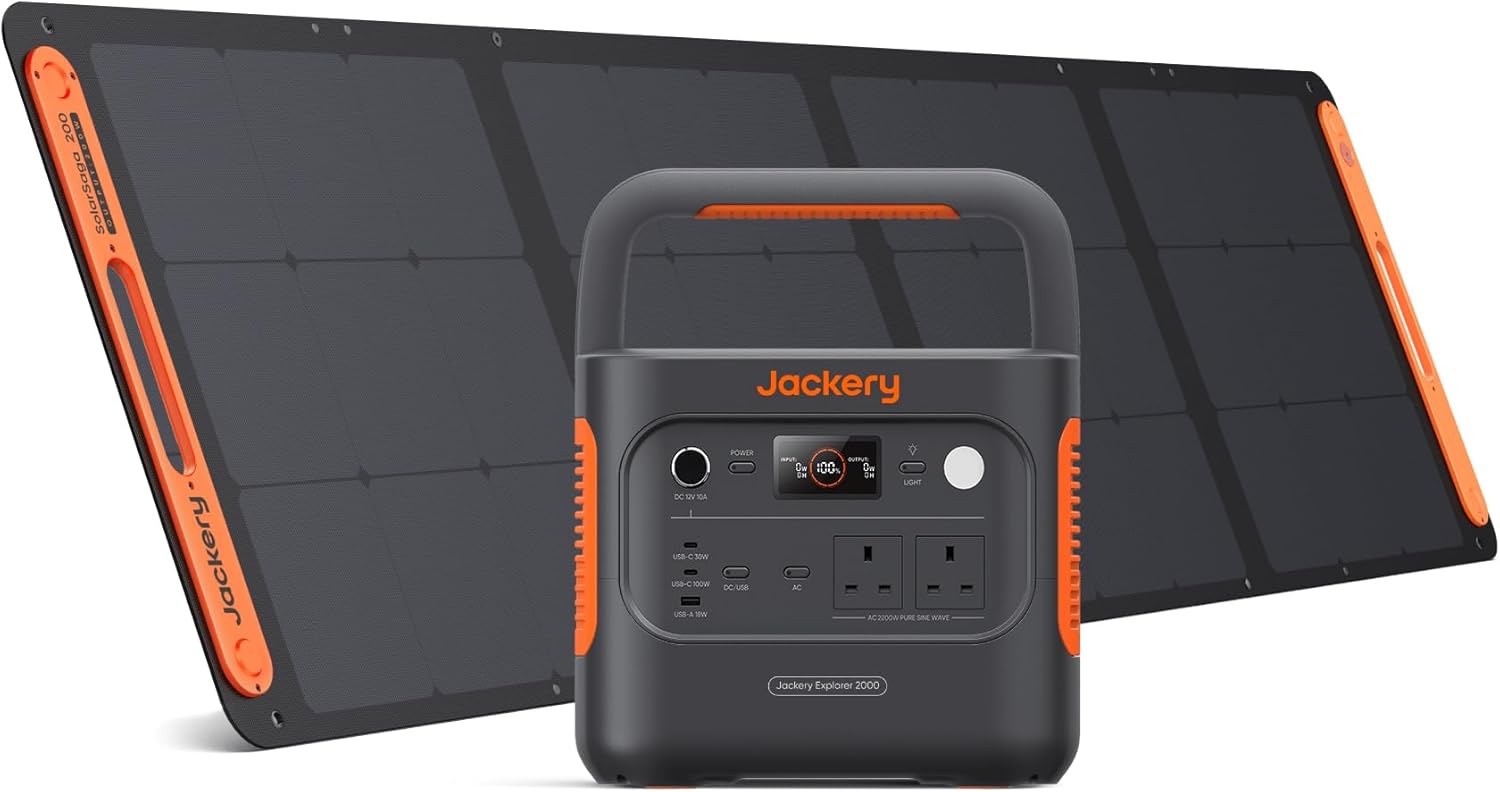
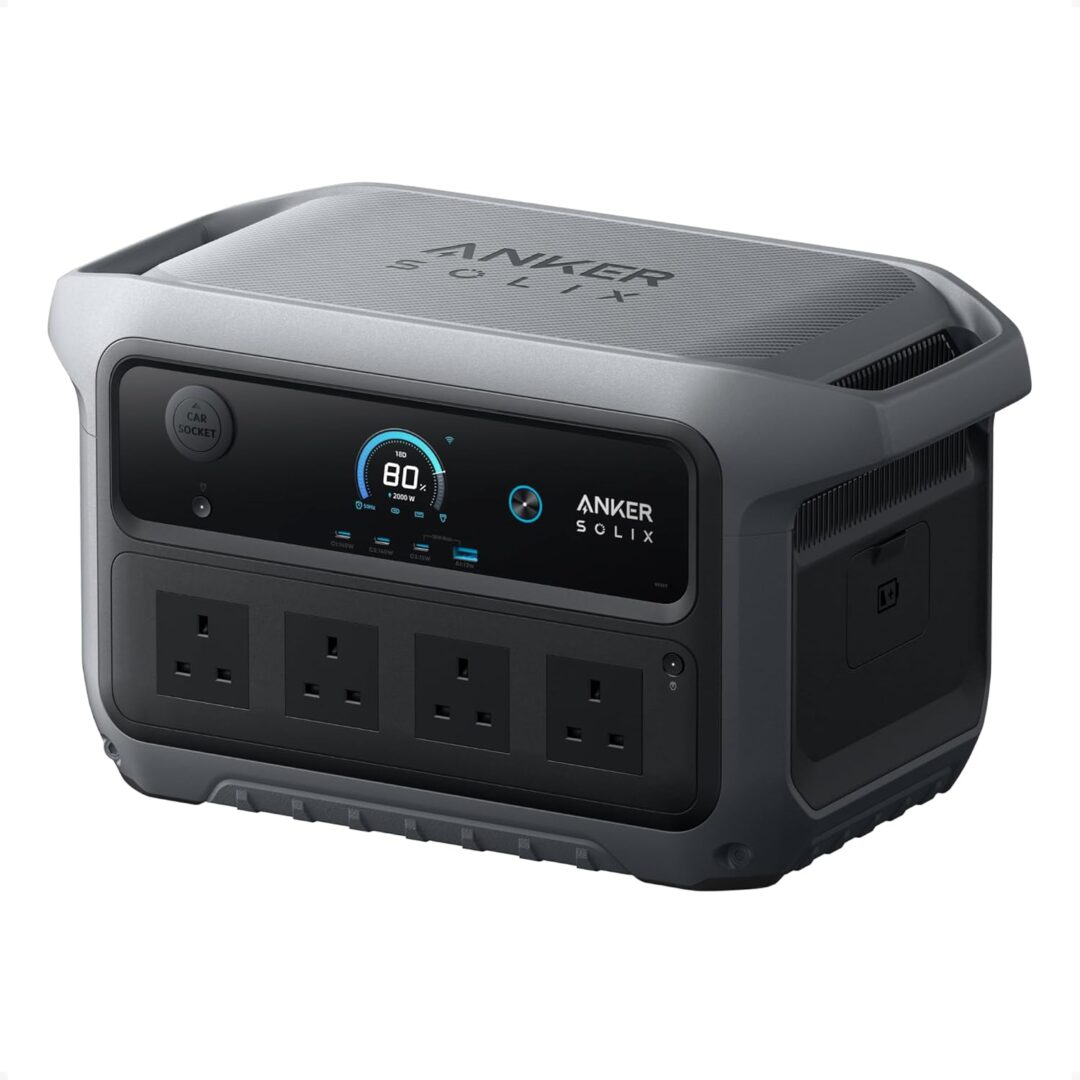
Tier 3 is built for households that need to maintain a near-normal lifestyle during an extended grid outage — not just keep a router and laptop running, but keep a fridge-freezer cold, run a washing machine cycle, watch television, cook food in a microwave, and charge every device in the house simultaneously. With capacities ranging from 2042Wh to 2048Wh and continuous AC outputs between 2200W and 2400W, every unit here comfortably handles the full range of UK household appliances outside of electric showers and ovens.
Two units in this tier ship with solar panels included — the EcoFlow DELTA 3 Plus with a 220W bifacial panel and the Jackery Solar Generator 2000 v2 with a 200W panel. Both represent complete off-grid systems that require no additional purchases to begin generating and storing solar power. For households pairing a Tier 3 battery with an existing plug-in solar array, the 2kWh capacity at this level captures the majority of a full UK summer day's generation in a single charge cycle.
Multi-Day Outage Planning — Sizing Your Storage Correctly
A typical UK household running a fridge-freezer (150W), LED lighting across four rooms (50W), a television (100W), a broadband router (20W), and continuous device charging (100W) draws approximately 420W continuously. A 2kWh unit at that combined load provides approximately 4 to 5 hours of full household coverage before requiring recharge. Paired with a 200W solar panel on a clear UK summer day, the same unit can sustain that load indefinitely during daylight hours. For outages beyond 24 hours in winter conditions, mains top-up via an overnight cheap-rate tariff such as Octopus Go alongside solar input gives the most reliable coverage year-round.


Tier 3 — Side by Side Comparison
| Product | Price | Capacity | AC Output | Weight | Warranty | Solar | Buy |
|---|---|---|---|---|---|---|---|
| Jackery Explorer 2000 v2 | £869 | 2042Wh | 2200W continuous | 17.9kg | 5 Years | Not Included | Buy Now |
| EcoFlow DELTA 3 Plus + 220W | £938 | 1024Wh | 2400W continuous | Not specified | 5 Years | 220W Included | Buy Now |
| Jackery Solar Generator 2000 v2 + 200W | £1,099 | 2042Wh | 2200W continuous | 17.9kg | 5 Years | 200W Included | Buy Now |
| Anker SOLIX C2000 Gen 2 | £1,099 | 2048Wh | 2400W / 4000W | 18.9kg | 5 Years | Not Included | Buy Now |
AC Output shown as Continuous W / Peak Surge W where available. All units LiFePO4 chemistry. Prices correct at 25/05/26 — verify on Amazon before purchase.
How Far Does 2kWh Go — Real Runtime Estimates for UK Households
The figures below are based on typical UK appliance draw rates and assume 90 percent inverter efficiency. They represent continuous single-appliance runtime from a fully charged 2kWh unit. In practice, most households run multiple lower-draw devices simultaneously, which spreads the load and extends overall runtime beyond any single-appliance figure.
Fridge-Freezer
150W average draw
12+
hours continuous
LED Lighting (4 rooms)
50W average draw
36+
hours continuous
Television (55 inch)
100W average draw
18+
hours continuous
Full Home Setup
Fridge + TV + Lights + Router
4 to 5
hours combined
Pairing a Tier 3 unit with a 200W or 220W solar panel — as two of the four units above offer out of the box — means those runtime figures extend significantly during daylight hours. A 200W panel in a south-facing UK garden generates approximately 0.8kWh to 1.2kWh on a typical summer day, offsetting a substantial portion of the household's combined draw without drawing from the battery at all. For full panel sizing guidance, see our plug-in solar guide.
For households on a flexible overnight tariff such as Octopus Go, charging a 2kWh unit at 7p per kWh costs approximately 14p. Discharging that same 2kWh during peak daytime hours at 24p per kWh saves approximately 34p per cycle — roughly £124 per year from tariff arbitrage alone, before solar input is accounted for.
Tier 3 is the first level where a solar battery begins to function as a serious energy management tool rather than purely a backup device. The five profiles below cover the most common buying situations at this capacity.
Families Needing Multi-Appliance Outage Coverage Strong fit
For households with children, pets, or dependents where a grid outage cannot simply mean going without — keeping the fridge cold, maintaining heating controls, powering medical equipment, and ensuring all family members can charge devices simultaneously — Tier 3 is the minimum appropriate capacity. The 2kWh units here will run a full household essential load for four to five hours without solar input, and significantly longer when paired with a panel during daylight hours.
The Jackery Solar Generator 2000 v2 at £1,099 with a 200W panel included is the most complete family outage solution in the tier. It arrives ready to deploy, requires no additional purchases, and the 2042Wh capacity provides the deepest reserve in the tier for extended outage scenarios.
Households Wanting Serious Solar Storage Strong fit
A 400W to 800W plug-in solar array on a good UK summer day generates between 1.5kWh and 3kWh. At Tier 2 capacity, a 1kWh battery fills before midday on a strong generation day, leaving afternoon generation unused. At Tier 3, a 2kWh battery absorbs the majority of a full day's generation and holds it for evening discharge — meaning more of your free solar electricity displaces grid imports at peak rates.
The Anker SOLIX C2000 Gen 2 at £1,099 and 2048Wh is the strongest Tier 3 option for solar storage, with a 2400W continuous output that can handle any appliance you pair with your array and a 4000W surge rating that covers motor startup spikes on washing machines and fridge-freezers.
Home Office Users With High-Draw Equipment Good fit
For home office users running a workstation PC (300W to 500W), multiple monitors, a NAS drive, network infrastructure, and ancillary equipment simultaneously, Tier 2 capacity can run short during a longer outage. A Tier 3 unit at 2kWh doubles the available runtime for the same load — covering the majority of a full working day without needing a recharge.
The Jackery Explorer 2000 v2 at £869 is the most cost-effective Tier 3 entry point for home office use, offering 2042Wh of storage and 2200W continuous output at the lowest price in the tier. For users who also want UPS-grade switchover protection for desktops and NAS drives, check whether your preferred unit includes UPS mode before purchasing — not all Tier 3 units include this feature.
Households on Flexible Tariffs Maximising Bill Savings Strong fit
At 2kWh capacity, the financial case for overnight tariff arbitrage becomes compelling. Charging overnight on Octopus Go at 7p per kWh costs approximately 14p to fill a 2kWh unit. Discharging during peak hours at 24p per kWh saves approximately 34p per cycle. At daily cycling, that is approximately £124 per year in bill savings from tariff arbitrage alone. Add solar input during the day and the combined annual saving from a well-sized Tier 3 setup can exceed £200 per year.
The payback period on a Tier 3 unit used primarily for tariff arbitrage ranges from four to six years depending on the unit cost, tariff rates, and solar input. Ofgem price cap rates affect the peak-rate saving figure — check current rates when calculating your own payback estimate.
Buyers Stepping Up From Tier 1 or Tier 2 Good fit
Many households start with a Tier 1 or Tier 2 unit and find their use case grows beyond what it can cover. The most common trigger points are wanting to run a fridge-freezer through a full outage, discovering that a 1kWh solar battery fills before midday on a summer day, or realising that bill savings at lower capacity are too modest to justify daily cycling.
If you already own a Tier 1 or Tier 2 unit, a Tier 3 purchase does not make the smaller unit redundant. Running both in parallel — the smaller unit covering office equipment and devices, the larger unit covering kitchen and living room loads — is a practical configuration that many households find provides the most flexible coverage. Both units can charge simultaneously from solar and mains without interference.
Tier 4: Whole Home — 2500Wh and Above
Tier 4 is for households that need sustained, serious off-grid capability. These are not backup devices in the conventional sense — they are portable energy infrastructure. With capacities starting at 3kWh and continuous AC outputs reaching 3600W, the three units here can run electric hobs, tumble dryers, power tools, and air conditioning units alongside a full household base load. They are also the right choice for households building a permanent portable energy independence setup alongside an 800W plug-in solar array.
At this price point — £1,599 to £1,799 — review counts on Amazon are naturally lower than entry-level units. That is not a quality signal, it is a volume signal. These are considered purchases. Brand credibility, warranty terms, and inverter quality carry more weight than star count at this level. All three units use LiFePO4 chemistry. For a detailed explanation of why that matters, see Section 2.
Whole Home Coverage — What 3kWh Actually Powers
A 3kWh unit running a fridge-freezer (150W), LED lighting across four rooms (80W), a television (100W), a broadband router (20W), and continuous device charging (150W) draws approximately 500W combined. At that load, the battery provides approximately 12 hours of full household coverage before requiring recharge. Paired with a 400W solar array on a clear UK summer day, the same unit can run that load indefinitely during daylight hours. For winter use or extended cloudy periods, overnight mains charging on a flexible tariff such as Octopus Go alongside daytime solar makes these units viable year-round energy management solutions — not just emergency backup.
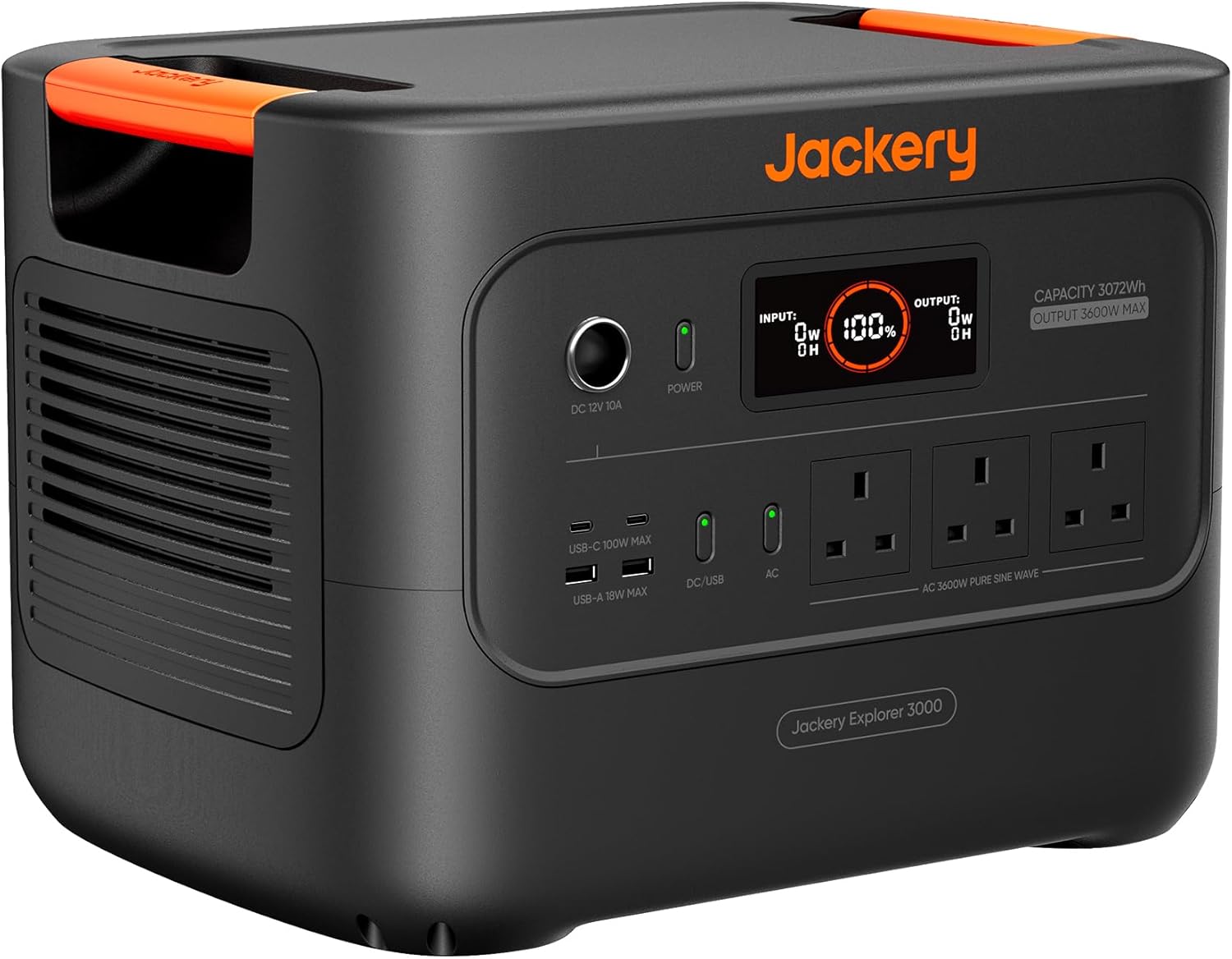
Jackery
placeholderExplorer 3000 v2 Portable Power Station
£1,599
| Capacity | 3072Wh |
| AC Output | 2990W continuous |
| Weight | 27kg |
| Battery | LiFePO4 |
| Warranty | 5 Years |
| Solar Panel | Not Included |
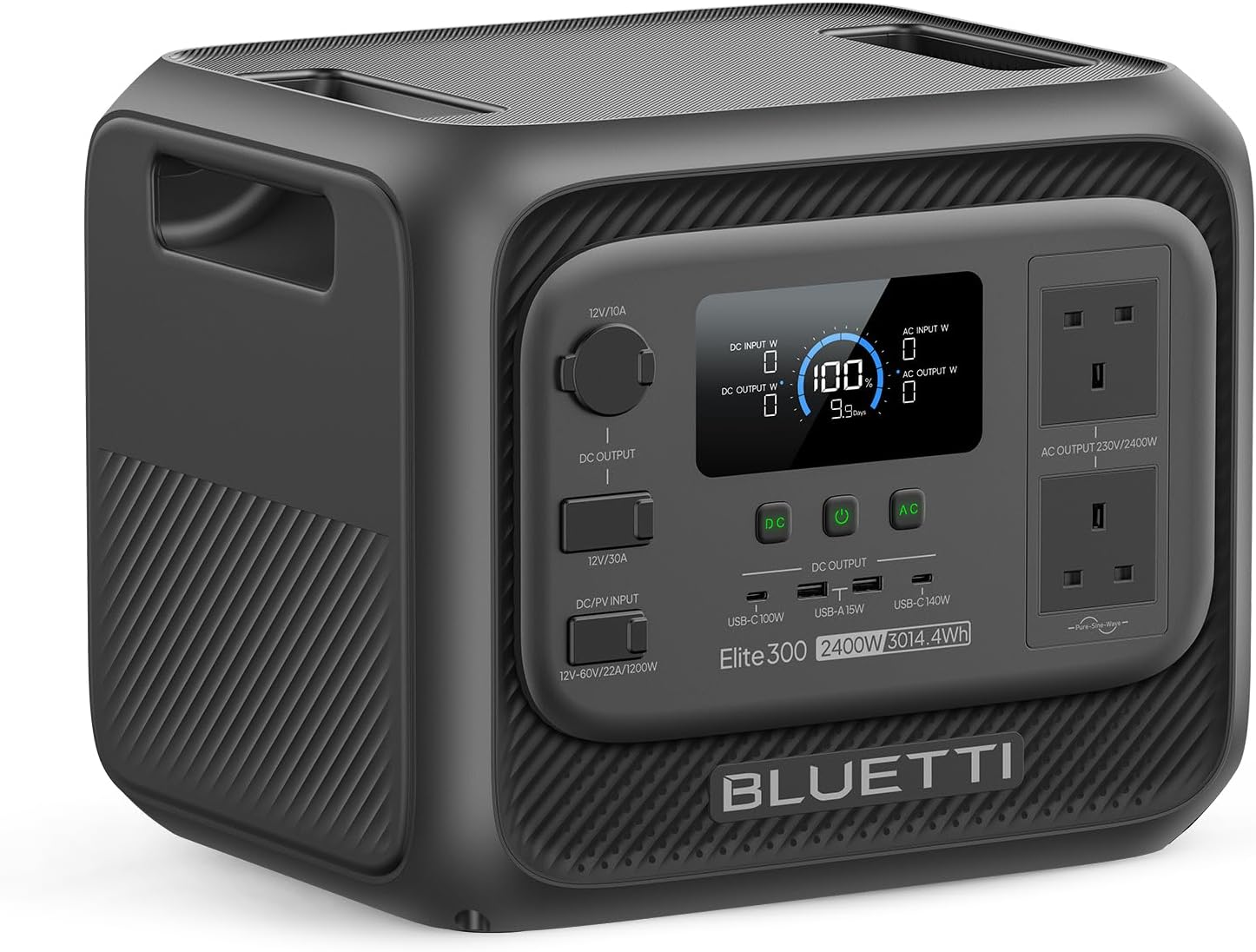
BLUETTI
placeholderElite 300 Portable Power Station
£1,599
| Capacity | 3014Wh |
| AC Output | 2400W (4800W surge) |
| Weight | 26.3kg |
| Battery | LiFePO4 |
| Warranty | Not specified |
| Solar Panel | Not Included |
Anker
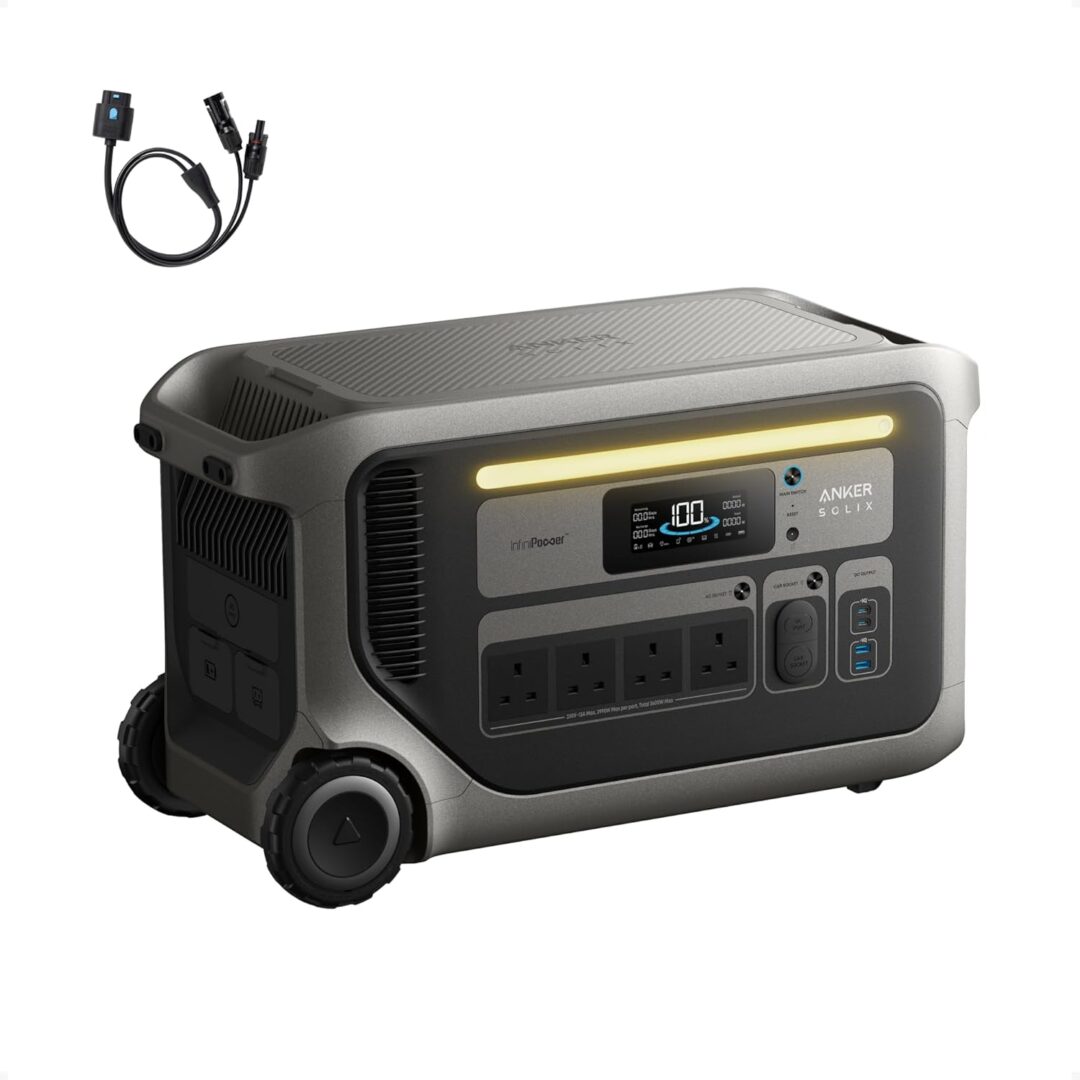
placeholderSOLIX F3000 Portable Power Station
£1,799
| Capacity | 3072Wh |
| AC Output | 3600W continuous |
| Weight | Not specified |
| Battery | LiFePO4 |
| Warranty | Not specified |
| Solar Panel | Not Included |
Tier 4 — Side by Side Comparison
| Product | Price | Capacity | AC Output | Weight | Warranty | Buy |
|---|---|---|---|---|---|---|
| Jackery Explorer 3000 v2 | £1,599 | 3072Wh | 2990W continuous | 27kg | 5 Years | Buy Now |
| BLUETTI Elite 300 | £1,599 | 3014Wh | 2400W / 4800W | 26.3kg | Not specified | Buy Now |
| Anker SOLIX F3000 | £1,799 | 3072Wh | 3600W continuous | Not specified | Not specified | Buy Now |
AC Output shown as Continuous W / Peak Surge W where available. All units LiFePO4 chemistry. No solar panels included at this tier. Prices correct at 25/05/26 — verify on Amazon before purchase.
Whole Home at 3kWh — Coverage, Tariff Savings, and Solar Pairing
12+
Hours at full household base load
£186
Estimated annual saving from daily tariff cycling
3,000+
LiFePO4 charge cycles before 80% capacity
400W
Recommended solar array for indefinite summer daytime coverage
At 3kWh capacity, the financial case for daily cycling strengthens significantly. Charging overnight on Octopus Go at 7p per kWh costs approximately 21p to fill a 3kWh unit. Discharging during peak hours at 24p per kWh saves approximately 51p per cycle. Cycled daily, that is approximately £186 per year from tariff arbitrage alone. Add a 400W to 800W plug-in solar array and the combined annual saving from a Tier 4 setup can exceed £300 per year depending on roof orientation and usage patterns.
The payback horizon at Tier 4 ranges from five to eight years at current UK energy prices — longer than Tier 2 and Tier 3 on a pure financial basis, but the level of coverage provided is qualitatively different. A household running a Tier 4 unit with a 400W solar array is not supplementing grid power — it is genuinely reducing grid dependence to a level that approaches energy independence for extended periods. For context on current energy pricing, see the Ofgem price cap guidance.
Tier 4 is a considered purchase. The five profiles below cover the situations where this investment makes clear sense — and one where it may not.
Households Building a Permanent Solar Energy Setup Strong fit
For households that have committed to plug-in solar and want storage that genuinely captures the majority of their generation, Tier 4 is the right destination. An 800W plug-in array paired with a 3kWh battery creates a system capable of covering a meaningful portion of a UK household's daily electricity consumption across the summer months — without a roof installation, without DNO notification beyond G98 filing, and without a certified installer.
The Anker SOLIX F3000 at £1,799 with 3600W continuous output is the strongest Tier 4 option for solar pairing — its inverter output headroom means it can handle any appliance combination your array is likely to power, including electric hobs on surge. For full guidance on building a plug-in solar system around a Tier 4 battery, see our plug-in solar guide.
Households Wanting Multi-Day Outage Self-Sufficiency Strong fit
At 3kWh, a single full charge provides 12 or more hours of full household base load coverage. Paired with a 200W to 400W solar panel, daytime generation extends that coverage significantly — making a two to three day outage manageable without mains access in summer conditions. For households in rural areas, on the coast, or in regions with a history of extended outages, Tier 4 provides a level of resilience that no smaller unit can match.
The Jackery Explorer 3000 v2 at £1,599 is the strongest value proposition at this tier for outage resilience — 3072Wh, 2990W continuous output, 27kg, and a clearly stated 5-year warranty. It is the most established unit of the three at this capacity level with the most verified customer feedback available.
High-Consumption Households Maximising Tariff Savings Good fit
For households with above-average electricity consumption — larger families, home workers with high-draw equipment, EV charging setups, or properties running server infrastructure — 3kWh daily cycling on a flexible tariff delivers a meaningfully larger annual saving than lower tiers. At the estimated £186 per year from tariff arbitrage alone, plus solar input, the financial case for Tier 4 over Tier 3 improves proportionally with consumption.
The key variable is how consistently you can cycle the full capacity. A 3kWh battery cycled to 50 percent daily delivers half the annual tariff saving of one cycled to full depth. For high-consumption households that naturally draw 2kWh or more of peak-rate electricity per day, Tier 4 cycling at full depth is realistic and the financial return is the strongest available at any portable battery tier.
Buyers Comparing Portable Batteries to Fixed Home Batteries Worth considering
Fixed home battery systems — Tesla Powerwall, Givenergy, Sonnen — offer significantly larger capacity (10kWh to 15kWh) but require DNO notification under G99 regulations, a certified installer, and planning consideration in some cases. Installation costs typically add £1,000 to £3,000 on top of the hardware price. They are permanently installed, cannot be taken if you move, and require professional maintenance.
A Tier 4 portable battery at £1,599 to £1,799 requires no installation, no DNO approval, no electrician, and can be moved between rooms or properties. The capacity is smaller — 3kWh versus 10kWh — but for a household whose primary goals are outage resilience and tariff arbitrage rather than whole-roof solar integration, the portable approach is significantly simpler and more flexible. For a detailed comparison of all home power options, see our full home power options guide.
When Tier 4 May Not Be the Right Choice Be honest with yourself
Tier 4 units weigh between 26kg and 27kg. They are not portable in the way a Tier 1 unit is portable — they sit in one place and stay there. If you are buying a battery primarily to move between rooms, take to a caravan, or use outdoors, a Tier 3 or Tier 2 unit is more practical.
If your primary use case is keeping a laptop and router running during an occasional outage, Tier 4 capacity is significantly more than you need and the financial return on the investment will be slow. The Tier 1 and Tier 2 sections of this page cover those use cases more cost-effectively.
If bill savings are your primary motivation and you cannot commit to daily cycling, the annual saving from a Tier 4 unit will be proportionally lower than the headline figures suggest. A smaller unit cycled consistently every day will outperform a large unit cycled occasionally. Be honest about your actual daily usage pattern before committing to this price point.
Solar Charging vs Mains Charging
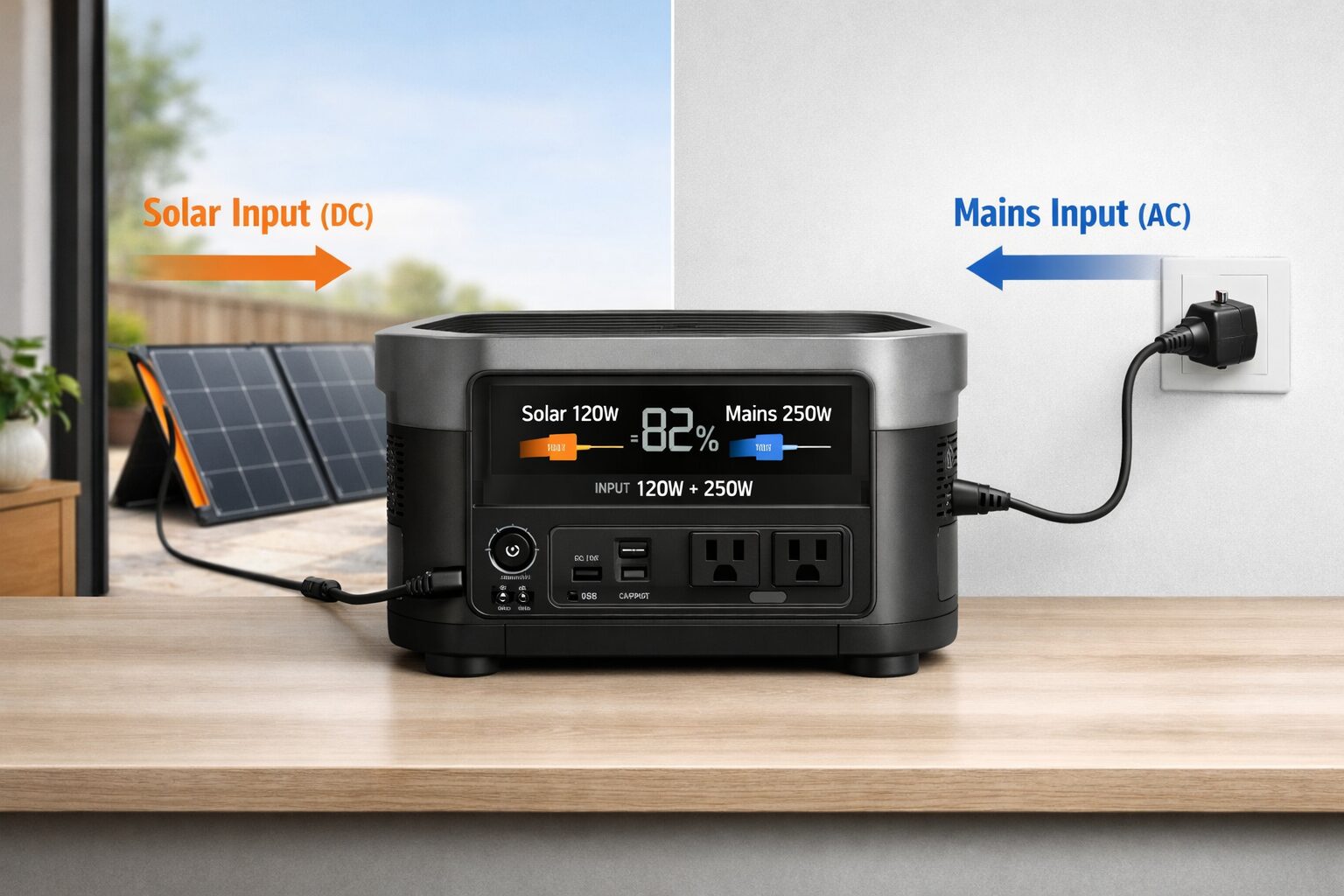
Every unit on this page can charge from three sources — solar panels, a standard 13A mains socket, or a 12V vehicle socket. Most UK households end up using a combination of solar and mains depending on the season, the weather, and how quickly they need the battery topped up. Understanding the strengths of each charging method helps you get the most from whichever unit you choose.
Solar Charging
Free electricity from the sun — the most cost-effective long-term charging method
Solar charging is the most cost-effective way to keep a battery topped up once the initial panel cost is recovered. In the United Kingdom, even a 200W panel on a south-facing mount generates meaningful electricity on bright days between March and October. A 400W array on a clear June day can generate enough to fully recharge a 1kWh battery twice over.
The practical consideration for UK households is that solar generation is variable. A run of overcast days in November will not keep a large Tier 3 or Tier 4 battery topped up without mains supplementation. Planning for a mix of both charging sources is the most resilient approach year-round. For full panel sizing guidance, see our plug-in solar guide.
Mains Charging
Predictable, fast, and reliable — especially valuable on flexible overnight tariffs
Mains charging from a standard 13A socket gives you complete control over when and how fast your battery charges. For households on a flexible electricity tariff such as Octopus Go, charging overnight at 7p per kWh and discharging during peak daytime hours at 24p per kWh turns the battery into a bill-saving tool even without any solar input at all.
Mains charging is also the fastest method available. Several units in Tier 2 and above charge at 1000W or above from the mains — meaning a 1kWh unit can be fully recharged in under an hour when needed. For outage preparedness, a battery that can be topped up quickly between use cycles is significantly more useful than one that takes six hours to recharge.
UK Solar Generation by Month — What to Realistically Expect from a 200W Panel
The figures below are approximate monthly generation estimates for a 200W solar panel on a south-facing UK mount at a 35-degree angle — broadly representing an average UK location. Actual generation varies by region, shading, panel angle, and weather. Scotland typically generates 10 to 15 percent less than the figures below. Southern England typically generates 5 to 10 percent more.
A 200W panel across a full UK year generates approximately 170kWh to 200kWh in total. At the current Ofgem price cap unit rate of approximately 24p per kWh, that represents £40 to £48 of electricity per year generated for free — assuming all generation is consumed rather than exported. A 400W array doubles those figures, and an 800W array at the legal UK plug-in limit generates approximately £160 to £190 of electricity annually at current rates.
UK Regulations — What You Do and Do Not Need
DNO Notification
Portable solar batteries and power stations are classified as appliances, not fixed installations. No notification to your Distribution Network Operator is required. This distinguishes them from fixed systems such as the Tesla Powerwall, which require G99 notification.
Electrician or Part P Sign-Off
No electrician is required to install or operate a portable solar battery. You charge it from a standard 13A socket and connect a solar panel via MC4 or proprietary cable. No hardwiring, no building regulations notification, no certified installer.
Planning Permission
Portable power stations do not require planning permission. Ground-mounted or balcony-mounted solar panels under certain size thresholds also typically fall under Permitted Development rights. Check Planning Portal guidance for your specific panel installation.
G98 Notification for Grid-Tied Inverters
If you connect a plug-in solar inverter directly to your home ring main — rather than using a portable battery as an intermediary — G98 notification to your DNO is required within 30 days of installation. This applies to plug-in solar setups, not to standalone portable batteries charged by solar panels.
Do Not Plug a Battery Inverter Output Into a 13A Wall Socket
These units charge from a standard 13A socket — but their AC output sockets are for powering your devices directly, not for feeding power back into your home ring main. Connecting a battery inverter output to a wall socket is dangerous, illegal under UK Wiring Regulations (BS 7671), and will void your home insurance. For legal grid-tied options, see our plug-in solar guide.
How Solar Batteries Fit Into Your Home Energy Setup
With Plug-In Solar Panels
Connect panels directly to the battery's solar input port. The battery stores generation during the day and discharges through its inverter to your devices in the evening. No electrician needed, no grid connection involved. See our plug-in solar guide for panel pairing detail.
With Flexible Energy Tariffs
Charge the battery overnight on Octopus Go, Flux, or equivalent cheap-rate tariffs. Discharge during peak hours. The battery acts as a domestic energy arbitrage tool — buying cheap electricity and using it when grid rates are highest.
With Home Circuits via Extension Leads
Portable batteries power devices via their own sockets and USB ports. They can feed extension leads to cover multiple devices in a room without any hardwiring or modification to your home's electrical installation. Do not run extension leads from the battery back into wall sockets — this is not permitted and is unsafe.
Alongside Fixed Home Battery Systems
Portable batteries are not a replacement for fixed home battery systems such as the Tesla Powerwall. They are complementary — the portable unit covers immediate device and appliance loads while a fixed system handles whole-home overnight storage. Many households run both. For a full comparison, see our home power options guide.