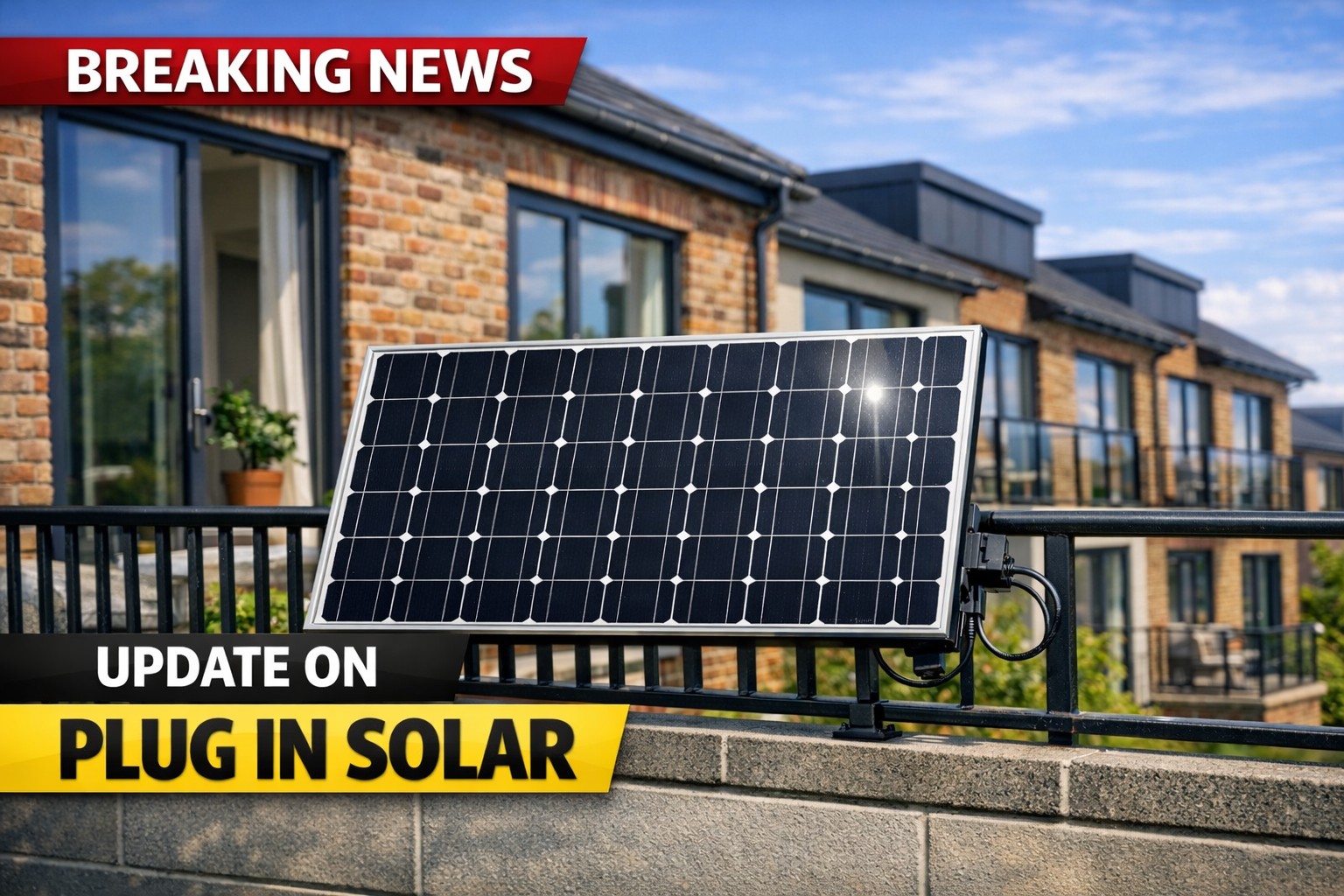
Is Plug-In Solar Safe in the UK: What to Check Before You Buy
Five major electrical safety bodies have called for a pause on the rollout. We cut through the politics and give you the facts.
In March 2026, Energy Secretary Ed Miliband announced that plug-in solar panels would be in UK shops within months. Lidl, Iceland and EcoFlow were named as retail partners. The promise was straightforward: a kit costing around £400, plug it into a standard wall socket yourself, cut your energy bill by £70 to £110 a year. No electrician required, no planning permission, no scaffolding.
Less than three months later, five of the most authoritative electrical safety bodies in the UK issued a joint warning. The Electrical Contractors Association, Electrical Safety First, the Institution of Engineering and Technology, NICEIC and SELECT spoke with one voice, urging the government to slow down. A rushed launch, they said, could put homes at risk. Lidl has since confirmed it is still in the early stages of deciding whether to stock the devices at all. There is no firm launch date. The full joint statement was reported by Construction News on 8 June 2026.
The government has not responded publicly to the joint safety statement.
So what is actually happening? Is plug-in solar safe? Can you buy one now? And if you do, what do you need to check first? This guide covers what the safety bodies are actually worried about, what the law says right now, and what you should do before spending a penny. If you want to understand how much power you currently use before thinking about solar, our free energy calculator is a good place to start.
- What Miliband Announced in March 2026
- Why Five Safety Bodies Called for a Pause
- What is Actually Legal Right Now
- Your Home Insurance Could Be Void
- What Gemshore Recommends Right Now
- What Could Plug-In Solar Actually Save You
- VAT on Plug-In Solar
- What to Watch For in July 2026
- Is Plug-In Solar Safe: Your Questions Answered
What Miliband Announced in March 2026
On 24 March 2026, Energy Secretary Ed Miliband and Housing Secretary Steve Reed made a joint announcement that the government would update UK regulations to allow plug-in solar panels to connect directly to domestic mains sockets. The announcement was framed around the ongoing conflict in the Middle East and rising energy costs.
Miliband said: "The Iran War has once again shown that the drive for clean power is essential for our energy security so we can escape from the grip of fossil fuel markets we don't control. Whether through solar panels fitted as standard on new homes or making it possible for people to purchase plug-in solar solutions in shops, we are determined to roll out clean power so that we can give our country energy sovereignty."
The headline promise was clear. Plug-in solar kits would be available in supermarkets within months. Lidl, Iceland and EcoFlow were named as partners. Government estimates suggested households could save £70 to £110 a year. No electrician would be needed. No planning permission. Just buy it, hang it on your balcony or garden fence, plug it in and start generating.
What the announcement did not mention was that the government had already commissioned a safety study in October 2025, at a cost of £80,309, specifically to assess whether plug-in solar could be safely deployed in UK homes without modifications to existing wiring. The study concluded the risks were manageable with appropriate product standards in place. Those product standards do not yet exist.
The critical detail buried in the announcement was this: the legal change in April 2026 made plug-in solar permissible in law. It did not make it safe to self-install without checks. The BSI product standard that would allow a certified kit to be plugged into a standard 13-amp socket by a homeowner without any electrical qualification does not exist yet. It is expected in July 2026. Until it is published, anyone installing a plug-in solar system is still required to use a CPS-registered electrician.
Few of the headlines in March mentioned any of this.
Why Five Safety Bodies Called for a Pause
On 8 and 9 June 2026, five organisations published a joint statement calling on the government to take a safety-first approach before pushing ahead with the mass retail rollout of plug-in solar. The five bodies were the Electrical Contractors Association, Electrical Safety First, the Institution of Engineering and Technology, NICEIC and SELECT.
These are not fringe voices. Between them they represent the overwhelming majority of qualified electricians and electrical safety professionals in the UK. When all five speak together, it is worth listening.
Their concerns fell into three areas.
Stuart Patience, director and head of energy solutions at built environment consultancy Hollis, summed up the industry view plainly when he told Fire Safety Matters magazine: "Buying plug-in solar panels from the supermarket sounds like a great idea in principle, but it is not like picking up a pint of milk or a tin of beans. There will assuredly be savings in energy costs for thousands of people, but we should always be aware of the risks."
None of the five bodies said plug-in solar should never happen. Their position is that enthusiasm and safety are not moving at the same speed, and that a proper product standard and public awareness programme need to come before mass retail availability.
What is Actually Legal Right Now
This is where it gets complicated, because the answer depends on how you install it.
Plug-in solar became legal in the UK on 15 April 2026 when the IET published BS 7671 Amendment 4. That is the wiring regulations standard that governs how electrical installations are connected in UK homes. The amendment updated the rules to permit sub-800W plug-in solar systems to connect to domestic circuits.
However, legal does not mean self-install. There are two separate standards at play here and most news coverage has confused them.
In plain English: you can buy a plug-in solar kit right now. EcoFlow's STREAM series is already available in the UK from around £499. But to install it yourself, without a qualified electrician, you need to wait for the BSI product standard to be published in July 2026. Until then, installation must be carried out by a CPS-registered electrician.
It is also worth noting that Miliband's announcement did not make plug-in solar legal for the first time. Grid-tied plug-in solar was already technically permissible if installed by a qualified electrician under the previous regulations. What the March announcement and the subsequent BS 7671 update did was create a pathway for eventual DIY self-installation. That pathway is not open yet.
Your Home Insurance Could Be Void - What to Know Before You Install
This is the risk that has received almost no coverage in the mainstream reporting of the Miliband announcement, and it is one of the most serious practical concerns for anyone considering buying a plug-in solar kit right now.
Most standard UK home insurance policies contain a clause requiring that significant electrical work be carried out by a qualified professional. The exact wording varies between insurers, but the principle is consistent: if you make a material change to your home's electrical installation without using a competent person, and something subsequently goes wrong, your insurer may refuse to pay out.
There is also a separate issue with product warranties. Most solar panel and microinverter manufacturers require professional installation for their product warranties to remain valid. Buying a kit and installing it yourself before the self-install route is fully legal could leave you with no warranty cover either.
The sensible approach right now is straightforward. If you want to get a system installed before the BSI standard is published in July, use a CPS-registered electrician. The cost of a professional installation is typically £200 to £400 depending on your location and the complexity of the job. Weighed against the risk of an invalidated insurance policy, it is money well spent.
None of this means plug-in solar is a bad idea. It means the timing matters. July 2026 is not far away. Waiting for the BSI product standard to be published before self-installing is the straightforward way to avoid all of these risks in one go.
What Gemshore Recommends Right Now
We have covered plug-in solar since the March announcement and our position has been consistent throughout. Here is where we stand in June 2026.
What Could Plug-In Solar Actually Save You
Once the safety and legal questions are answered, the savings question is the one most people actually want answered. The numbers vary significantly depending on your roof or panel direction, the angle you mount at, how much electricity you use during the day, and your current unit rate.
The calculator below uses regional UK solar production data and lets you adjust for your specific setup. Change the kit size, direction, angle and household profile to get a figure that reflects your situation rather than a national average.
One thing worth noting: the savings figures assume you are home during the day to use the solar power as it generates, or that you have battery storage. If you are out all day and have no battery, your self-consumption rate drops significantly and the payback period stretches. The home battery storage option in the calculator accounts for this.
Plug-in Solar Savings Calculator
Estimate your annual savings with different panel configurations from 200W up to 800W. Based on regional UK production data models.
Calculator assumptions and methodology Click to expand
VAT on Plug-In Solar - What You Actually Pay
VAT is more complicated for plug-in solar than most articles suggest, and getting it wrong can significantly affect your payback calculation. The short version is that whether you pay 0% or 20% depends almost entirely on how you buy and install the system.
Since April 2022, the government has applied a 0% VAT rate to the supply and installation of energy-saving materials in UK residential properties. That includes solar panels, microinverters, mounting hardware, cables and labour. The 0% rate runs until March 2027. The critical word in that sentence is installation.
The practical impact is significant. On a £900 kit the difference between 0% and 20% VAT is £150. Add professional installation at £300 and a combined supply-and-install contract at £1,200 with 0% VAT costs the same as buying the kit alone at 20% and then paying for installation separately at standard rate on top. Getting the VAT right matters.
There is a grey area once the BSI product standard publishes in July 2026 and certified kits go on general retail sale. It is not yet clear whether HMRC will extend the 0% rate to retail sales of certified plug-in solar kits without installation. This is something to watch. We will update this page when the position becomes clear.
| Scenario | VAT Rate | Notes |
|---|---|---|
| CPS electrician supplies and installs as single contract | 0% | Until March 2027. Covers panels, inverter, battery, mounting and labour. |
| Buying a kit from Amazon or retailer yourself | 20% | Retail sales without installation do not qualify for the 0% relief. |
| Certified retail kits after BSI standard (July 2026) | Unclear | HMRC position on certified self-install retail kits not yet confirmed. |
| The 60% rule - watch this | Partial | If the kit cost exceeds 60% of the total job cost, only the labour qualifies at 0%. The materials revert to standard rate. On a £900 kit with £300 installation, the kit is 75% of the total - ask your installer to check before quoting. |
| Portable power stations (BLUETTI, Jackery etc) | 20% | Classed as consumer electronics. Not solar installation equipment. |
There is one more thing worth understanding about how the 0% relief actually works - and it is something almost nobody explains clearly.
You do not claim the VAT back. There is no form, no HMRC application and nothing for you to do. The installer applies 0% VAT directly on the invoice at the point of purchase. The saving happens before you pay, not after.
But this only works if the installer is the one buying the equipment. The order of purchase matters enormously.
What to Watch For in July 2026
July 2026 is the month when the picture should become significantly clearer. Here is what is expected and what to look for before making any purchasing decision.